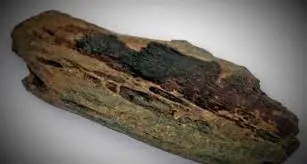
 Human bone fragments (2 individuals) →
 Leather book binding fragments →
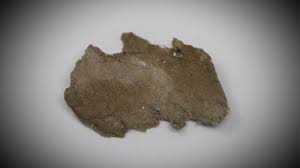 Parchment scrap (H8) →
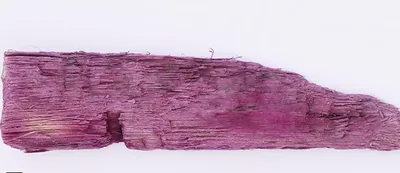 Purple-stained wood fragment →
 Pigmented Parchment Fragments →
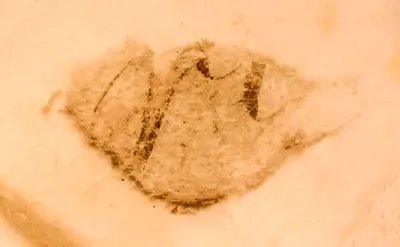 Parchment fragment →
Simeon Lynds, the Oak Island Organizer
Simeon Lynds organized the 1803 Onslow Company, the first systematic excavation of Oak Island's M...

Drilled 2017 by Lagina team, 213 ft
Money Pit caisson re-entered in Season 6 with the oscillator and hammer grab after sitting at 213 feet since Season 5, to recover the Chappell Vault material pushed aside near 170 feet. Spoils from below 168 feet produced wood, possible parchment and bookbinding, cotton rag paper, a ship decking nail and possible bone before ground subsidence and a sinkhole around the caisson stopped work. In Season 7 it was cited as lying about 10 feet from the Shaft Six tunnel and 25 feet from FG-12, and backfill from H-8 ended RF-1.
Positions on the map are approximate; each dot marks the top of the hole.
Rows are in depth order; the column on the left is the hole, and a figure between rows is the stretch with nothing logged. Depths as reported by each source.
In 1897 the Oak Island Treasure Company drilled from a platform at 90 feet. Crooker, drawing on William Chappell, the Nova Scotia contractor who ran the drill, records cement at 153 feet 8 inches over five inches of oak, then a substance in which the drill wedged as if in loose metal. Borings from just under 154 feet held oak chips, coconut fiber, and a parchment scrap inked with what looked like "vi". A third hole found cement to about 160 feet and iron at 171 feet. T. P. Putnam, the work manager, told Frederick Blair privately that the bit had shown gold, a statement the show found in Blair's affidavit in 2017. Chappell's 1931 shaft found none of it, and its notes record a drift of ten to twelve feet north.
H-8 was one of eight holes the Laginas added to their 2017 Geotech grid after reading those notes, set on the 1897 platform. At about 145 feet driller Ivan Gough clipped something hard in a void. At 195 feet blue glazed pottery came up, which archaeologist Laird Niven identified as Staffordshire pearlware of about 1780 to 1800. A dense object from 160 to 165 feet, first taken for hardwood, was bone. Saint Mary's University sequenced two fragments as human, from two people of European and Middle Eastern descent, dated to 1682 to 1736 and 1678 to 1764. Sullivan puts the bones at 190 feet; the show's record has 160 to 165. From the same spoils came a scrap with collagen under the microscope, so parchment, and leather bonded to spun fibers that bookbinder Joe Landry judged consistent with a bound book.
In Season 5 Dan Blankenship, the Florida contractor who had searched the island since 1965, started Irving Equipment's oscillator on a 50-inch caisson. It ground through timbers of the Chappell shaft; at 150 feet metal detectorist Gary Drayton pulled a concrete-crusted iron spike from the spoils. The oscillator rested on a flat wooden surface near 170 feet, then the casing dropped from 162 to 172 feet into a void geologist Terry Matheson read as a cavern or tunnel. Out came pottery, bone including a possible knuckle at 162 feet, and more leather. At 196 feet the caisson met bedrock with no vault. Craig Tester called the thin return incomprehensible next to the six-inch borehole; he and Marty Lagina concluded the caisson had shoved the structure sideways. The steel was left at 213 feet; Marty dropped a two-dollar coin down it to track drift.
Seismic work in Season 6 showed a squared-off void at 160 to 170 feet beside the hole. In Season 6 the crew broke the plug at the bottom of the caisson, raised it to 170 feet and sent down an ROV whose sonar showed a right angle. Hammer-grab spoils from below 168 feet produced wood Craig Tester thought might be vault, a scroll-like piece of fibrous material, leather bookbinding, paper with red and yellow pigment, a possible third piece of bone, and a square ship's decking nail. Chemist Christa Brosseau's lab reclassified one supposed bone as iron slag and confirmed cotton rag paper, which Landry dated between the 1300s and 1600s. Then the ground around the caisson began to drop: eighteen inches of subsidence became, by morning, a hole eight feet deep and ten across. H-8 was abandoned.
RF-1, a caisson a few feet off, ended in Season 7 when backfill from the H-8 sinkhole poured in at 202 feet, bringing Marty's coin with it ten feet sideways through the solution channel. Later holes have chased that plug. The record supports a wooden surface near 170 feet and human bone, parchment, bookbinding and rag paper from below 160 feet, where no searcher is known to have worked. It does not show the Chappell vault, and Rick Lagina himself, in Sullivan's account, allowed that the scraps might have migrated in through moving ground, and asked where the 10,000 board feet of timber lost in 1861 had gone. The answer is still underground.



As an Amazon Associate I earn from qualifying purchases.
Simeon Lynds organized the 1803 Onslow Company, the first systematic excavation of Oak Island's M...
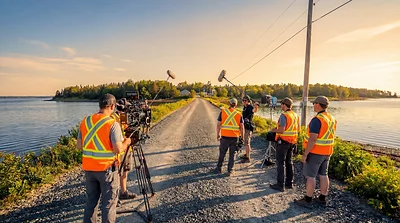
Two brothers from Michigan who dreamed of solving the Oak Island mystery as children have led the...

Oak Island evidence as of 2026: the carbon dates, the coins, the human remains, the Lot 8 boulder...