About This Artifact
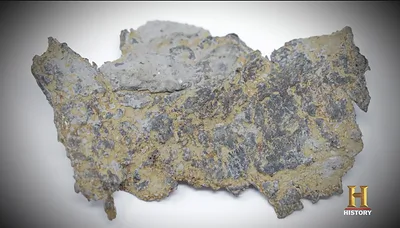
Gary Drayton recovered an iron spike coated in a concrete-like substance from the 150-foot level of borehole H8 spoils during the Season 5 caisson dig. The 60-inch caisson had reached 155 feet of casing by that point, with the hammer grab excavating at 150 feet, and project manager Vanessa Lucido of Irving Equipment Limited oversaw the operation. The spike was found in the same wash plant batch as fragments of bone, pottery, glass, and hand-chopped wood recovered by Jack Begley and the spoils crew.
The concrete-like coating echoes the documented history of cementitious material reported deep in the Money Pit. William Chappell, drilling into the Pit in 1897, recorded striking what he and his workmen described as cement at the level of the wood layer, leading to the long-running interpretation that an artificial chamber had been sealed there. Samples of similar cement-like material recovered from later drilling were analysed by the Belleville Research Laboratory of Canada Cement Lafarge and described as crude lime carbonate consistent with pre-industrial preparation, not Portland cement.
If the coating on the H8 spike is the same material, it would place the spike at or near the depth at which historical searchers reported encountering the so-called concrete vault. Later in the same episode, at 170 feet, oscillator operator Danny reported torque pressure on the caisson doubling against a flat, hard, consistent surface that Rick Lagina noted matched the profile of a collapsed underground structure. No laboratory analysis of the H8 spike's coating has been publicly reported, and the precise composition of the material remains untested.
Historical Context
The Curse of Oak Island, Season 5, Episode 10, "The Signs of a Cross" (History Channel, January 16, 2018). Eyewitnesses on screen: Gary Drayton, Jack Begley, Rick Lagina, Charles Barkhouse, Marty Lagina, Craig Tester, Vanessa Lucido (Irving Equipment Limited). Historical cement references: William Chappell affidavits (1897 drilling); Belleville Research Laboratory of Canada Cement Lafarge analysis of cement samples from 10X-area drilling, cited in Joy Steele and Gordon Fader, Oak Island Mystery Solved, 2nd ed. (Halifax: Formac, 2018).
Where It Was Found
Found at Borehole H8 spoils, 150-foot level (Lot 18, Money Pit area). Location: the original 1795 excavation shaft on Oak Island, Nova Scotia.