
The Roosevelt Connection
Franklin D. Roosevelt's Oak Island obsession spanned thirty-six years, from a boyhood visit to th...

Dug 1931 to 1941, 171 ft
12 x 14 ft. 1931 to 155 ft with artifacts of the original excavators; Hedden 1936 to 160; Hamilton retimbered to 160 (1939), deepened to bedrock at 167 (1941). Partly collapsed into Dunfield's pit January 1966.
Positions on the map are approximate; each dot marks the top of the hole.
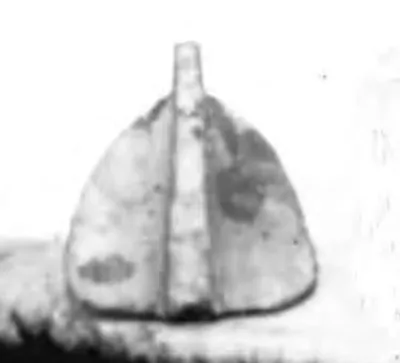 Anchor Fluke →
 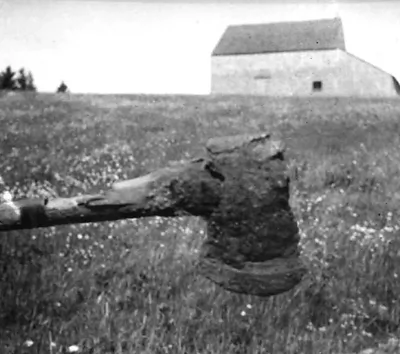 Felling Axe →
 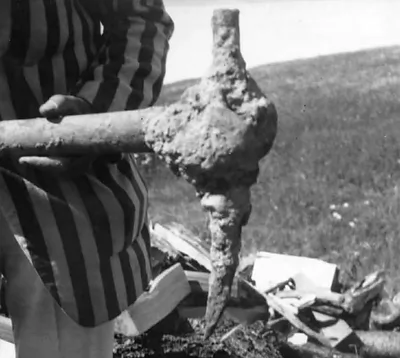 Cornish miner's pick →
 Rows are in depth order; the column on the left is the hole, and a figure between rows is the stretch with nothing logged. Depths as reported by each source.
In 1897 the Oak Island Treasure Company drilled from a platform at 90 ft in the Money Pit, with William Chappell, a Nova Scotia lumberman and company director, at the drill. Crooker records iron at 126 ft, then in a second hole what the drillers called cement at 153 ft 8 in, oak, a gap, and something soft pictured as metal in bars and loose coin; the borings held the parchment fragment. A third hole met iron at 171 ft. Chappell later told Frederick Blair, the Amherst insurance man who held the search license, that he had seen yellow metal on the bit.
By 1931 the Money Pit was a grassed hollow, its cribbing stripped by Henry Bowdoin in 1909 and its walls fallen in. Chappell came back with his son Melbourne, and Blair lived on the island as their employee. Chappell pointed to cribwork he said he had helped build; Blair put the pit six feet off. Sullivan and Fanthorpe record the compromise: a shaft 12 by 14 ft, the broadest yet dug on the island, just southwest of the pit according to Steele and Fader, wide enough to catch the vault either way.
The diggers found no cement, no oak, no iron and no soft metal, only the leavings of earlier searches, from depths that made no sense. Sullivan lists an anchor fluke at 116 ft (Crooker gives 120), an ax head Blair thought Acadian, and a pick and parts of a miner's seal-oil lamp at 127 ft. Blair wrote that from 116 ft 6 in to 155 ft the earth in more than half the shaft was disturbed, and that the tools lay ten to seventeen feet below any searcher's level; he took them to have dropped into an open space when the pit collapsed in 1861.
Crooker gives the shaft as 163 ft deep with drill probes 12 ft further into what felt like undisturbed clay. A tunnel from 157 ft nearly buried the foreman when its roof came in. Work stopped on 29 October 1931 with about $40,000 spent, and the landowner's heirs declined to renew Blair's lease.
Gilbert Hedden, the New Jersey steel fabricator who bought the east end in 1935, reopened the shaft in June 1936. Crooker, Sullivan, Fanthorpe and Finnan put the retimbering at 170 ft; Steele and Fader say 160. Drills from 150 ft brought up oak splinters read as a chest or platform dropped in 1861. Erwin H. Hamilton, a New York University engineering professor (Edwin in Crooker and Sullivan), took over in 1938, reinforced buckling cribbing and bored fifty-eight holes to bedrock at 168 to 171 ft. Clarke has the shaft deepened to bedrock at 167 ft in 1941; Crooker gives 176 ft, with oak chips drilled from under the limestone. Hamilton concluded, as Sullivan reports it, that the Money Pit lay a few feet off, between this shaft and Hedden's.
In November 1965 Robert Dunfield, the California petroleum geologist, opened a hole 50 ft across that took in the Money Pit and both the Hedden and Chappell shafts; Clarke records that in January 1966 the pit, the 1863 shaft and the Chappell Shaft fell in together, leaving an opening 80 ft wide. The show has met its timbers since: a caisson clipped its south edge in Season 5, Doug Crowell, the team's historian, identified a metal plate at 160 ft in Season 7 as the shield from its base, and in Season 13 the team drew its outline on the grid plan and set a hole in its southwest corner.
The record supports a large shaft, placed by compromise, that reached 155 ft in 1931 and bedrock a decade later without meeting any of the 1897 drill targets. Its searcher tools far below any known floor were proof to Blair of a cavity and a fallen deposit; Fanthorpe allows they could be fill shifted by earlier work. Whether it missed the vault by six feet, or whether there was a vault to miss, the shaft itself cannot settle.




As an Amazon Associate I earn from qualifying purchases.
Franklin D. Roosevelt's Oak Island obsession spanned thirty-six years, from a boyhood visit to th...

Between 1500 and 1650, Spain extracted 181 tons of gold and 16,000 tons of silver from the Americ...

Oak Island is a small island off Nova Scotia where people have searched for buried treasure since...