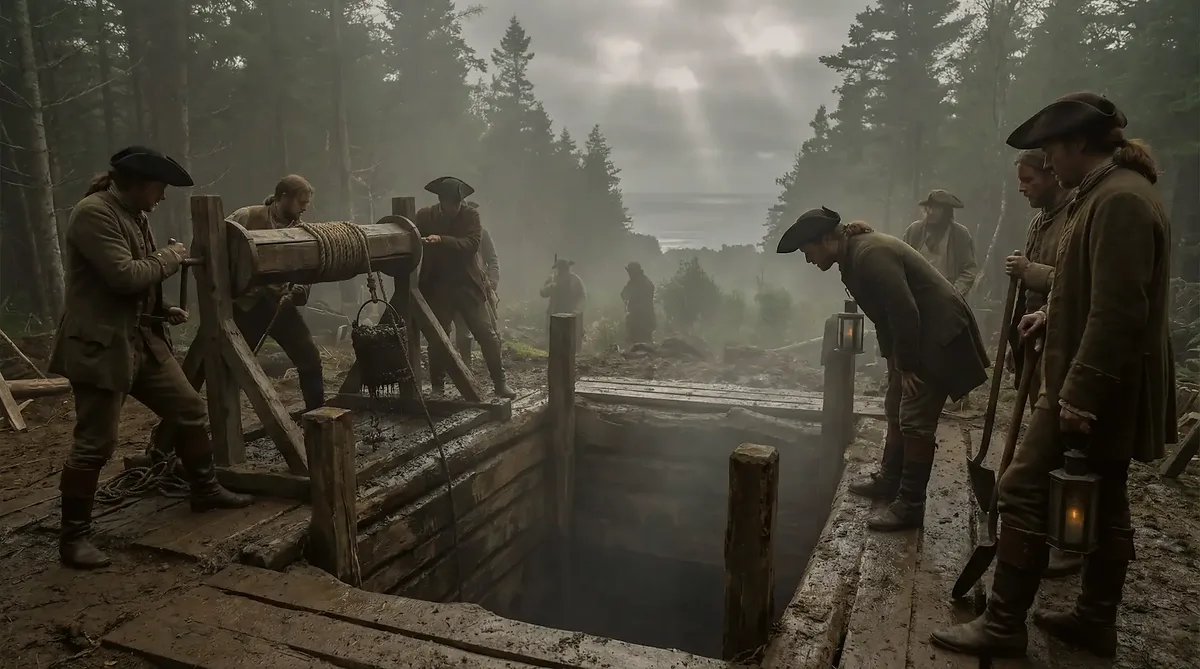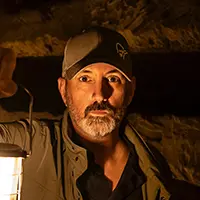
When Samuel Ball died on Oak Island on December 14, 1845, at the age of eighty-one, he owned nine of the island's four-acre lots, about one hundred acres on the mainland opposite, and a small island in Mahone Bay called Hook Island. No one before or since has held more of Oak Island. His house stood on Lot 25, where the stone foundation can still be traced in the grass. The tax rolls knew him as a farmer who kept cattle and sheep, cut timber, and fished. He had come to Nova Scotia at nineteen with nothing but his freedom, a formerly enslaved man from South Carolina, and how he came to own so much of the most expensive ground in the bay is a question the surviving documents answer only in part.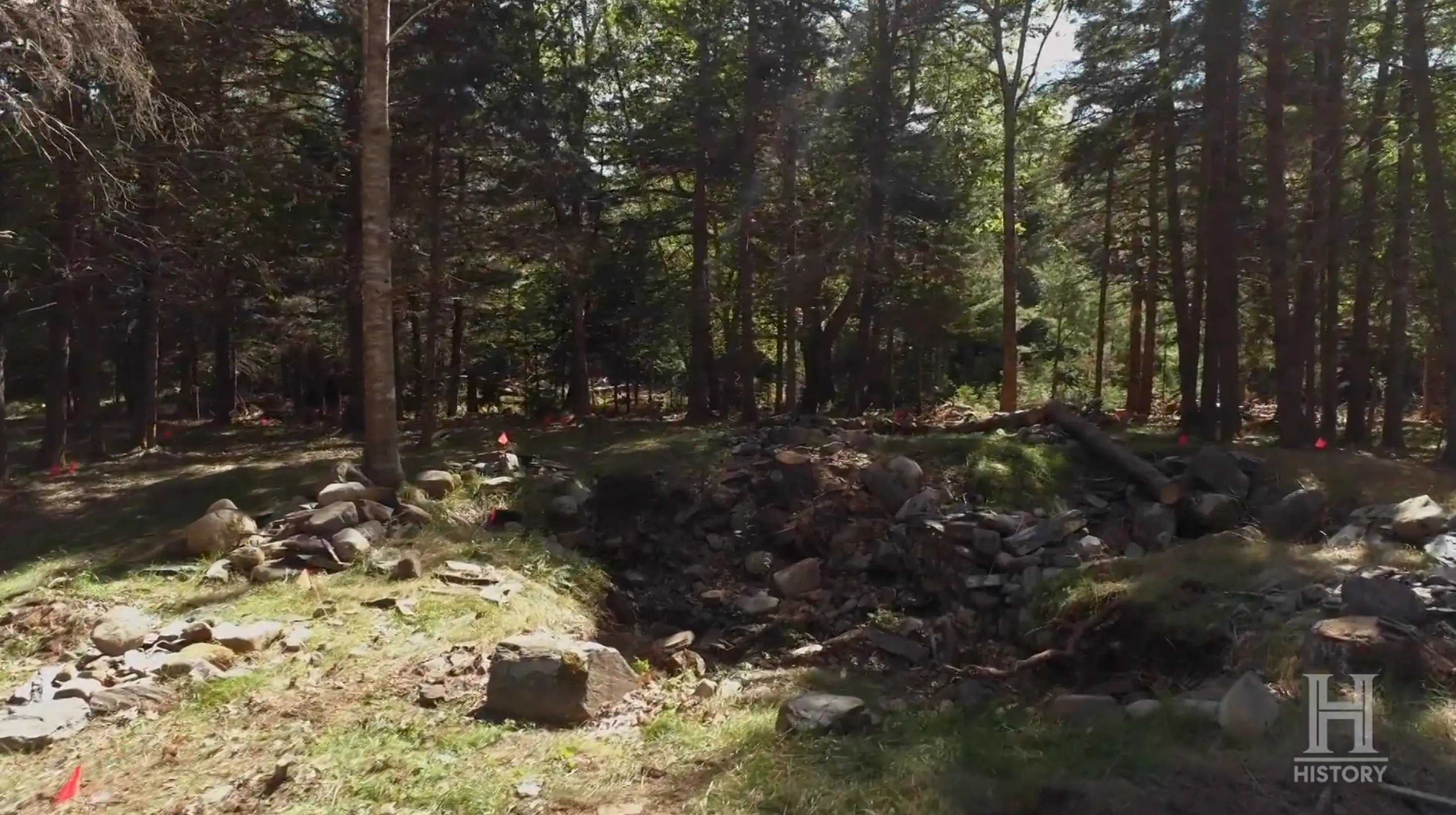 Samuel Ball Foundation (Lot 25)→
A Master's Name
1 min
Ball was born around 1764 and grew up enslaved on a South Carolina plantation. Almost nothing of his early life survives on paper. Mather Byles DesBrisay, the Lunenburg County judge who wrote the first history of the county, recorded only that Ball had come from South Carolina "where he had been a slave to a master whose name he adopted." Which of the Carolina households of that name held him is not recorded in any document found so far.
The Revolution gave him a way out. On November 7, 1775, John Murray, the Earl of Dunmore and royal governor of Virginia, issued a proclamation promising freedom to enslaved men who left rebel masters and took up arms for the Crown. The offer traveled quickly through the southern colonies, and over the course of the war thousands of enslaved people made their way to British lines.
 A History of Lunenburg County→
Freedom Behind British Lines
1 min
Ball was one of them. He escaped the plantation and joined the British forces under Lord Charles Cornwallis, who led the campaign in the South, and was soon transferred to the army of General Sir Henry Clinton, then moving north toward New York. There he was assigned to the command of Thomas Ward, a loyalist officer whose corps of refugees held a fortified post at Bergen Point in New Jersey, across the water from British-held Manhattan.
Ward's men lived on the front line. Colonel Alexander Scammell, a Continental Army officer, reported to George Washington in May 1781 on his attempt to dislodge Ward's refugees from their works near Fort Lee. In February 1782, some two hundred American troops attacked the refugee post at Bergen, and the loyalist Royal Gazette in New York reported that the advanced sentinel, "a Negro man," was bayoneted as they approached. Ball's own recorded work at Bergen Point was cutting wood for the army. Whether his years with Ward left him with anything more than his freedom is possible but undocumented.
A Ledger and a Ship to Nova Scotia
1 min
When Cornwallis surrendered at Yorktown in 1781, the Black Loyalists who had served the Crown gathered in New York, where the peace put their freedom in question. In 1783 Brigadier General Samuel Birch, the British commandant of the city, registered some three thousand of them for passage to Nova Scotia in a ledger now known as the Book of Negroes. Ball reached Shelburne that year, at about nineteen. The Black settlers there were promised land, and many waited years for it or never received it at all. Ball was among those who never did, and after three years in Shelburne he moved up the coast to Chester, on Mahone Bay.
 Mahone Bay: History of the Waters That Hold Oak Island→
Eight Pounds for Four Acres
1 min
On September 22, 1787, Ball paid eight pounds for his first lot on Oak Island. The Lunenburg County deed books show that, acre for acre, Oak Island land was the most expensive in Mahone Bay, and a man paying that price for four acres could have bought far more ground on the shore. Why a young man with no family money chose the island over the mainland is not explained in any record he left.
He kept buying. In 1790 he paid five pounds for Hook Island to Daniel Vaughan, whose nephew Anthony Vaughan is remembered as one of the three young men who opened the Money Pit in 1795. In 1798 he bought Lot 8 for six pounds. Over the next four decades he assembled lots 6, 7, 8, 24, 25, 26, 30, 31, and 32. Lot 26 came to him from Captain James Anderson, a Virginian who swore the patriot oath in 1776, went over to the British two years later, and lived on the island from 1785 to 1788.
 Captain James Anderson: The Pirate Oak Island Owner→
Sworn Before the Justice at Chester
1 min
The only document in Ball's own voice is a memorial he swore in 1809, asking the government for the land a Black Loyalist had been promised a quarter century earlier. He swore it before Thomas Thompson, the justice of the peace at Chester. "Your Memorialist Ball has no lands but, what he has purchased, never having got any from government," it reads, "and there is a four-acre lott vacant, No. 32, on Oak Island, joining a lott purchased by your Memorialist." It adds that he had "but one son living."
Thompson added a certificate of his own. He had known Ball for more than twenty years, he wrote, and believed him "an honest, sober and industrious settler, worthy of encouragement." The lot was granted. By then Ball had been living on Oak Island for twenty-three years.
Rich in Land, Not in Coin
1 min
Ball is often described as one of the richest men in Nova Scotia. The phrase comes from The Curse of Oak Island television series, which used it in an episode about his descendants, and it has since been repeated across dozens of websites as though it came from a historical record. None has been found. The documents show something more modest and, in its way, more interesting. The 1793 poll tax returns list the people of Oak Island as farmers of small means, and Ball's neighbor Daniel McGinnis, the man credited with first finding the Money Pit, owned livestock comparable to his. The mainland acreage he held was cut-over land, cleared of timber. Ball was land rich in a place where land changed hands for a few pounds.
Yet the questions do not all fall away. He was able to pay a premium for island lots from the start, to keep buying for decades, and to keep a servant, Isaac Butler, a Black man who stayed with the household until Ball's death. For a farmer who fished and cut wood, that is a steady accumulation. Whether hard work over sixty years accounts for all of it is the point on which opinions divide.
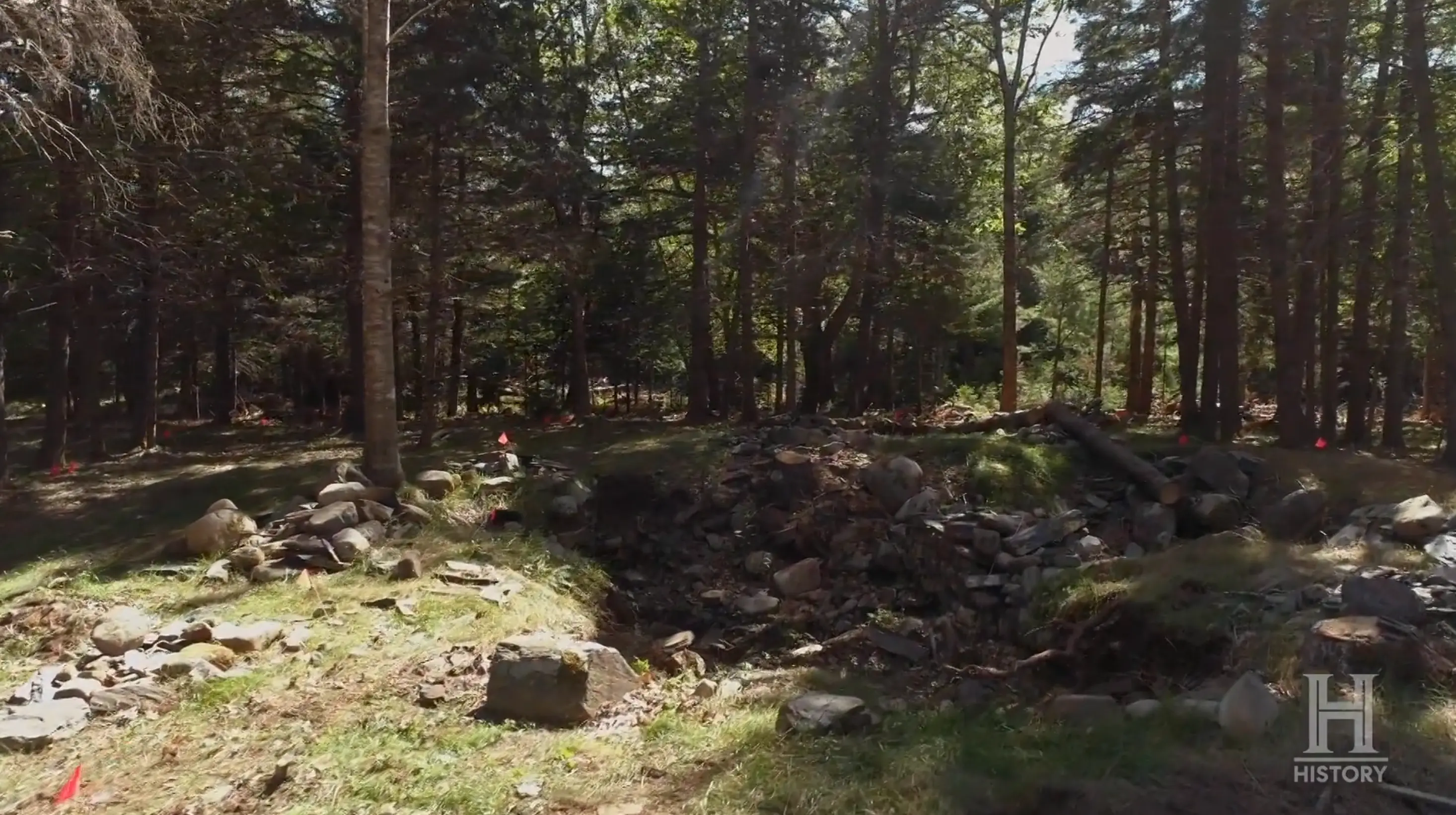 Samuel Ball's Property→
The Name DesBrisay Took Out
1 min
A change between two editions of a county history keeps Ball close to the center of the Oak Island story. In the first edition of DesBrisay's History of the County of Lunenburg, published in 1870, the three men named as discoverers of the Money Pit are Daniel McGinnis, John Smith, and Samuel Ball. In the second edition, published in 1895, Ball's name is gone and Anthony Vaughan stands in its place. DesBrisay gave no reason for the change. He kept Ball in the book as one of the island's early residents, remembered as "a good man."
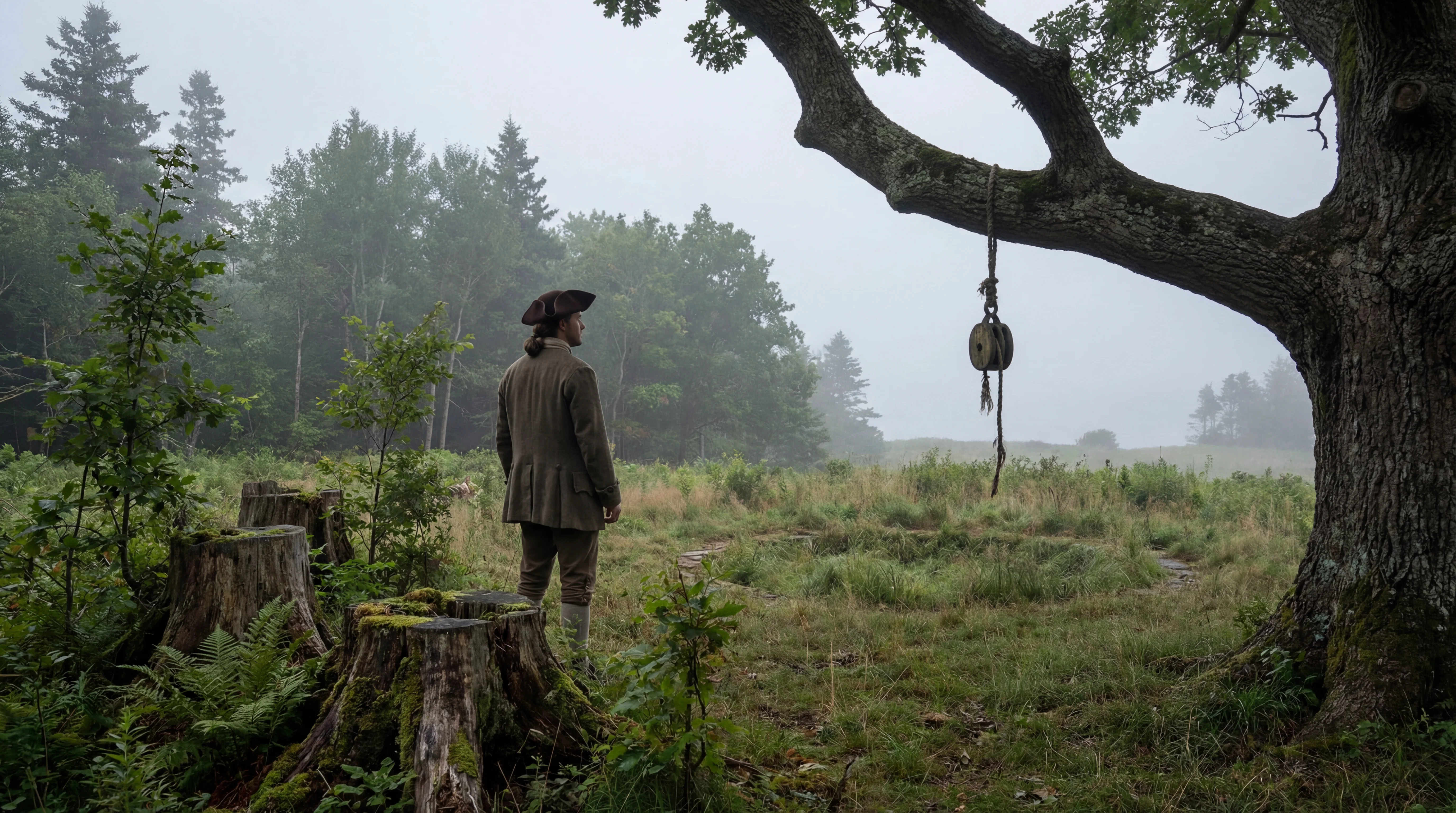
The three men certainly knew one another. The 1791 census places Ball and McGinnis as neighbors on the island. When McGinnis made his will in January 1827, Ball was one of the witnesses. When Ball made his own will in 1841, Anthony Vaughan was named among the executors, and the mainland acreage it describes adjoined land owned by Daniel McGinnis. Whether Ball was present when the depression under the oak was first opened, or joined the story soon after, is a matter the two editions leave open between them.
 The Real Daniel McGinnis of Oak Island→
Buttons, Coins, and a Lock on Ball's Land
1 min
The ground Ball farmed has since been searched with metal detectors. On Lot 24, metal detection expert Gary Drayton and Charles Barkhouse, a local historian who has studied the island for decades, recovered an eighteenth-century dandy button of the kind worn on British officers' cuffs, copper coins bearing the likeness of King George II, and a lead ingot of the type soldiers cut up to cast musket balls. In the same search they found a small metal plate from the stock of a musket or pistol, carrying what appears to be an engraved name.
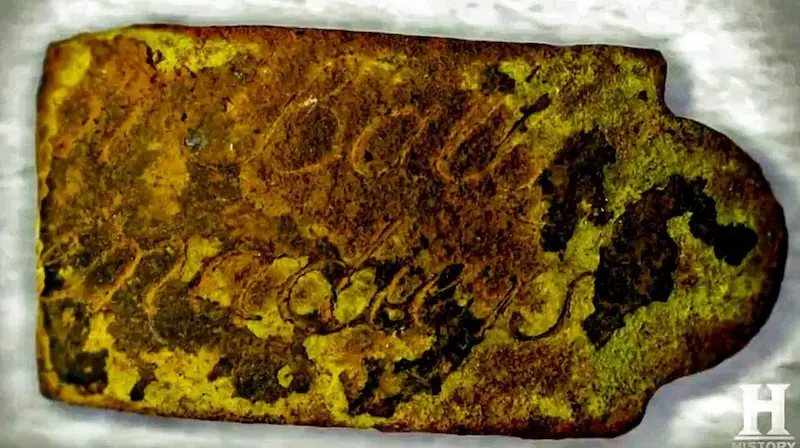 'Ball' name tag→
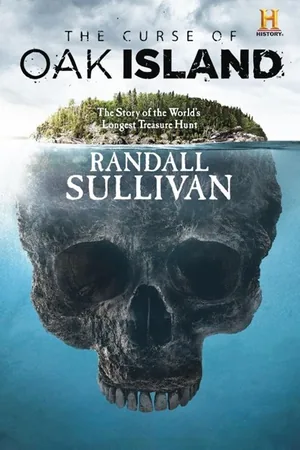
To Drayton, the cluster pointed to a British military presence on the island before 1795. Randall Sullivan, the journalist whose book on the treasure hunt traces Ball's life in detail, saw another reading: the same objects are consistent with the belongings of Ball himself, a man who spent years in a British camp. On Lot 25, near the foundation of his house, Drayton later recovered an iron lock plate with its keyhole intact, the kind fitted to a box or chest.
Three Chests and a Golden Cross
1 min
The boldest story about Ball's wealth comes from family memory rather than documents. In 2007 Danny Hennigar, a Chester historian, was shown a heavy cross of braided, hand-hammered gold by a woman descended from Daniel McGinnis. She told him the three discoverers had found three chests at a shallow depth in the pit and each had taken one. In 2015 that woman, Joyce McGinnis, brought the cross to Oak Island with her sisters. Jewelers she had consulted, she said, thought it could be as old as five hundred years, and her family had been told to hand it from eldest son to eldest son and "never let this out of your sight."
If the story is true, and if Ball was the third man as DesBrisay first wrote, then his eight-pound purchase in 1787 and everything that followed would read very differently. No document confirms either part.
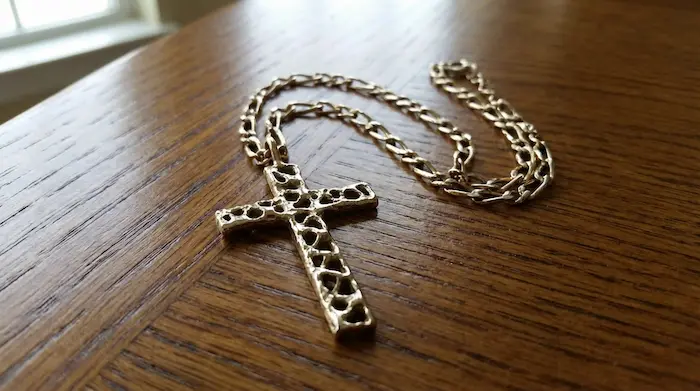 McGinnis Gold Cross→
The Rest of the Story
1 min
Randall Sullivan went looking for Ball's descendants in the hope that they, like the McGinnis family, had kept a story of their own. He traced Frank Stanley Boyd, a descendant eight generations removed who had written about his ancestor online before his death in Halifax in 2010, and through him reached his son, John-David Boyd, a plumbing contractor in New Brunswick. John-David told him that his father had called him to his bedside near the end to tell him "the rest of the story," and then said, "don't give it away." After a cordial first reply he stopped answering, and the television producers Sullivan passed his details to had no more success. Whatever the family holds, it has stayed with them.
Sixty Years on the Island
1 min
Ball lived on Oak Island for close to sixty years. By 1809 he had only one son still living, and his wife, Catherine, survived him. Transcriptions of his will record a wish that none should possess his land unless they took the name Ball. His will was probated on January 5, 1846. No likeness of him is known, and no gravestone bearing his name has been found.
What remains is the paper trail of a man who arrived with nothing and died owning more of the island than anyone else ever has: a deed for eight pounds, a sworn memorial asking for four vacant acres, his signature as witness on a neighbor's will, and a name that appears in one edition of a county history and disappears from the next. The foundation of his house is still there on Lot 25, overgrown but visible, on an island where men have been digging for treasure since before he arrived, or perhaps since shortly after he did.
Sources
1 min
Archival records
- Will of Samuel Ball, dated 1 October 1841, probated 5 January 1846. Lunenburg County probate records, Book 1, p. 37.
- Memorial of Samuel Ball asking for the grant of Lot 32 on Oak Island, Chester, 9 September 1809, with the sworn certificate of Thomas Thompson, Justice of the Peace. Full text printed in Sullivan (2018).
- Lunenburg County Registry of Deeds: Ball's first Oak Island lot, 22 September 1787 (£8); Hook Island from Daniel Vaughan, 1790 (£5); Lot 8 from Robert Melvin, 1798 (£6). The Hook Island deed as transcribed by the Oak Island Compendium.
- Will of Daniel McGinnis, dated 4 January 1827, probated 27 February 1827, with Samuel Ball among the witnesses. Described in Sullivan (2018).
- Nova Scotia census returns, 1791, and poll tax records, 1793, entries for Oak Island.
- Book of Negroes, 1783, compiled under Brigadier General Samuel Birch. British copy in the Carleton Papers, The National Archives, Kew, PRO 30/55/100.
- Colonel Alexander Scammell to George Washington, 24 May 1781, on Thomas Ward's refugee corps near Fort Lee. Papers of George Washington, Founders Online, National Archives.
- The Royal Gazette (New York), 9 February 1782, report of the attack on the Loyal Refugee post at Bergen on 7 February 1782.
- John Murray, Earl of Dunmore, proclamation of 7 November 1775 offering freedom to enslaved men who joined the British forces.
Books
- DesBrisay, Mather Byles. History of the County of Lunenburg. First edition, 1870. Second edition, Toronto: William Briggs, 1895.
- Sullivan, Randall. The Curse of Oak Island: The Story of the World's Longest Treasure Hunt. New York: Atlantic Monthly Press, 2018. Ball's life and landholdings, the 1809 memorial, Danny Hennigar's 2007 account of the McGinnis cross, the author's contact with John-David Boyd, and the Lot 24 finds of a dandy button, a King George II coin, and a lead ingot.