On a fog-wrapped headland at the eastern tip of Cape Breton Island, France built the most expensive fortification in the New World. Construction began in 1719 and continued for over twenty-five years, consuming more than thirty million livres against an original budget of four million. By the mid-1740s, the Fortress of Louisbourg enclosed over fifty acres behind walls thirty feet high and a ditch eighty feet across, defended by more than 150 cannons and mortars, and garrisoned by some 2,000 soldiers. It was the commercial heart of French Atlantic Canada, a thriving port through which an average of 150 vessels passed each year, trading in cod, manufactured goods, sugar, and rum with partners in France, Quebec, the West Indies, and even New England. And then, in a matter of weeks, it was gone. Twice besieged and twice captured by the British, Louisbourg was systematically demolished stone by stone between 1760 and 1768 so that France could never use it again. But one question has lingered for nearly three centuries: what happened to the treasury?
The Fortress and Its Wealth
1 min
Louisbourg was established in 1713 after the Treaty of Utrecht stripped France of its claims to Newfoundland and mainland Nova Scotia, leaving only Cape Breton Island (then called Ile Royale) and Prince Edward Island (Ile Saint-Jean) as French possessions in Atlantic Canada. The engineer Jean-Francois du Vergery de Verville chose the site for its natural harbour and its strategic position guarding the entrance to the Gulf of St. Lawrence and the sea route to Quebec. The fortifications that rose between 1720 and 1745 were European-style masonry on a scale rarely seen in North America: the King's Bastion alone required over 500,000 cubic feet of cut stone. Benjamin Franklin, writing on the eve of its first siege, called it a "tough nut to crack."
 Benjamin Franklin's Nova Scotia Connection→
Sustaining this outpost required a constant flow of money from France. The Royal Treasury regularly dispatched pay-ships to Louisbourg carrying wages for soldiers, contractors, and the hundreds of labourers employed in its construction and maintenance. These shipments, combined with the tax revenues generated by Louisbourg's lucrative cod fishery and its role as a trading hub, meant that significant sums of gold and silver were held at the fortress at any given time. It was this wealth, along with the military stores, provisions, and personal fortunes of its merchant class, that would become the subject of one of Oak Island's most persistent theories.
The Fall of Louisbourg
2 min
The first siege came in the spring of 1745, during King George's War. A force of New England colonists backed by a Royal Navy squadron laid siege to the fortress, whose garrison was poorly supplied, underpaid, and on the verge of mutiny. Troops had actually revolted the previous December over wages months overdue and conditions so poor that fishermen refused to put to sea. After forty-six days of bombardment and assault, the fortress capitulated on June 16, 1745. The capture stunned the French establishment and enraged the court of Louis XV, who immediately began planning a counterattack.
The result was the Duc d'Anville Expedition of 1746, the largest French military force ever dispatched to the New World prior to the American Revolution. Admiral Jean-Baptiste Louis Frederic de La Rochefoucauld de Roye, Duc d'Anville, sailed from France on June 22, 1746, with a fleet variously reported as 64 to 73 ships carrying between 11,000 and 13,000 men, 800 cannons, and orders from King Louis XV to recapture Louisbourg, retake Acadia, and "consign Boston to flames." The expedition was a catastrophe. Storms in the Bay of Biscay, dead calms off the Azores, lightning strikes that detonated a magazine, and epidemics of typhus and scurvy ravaged the fleet across a three-month Atlantic crossing. By the time the remnants limped into Chebucto Bay (present-day Halifax Harbour), thousands were dead or dying. D'Anville himself died of a stroke on September 27, 1746, six days after arriving. His replacement, Vice-Admiral d'Estourmel, attempted suicide two days later. The expedition collapsed without ever reaching Louisbourg.
Louisbourg was returned to France by the Treaty of Aix-la-Chapelle in 1748, but its reprieve was short. During the Seven Years' War, a second British force of over 12,000 troops and 150 ships under General Jeffrey Amherst besieged the fortress in 1758. After seven weeks, during which a lucky mortar shot detonated a French ammunition dump, the garrison surrendered on July 26. This time there would be no return. The British used Louisbourg as a staging point for the 1759 Siege of Quebec and the Battle of the Plains of Abraham, and then spent eight years reducing the fortress to rubble.
The Oak Island Theory
2 min
The Louisbourg theory exists in several variants, but all share a central premise: that French military personnel, anticipating the loss of their fortress, concealed its treasury on Oak Island rather than allow it to fall into British hands.
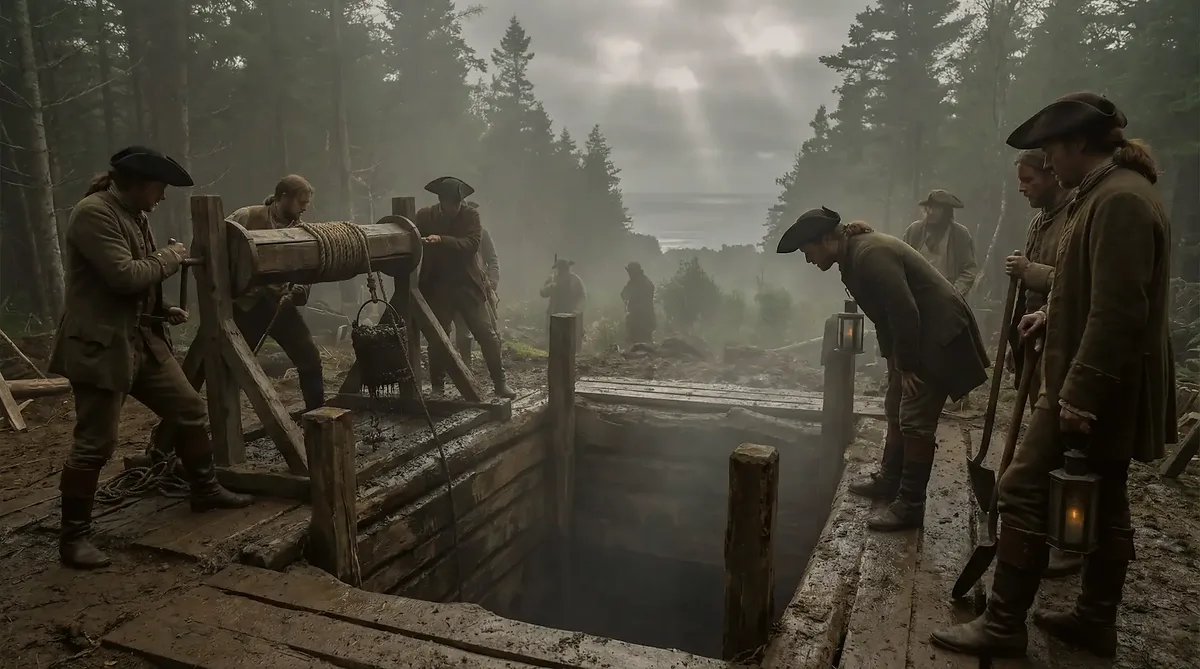
The best-known version was articulated by author John Godwin, who argued that the apparent size and complexity of the Money Pit pointed to French Army engineers as its builders. In Godwin's scenario, engineers who had spent decades constructing Louisbourg's elaborate fortifications, including underground tunnels, drainage systems, and bomb-proof casements, applied those same skills to building a concealed vault on an island roughly 200 miles down the Nova Scotian coast. The theory gained modern traction when naval historian Chipp Reid presented it to the Oak Island team in Season 7, Episode 5 ("Tunnel Visions"). Using an 18th-century military map of Cartagena, Colombia, drawn by English engineer John Thomas the Elder in 1741, Reid demonstrated that several structures uncovered at Smith's Cove, including the U-shaped structure, the L-shaped structure, and the slipway, bore a striking resemblance to the components of a "water battery," a beachside artillery fortification of a type commonly built by French military forces. Reid proposed that the French military had used Oak Island as a defensive outpost in the early 1700s and hidden the Louisbourg treasury there before the first siege in 1745.
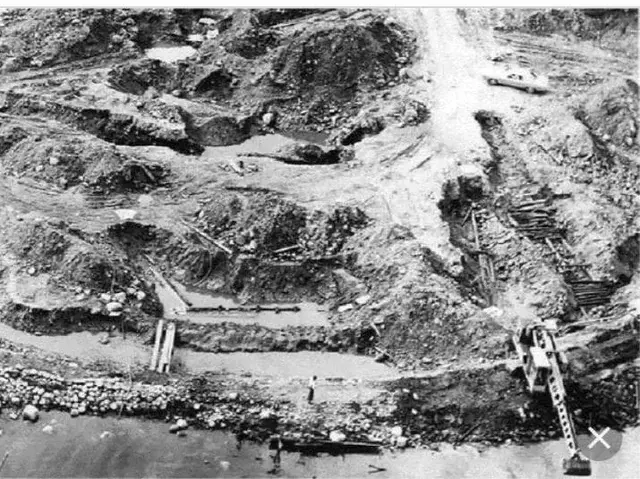 U-shaped wooden structure→
A second variant centres on the pay-ships. France dispatched regular shipments of gold and silver to Louisbourg to fund the fortress and pay its garrison. If one of these vessels was blown off course by an Atlantic storm, the crew might have been forced to conceal its cargo on a nearby island rather than risk capture. The same fate could have befallen a supply ship attached to the Duc d'Anville Expedition, whose fleet was scattered across the ocean by weeks of violent weather. In either case, Oak Island's location in Mahone Bay, sheltered and relatively close to the shipping lanes between France and Cape Breton, makes it a plausible emergency cache.
The Duc d'Anville Connection
1 min
The Duc d'Anville Expedition has generated some of the most intriguing documentary evidence on the show. In Season 5, Episode 10 ("The Signs of a Cross"), researcher Doug Crowell presented an eight-page document he had discovered in the Nova Scotia Archives in Halifax: what appeared to be an English translation of a French ship's log from a vessel that served as the vanguard of the d'Anville fleet. The log's author described sailing southwest from Chebucto Bay down the Acadian coast to what was either Mahone Bay or St. Margaret's Bay, where the crew reportedly dug a deep pit and constructed a "secret entrance" by tunnel from the shore, descriptions that evoke the Money Pit and the Smith's Cove flood tunnel with uncomfortable precision.
In Season 10, Episode 5, researchers Corjan Mol and Charlotte Wheatley expanded on this thread by presenting 18th-century French documents from the French National Archives. These records revealed that during the d'Anville Expedition, two advance scouting ships, l'Aurore and le Castor, were sent ahead of the main fleet on orders given directly by King Louis XV. The ships carried unusually large crews: 250 men aboard l'Aurore and 180 aboard le Castor. According to the documents, the two frigates arrived on the Acadian coast on June 4, 1746, in Mahone Bay. Official records indicate they accomplished nothing during their visit, a curious outcome for two heavily crewed warships dispatched on royal orders. More striking still was a passage from the log of Commander Duvigneau, submitted to the Admiralty upon return to France: "I will not speak to anyone about this place, but I am obliged to warn you that it is difficult to hide it from the quantity of people who have knowledge of it. I send my journal of navigation." Whatever Duvigneau's mission was, he considered it sensitive enough to warrant silence and his own acknowledgement that secrecy might not hold.
Engineering Parallels
1 min
One of the Louisbourg theory's most compelling elements is not financial but structural. In Season 7, Episode 12 ("Fortified"), Rick Lagina and Doug Crowell visited the Fortress of Louisbourg, now a Parks Canada living history museum reconstructed from the original plans. There, historian Sarah MacInnes showed them the fortress's original bomb-proof casements, among the only French structures to survive Britain's eight-year demolition campaign. Inside one casement was a stone drainage system that Crowell immediately noted resembled Oak Island's reported flood tunnels. MacInnes then took them to the countermine tunnel, an underground passage with stone walls and a vaulted stone roof, built through marshy terrain by engineers who had to manipulate the surrounding water during construction. The parallel to the conditions described in the swamp and at Smith's Cove was difficult to ignore.
This visit followed a key piece of dendrochronological evidence. Earlier that season, Dr. Colin Laroque had dated the wooden wharf at Smith's Cove to 1741, based on red spruce felled that year. The date placed its construction squarely in the period of French military activity on the Nova Scotian coast and just four years before the first siege of Louisbourg. Combined with the water battery hypothesis advanced by Chipp Reid, the structural evidence suggests that whoever built the Smith's Cove workings had access to French military engineering techniques and was active on the island during the precise period when Louisbourg's fate hung in the balance.
The La Rochefoucauld Thread
1 min
The Duc d'Anville's family name, La Rochefoucauld, carries its own weight in Oak Island research. The family was one of the oldest and most powerful noble houses in France, and its connections extend in several directions that intersect with the island's history. D'Anville's son, Louis-Alexandre de La Rochefoucauld, survived the expedition's aftermath and became a prominent figure in French intellectual life, eventually serving as a deputy in the States-General of 1789. He maintained connections with both Benjamin Franklin and Thomas Jefferson, raising the question of whether knowledge of any concealed treasure might have circulated among the same transatlantic networks that financed the American Revolution. The La Rochefoucauld name also appeared on the Zena Halpern map, a controversial document presented on the show that purported to connect the family to earlier activity on Oak Island.
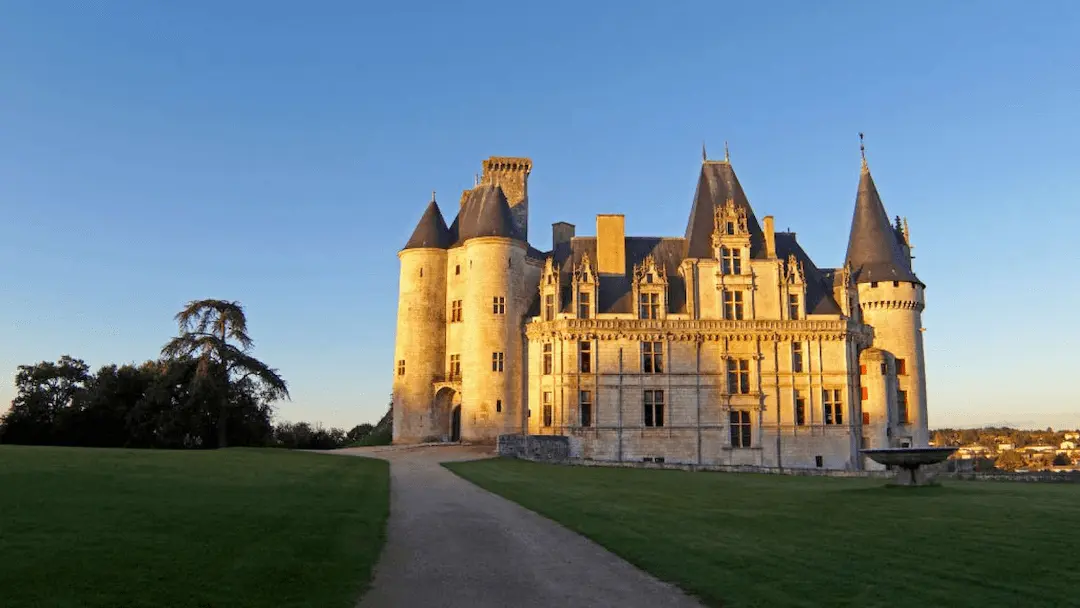 Château de la Rochefoucauld→
Strengths and Weaknesses
2 min
The Louisbourg theory draws strength from several overlapping lines of evidence. The timeline aligns well with dendrochronological dating of structures at Smith's Cove to the early 1740s. The French military demonstrably possessed the engineering expertise to construct underground tunnels, drainage systems, and fortified structures in marshy coastal terrain, as the surviving works at Louisbourg itself confirm. The geographic logic is sound: Oak Island sits roughly 200 miles southwest of Louisbourg along the Nova Scotian coast, close enough to reach by ship but remote enough to serve as a hidden cache. The documentary record includes tantalizing fragments: Duvigneau's cryptic letter, the ship's log describing a pit and tunnel dug in Mahone Bay, and the unexplained presence of two heavily crewed French frigates in the area in 1746. And the artifacts recovered on the island, including French-era buttons, tools, ox shoes matching those at Louisbourg, and construction materials consistent with 18th-century military practice, place French activity on Oak Island within the correct period.
The weaknesses are real but not fatal. No documentary evidence has been found in French archives explicitly stating that the Louisbourg treasury was removed to Oak Island or anywhere else. The fortress's accounts were maintained by French bureaucracy, and while records are incomplete, there is no gap in the ledgers that clearly corresponds to a missing treasury. The theory also competes with evidence of much earlier activity on the island: wood samples and artifacts dating to the 1600s and even the medieval period suggest that whatever happened on Oak Island may have begun centuries before Louisbourg was built. The Duc d'Anville ship's log, while suggestive, exists only as a later English translation whose provenance remains uncertain. And the various timelines (before the 1745 siege, during the 1746 expedition, after the 1758 capture) offer three different scenarios that, while not mutually exclusive, resist consolidation into a single coherent narrative.
What the theory does offer, perhaps more than any other, is a documented explanation for how the Money Pit could have been built. The question that haunts every Oak Island theory is not just who buried treasure on the island, but who had the manpower, the engineering skill, and the institutional resources to construct a shaft over a hundred feet deep, complete with flood protection and tunnel systems, on a remote island in the North Atlantic. The French Royal Army, fresh from building the most ambitious fortification in the Western Hemisphere, is one of the few candidates that does not require a leap of faith to answer that question.