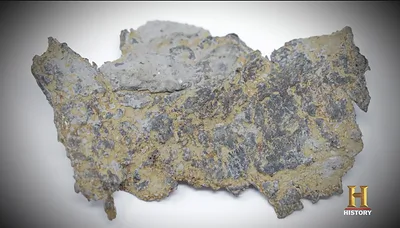
About This Artifact
Two fragments of human bone were recovered from the spoils of borehole H-8 in the Money Pit area at approximately 160 to 165 feet below the surface during Season 5. Archaeologist Laird Niven made the initial identification, noting the hollow structure and density of the denser specimen. At Saint Mary's University in Halifax, Dr. Christa Brosseau and Dr. Xiang Yang examined both fragments under a scanning electron microscope. Both registered calcium phosphate rather than lignin, confirming they were bone and not wood. The second fragment still retained soft tissue and hair, with follicle spacing that Brosseau described as more consistent with skin than animal hide.
Dr. Timothy Frasier, an associate professor of biology at Saint Mary's University, performed advanced DNA sequencing on the two samples. The results identified two distinct individuals: one of European descent (haplogroup H) and one of Middle Eastern origin (haplogroup U). Carbon-14 dating by Beta Analytical returned a range of 1678-1764 for the European bone and 1682-1736 for the Middle Eastern bone, both predating the 1795 discovery of the Money Pit. Craig Tester noted that the U-shaped structure at Smith's Cove, dendrochronologically dated to 1769, closely matched the Middle Eastern bone's date range of 1682-1736, suggesting coordinated activity on the island during the same period.
The presence of a Middle Eastern individual deep within the Money Pit, below any depth reached by known searcher expeditions, was the first physical evidence supporting theories connecting the island to the Knights Templar, who operated across Western Europe and the Holy Land during the twelfth and thirteenth centuries. Rick Lagina described the carbon dating results as the first definitive evidence of human presence in the Money Pit before anyone is known to have searched there. The bones were found in the same spoils that yielded leather bookbinding fragments, parchment, pottery, and purple-stained wood, forming the most concentrated collection of pre-discovery artefacts recovered from the Money Pit to that point.
Historical Context
Lagina team; Dr. Timothy Frasier, St Mary's University
Where It Was Found
Found at Borehole H8, Money Pit, ~160 ft. Location: the original 1795 excavation shaft on Oak Island, Nova Scotia.