At the Money Pit, Marty Lagina and Craig Tester supervise as the Irving Equipment crew, including Vanessa Lucido and Danny, fires up the oscillator to break through the compacted plug at the bottom of the H-8 caisson. The steel cylinder had been sitting at 213 feet since the previous season, when the team believed it pushed past the Chappell Vault, the seven-foot-tall wooden structure first reported by treasure hunters William Chappell and Frederick Blair in 1897. Once the plug loosens, the plan is to raise the caisson to 170 feet and use the hammer grab to extract material from where seismic scanning recently identified a large underground anomaly.
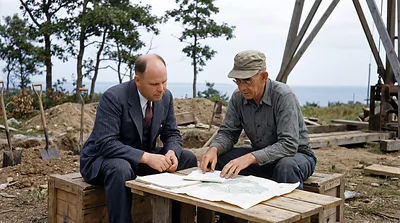
To investigate the anomaly further, Rick Lagina, Alex Lagina, and Craig bring in Mike Roberts and Joey Rolf from Dive Tech Limited to deploy an ROV equipped with Tritech micron sonar capable of detecting objects within 250 feet. Descending through over 158 feet of water inside the H-8 caisson, the ROV reaches approximately 170 feet and begins scanning. The sonar returns reveal what appears to be a clear right angle, a feature the team considers strong evidence of a man-made cavity or chamber. Before the scan can be completed, however, the ROV suffers a catastrophic electronics failure and takes on water, forcing the operation to be suspended. Despite the setback, the sonar evidence of a possible underground void drives the team to begin hammer-grabbing the shaft immediately.
At Smith's Cove, Rick joins geologist Terry Matheson and archaeologist Laird Niven as they continue excavating the slipway first discovered by treasure hunter Gilbert Hedden in 1936. Among the wash plant spoils, metal detection expert Gary Drayton recovers a hand-wrought iron object with a tapered point resembling a weapon or crossbow bolt. The find is strikingly similar to a metal object found on the island's southwest shore earlier in the season that was compared to a Roman pilum, a throwing spear used as far back as the first century BC.
In the War Room, Rick, Marty, Alex, and the team connect with Dr. Lila Koparova, director of the Center for Medieval and Byzantine Studies at the Catholic University of America. She examines the inscribed stone discovered near the Money Pit two weeks earlier. After ruling out runes due to the absence of guidelines above and below the characters, she identifies the rhythmic carving pattern as potentially consistent with Gothic script, specifically Textura rotunda, a style widely used from the 12th to 15th centuries. She ultimately concludes the markings are most likely decorative and architectural in nature. Separately, Rick, Gary, and Dan Henskee return to the area where the stone was found to search for additional fragments. Gary discovers an unusual coin or token with a webbing-like design unlike anything the team has encountered before.
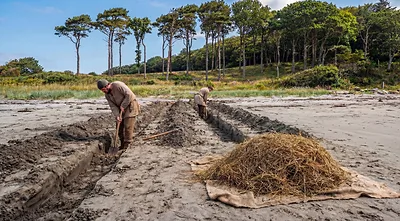
The episode closes with a major discovery at Smith's Cove. While excavating near the slipway and the U-shaped structure, Billy Gerhardt and the team uncover a concrete wall buried some three feet beneath the seabed, entirely unrecorded in any searcher documentation from 1850 onward. The wall is five inches thick and three feet tall. Rick and Marty note that the ancient Romans were the first to develop concrete that hardens in seawater, dating to the third century BC, and that similar engineering knowledge would have been required to build the island's flood tunnel system. Charles Barkhouse and the team agree the structure must predate anything previously known about Smith's Cove.