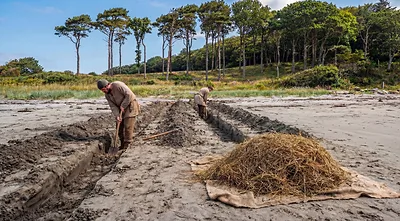
In the Season 11 finale, the team makes one final push in the Money Pit area. Geoscientist Dr. Ian Spooner and colleague Dr. Fred Michel have conducted new water sampling tests near the Garden Shaft and marked a borehole location designated E.5N-14.5, roughly eight feet northwest of the shaft, where they believe the source of precious metals detected at depths around 100 feet may be concentrated. Rick and Marty Lagina dub the borehole Bravo-Sierra. Just over a month earlier, probe-drilling at 106 feet inside the 18th-century Garden Shaft had triggered a sudden rush of saltwater, forcing the team to abandon the operation and raising the possibility that one of the legendary flood tunnels had been activated.
In the Oak Island lab, Rick Lagina and historian Doug Crowell meet with Jack Begley, lead archaeologist Laird Niven, and archaeometallurgist Emma Culligan to examine an arrowhead. The artifact was originally discovered on Oak Island in the 1960s by Robert Dunfield, and during the team's recent research trip across Europe, they showed it to curator Ane Jepsen Nyborg at the Ladby Viking Museum in Kerteminde, Denmark, who described it as "very quintessentially" Viking in its construction. Laird observes the arrowhead is unusually thin and narrow, designed for piercing rather than hunting, and suggests it was meant to penetrate chain mail. Emma runs XRF analysis and reports that the composition indicates a pre-1600s date, with phosphorus and sulfur levels consistent with English iron, though she notes that being English does not preclude a Norse origin given centuries of Viking activity in England.
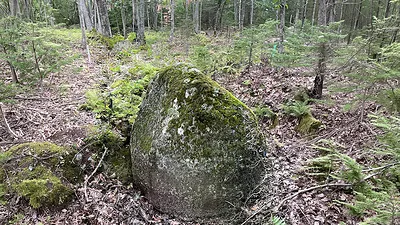
On Lot 10, near the center of the island, metal detection expert Gary Drayton and Alex Lagina dig flagged targets in the vicinity of Nolan's Cross. Two weeks earlier, Marty and the team had lifted the megalithic boulder known as Cone E, discovering a strange concrete-like substance containing animal hair underneath. Now Gary and Alex unearth a small iron artifact with a mushroomed top, indicating it has been repeatedly hammered. Gary identifies it as a possible chisel or inscription tool, the kind used to carve symbols into stone. The find carries particular weight given the carved boulders documented on the island over the years, including the H+O stone on the northern shore and the legendary 90 Foot Stone recovered from the Money Pit in 1804.
On Lot 5, archaeologists Laird Niven and Helen Sheldon continue excavating a rectangular stone foundation where artificially manipulated soils have been scientifically matched to samples from the Money Pit area. Helen uncovers two more small lead weights identical to one found in previous weeks, each weighing precisely 0.69 ounces. Marty arrives to examine them, and the team agrees that three identical weights at exactly the same measurement cannot be coincidental. When asked what they might have been used to measure, the answer is immediate: gold. The discovery strengthens the theory that Lot 5 may have served as a staging area for whatever was deposited in the Money Pit.
At the Money Pit, core drilling in borehole Bravo-Sierra reaches 119 feet. The core produces sand and in situ material but no vault and no treasure. Dr. Spooner confirms they have passed through the zone of interest. The result is profoundly disappointing, but the team draws a critical observation from the failure: the fine sandy material recovered is incapable of transmitting the 479 gallons per minute of water that recently flooded the Garden Shaft. Craig Tester concludes there must be an external source, a flood tunnel, and Marty and Rick agree. The season ends in the War Room with the team planning targets for the following year, including Aladdin's Cave, where a massive cavern was found at 150 feet with trace precious metals and wooden structures, borehole RF-1, where Roman-numeral-marked beams and a Scandinavian-linked pickax were recovered in 2019, and borehole H-8, where pieces of parchment and leather bookbinding were found in 2017 near possible evidence of the fabled Chappell Vault at nearly 180 feet.