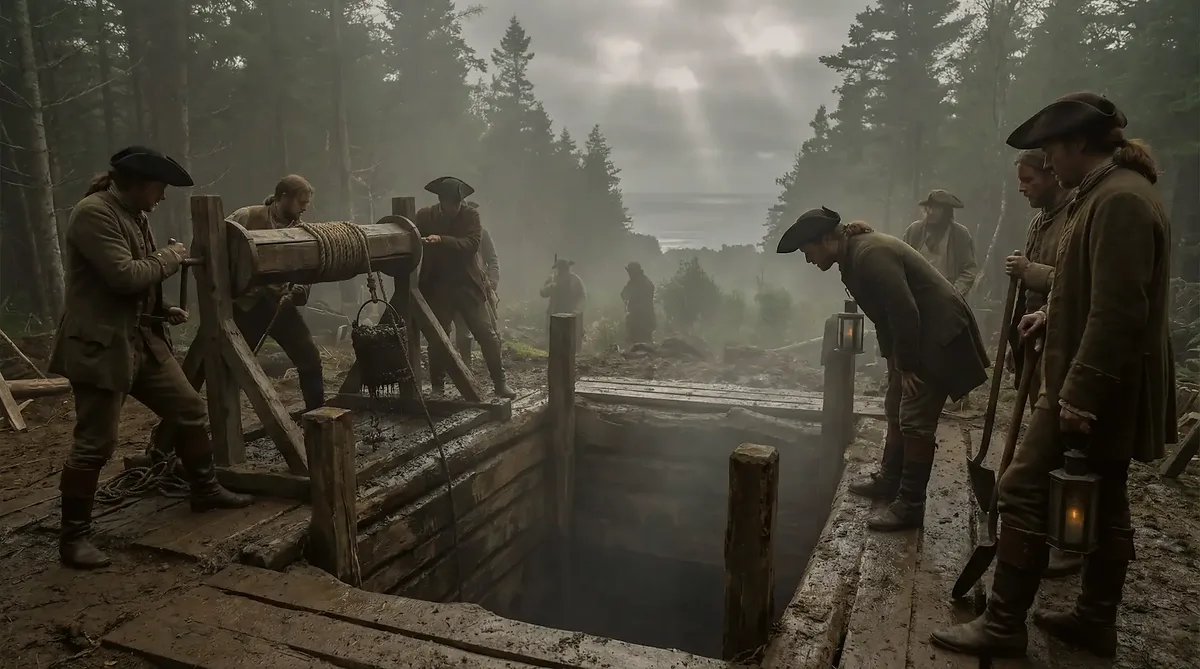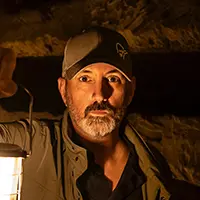
Of all the theories surrounding Oak Island, the Knights Baronet may be the most overlooked, and one of the most historically grounded. It does not rely on legends of medieval monks fleeing persecution or pirates burying plunder between raids. It begins with a documented act of the British Crown, a royal charter signed on September 10, 1621, that handed an entire province to a single Scottish courtier and created a hereditary order of knights with direct authority over the land where Oak Island sits.
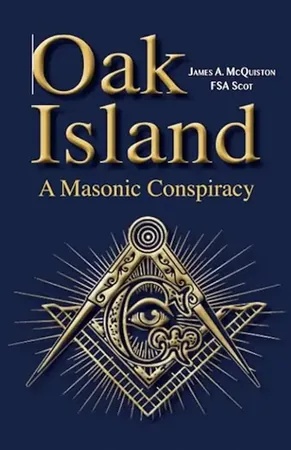
The theory was brought to prominence by the late James McQuiston, a historian, author, and Fellow of the Society of Antiquaries of Scotland, who spent years tracing the connections between this knightly order, the earlier military orders of medieval Scotland, and the mystery of Oak Island. His research, presented multiple times in the War Room on The Curse of Oak Island and developed across more than a dozen books, remains one of the most methodical and historically rigorous contributions to the Oak Island story.
The Creation of Nova Scotia
1 min
In the early 1600s, King James I of England (simultaneously King James VI of Scotland) wanted control of the vast stretch of North American territory between his colonies in Virginia and Newfoundland. The problem was the French. Samuel de Champlain and Pierre Dugua had established settlements in Acadia, and the oldest of these, Port-Royal, sat on the Bay of Fundy in what is now western Nova Scotia. The French were already there, and they were not leaving.
Sir William Alexander of Menstrie, a Scottish poet, courtier, and tutor to the young Prince Henry, proposed a solution. He would establish a "New Scotland" in the heart of French Acadia, replacing Catholic settlers with Scottish Protestant ones. King James agreed. On September 10, 1621, he granted Alexander the charter for Nova Scotia, making him lord proprietor of a territory encompassing what are now the three Maritime Provinces and the Gaspé Peninsula.
It was an enormous grant. On paper, Sir William Alexander owned everything, including the small wooded island in Mahone Bay that would one day become the most excavated piece of ground in North America.
The Order of Knights Baronet
1 min
Alexander's first attempts at colonisation failed. In 1622 he sent a ship from London to Kirkcudbright to collect settlers, but bad weather, reluctant artisans, and scarce supplies turned the expedition into a disaster. The colonists ended up stranded in Newfoundland. A second attempt in 1623 fared little better. Settlers explored the Nova Scotia coastline as far as Port-Joli and Port-au-Mouton, formed a favourable impression, then sailed home without establishing anything permanent.
The problem was money. Alexander was spending his personal fortune trying to populate a colony that no one wanted to move to. King James, who had successfully raised £225,000 by selling baronetcies to fund the plantation of Ulster in 1613, proposed the same scheme for Nova Scotia.
On October 18, 1624, the king announced his intention to create the Knights Baronets of Nova Scotia. The deal was straightforward: any Scottish gentleman who paid 3,000 merks, or who equipped and transported six armed settlers to Nova Scotia for two years, would receive a hereditary baronetcy and a barony of 16,000 acres in the new colony. Under Scots law, each baronet would "take sasine," receiving symbolic earth and stone from the actual land as proof of ownership. Since crossing the Atlantic was impractical for this ceremony, Charles I (who took the throne after James died in March 1625) arranged for the ritual to take place at Edinburgh Castle, where a mound of Nova Scotian earth was symbolically present.
A total of 150 baronetcies were authorised. By 1631, 85 had been created. The Knights Baronets of Nova Scotia were, on paper at least, the legal landowners of the province in which Oak Island sits.
The Templar Thread
1 min
What made McQuiston's research so compelling was his discovery of the connections running backward in time from the Knights Baronet to the older military orders. This was not speculation. He traced it through verifiable genealogical and institutional records.
The key moment was 1563, when the singular Grand Prior of the Order of the Knights of St. John and the Temple in Scotland turned over all possessions of both knighthoods to Mary, Queen of Scots. This was a transfer of real property, real authority, and real institutional memory from the remnants of the Templar and Hospitaller orders into the hands of the Scottish Crown.
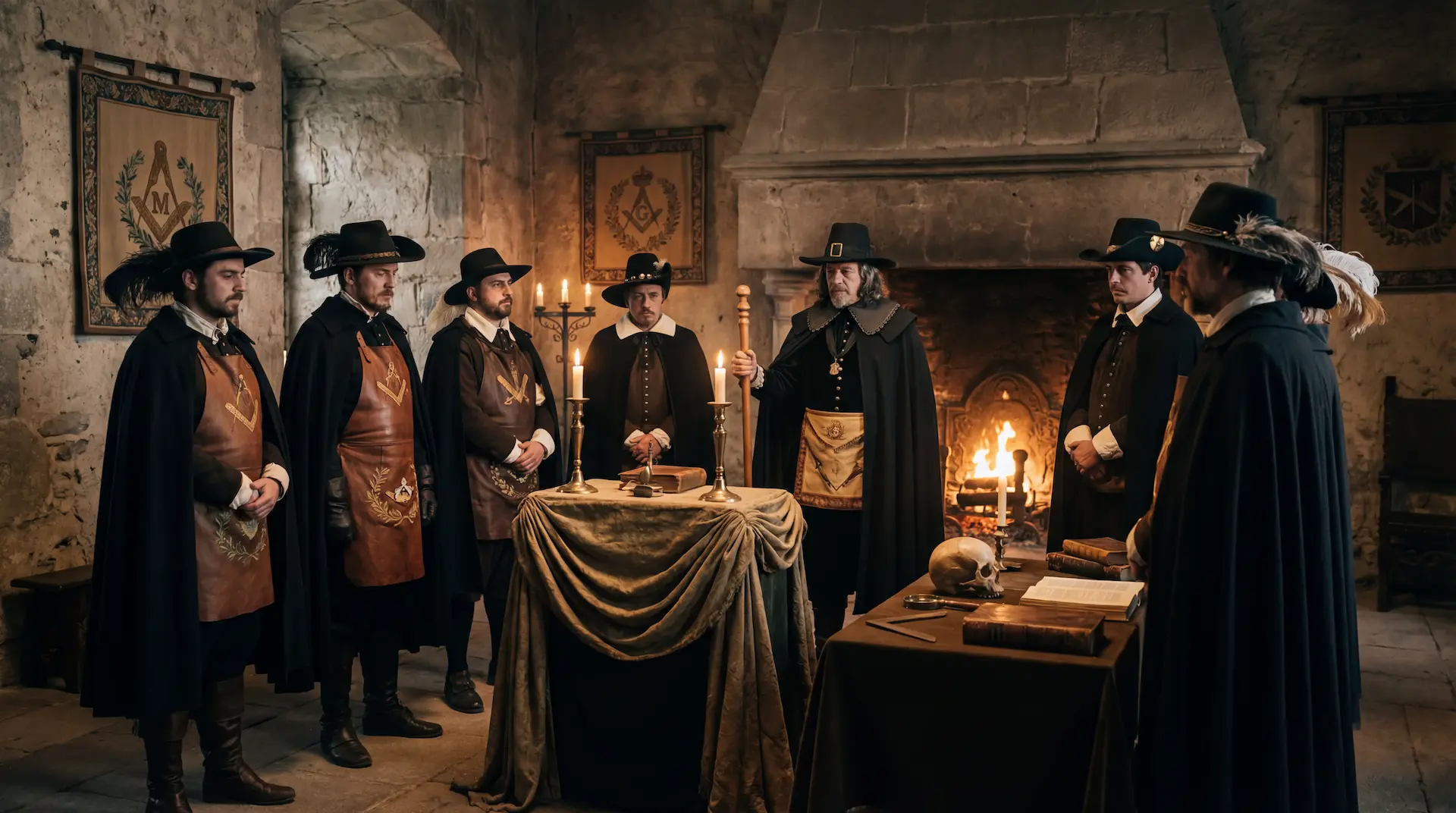
Within two generations, the heirs of four men involved in that 1563 transfer became Knights Baronets of Nova Scotia. And by July 3, 1634, the first recorded Freemasons appeared in Edinburgh, all with documented connections to Nova Scotia. McQuiston identified that roughly 25 percent of the Knights Baronet had some traceable connection back to the Knights Templar. The Baronetage was not simply a fundraising scheme for colonisation. It was, in McQuiston's carefully argued view, a continuation of something much older.
 Freemasons on Oak Island→
James McQuiston and the Oak Island Connection
1 min
McQuiston came to the Oak Island story through a personal discovery. In 1965, like so many others, he had read the Reader's Digest article about the mystery. But it was not until October 2016 that he realised his own extended family's title of Premier Knight Baronet of Nova Scotia might have something to do with the island's story.
He contacted the Oak Island team with a small amount of information. It was met with requests for more. That initial contact led to years of sustained research, more than a dozen books, and over a dozen appearances on The Curse of Oak Island. His theory, which he described as "a conspiracy of elites," was ranked among the top theories on the show, and Rick Lagina himself said on-air: "When you ask the who, what, when, where, why and how, I think James, above all the others, really deals with that."
McQuiston's approach was that of a detective, not a storyteller. A Fellow of the Society of Antiquaries of Scotland and a member of the Scottish Rite Research Society, he worked from primary sources: letters, family histories, war records, and documents scanned from libraries dating back to the 1600s, sourced from archives in Scotland, England, and Nova Scotia. He collaborated closely with Oak Island historians Charles Barkhouse and Doug Crowell, and carried out regular research for the team that continued almost weekly until his passing.
James McQuiston died unexpectedly on December 6, 2025, at the age of seventy-five. His loss was felt deeply across the Oak Island research community and far beyond it. He was, by every account, generous with his findings, supportive of fellow researchers, and possessed of a rare combination of deep scholarship and genuine warmth. His work on the Knights Baronet represents one of the most significant original contributions to the Oak Island literature, and it continues to shape the direction of the search.
The 1671 Medallion and New Ross
1 min
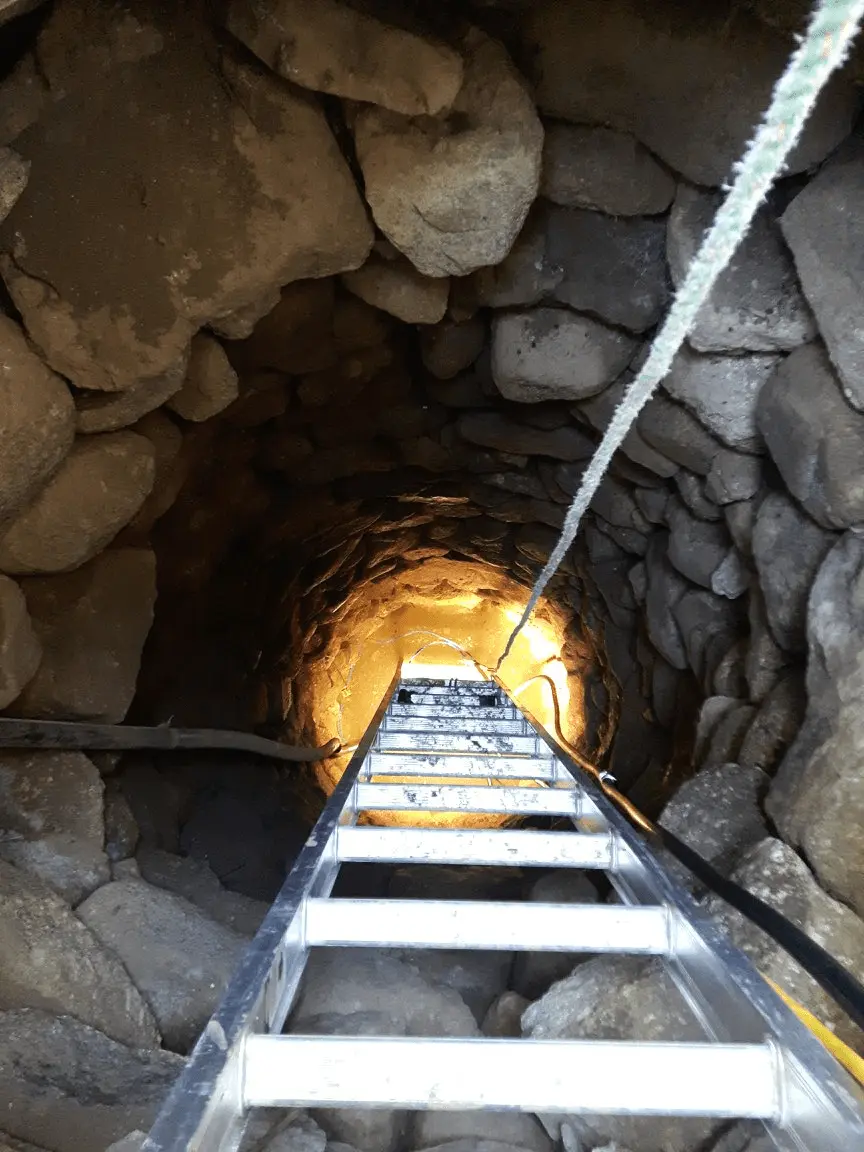
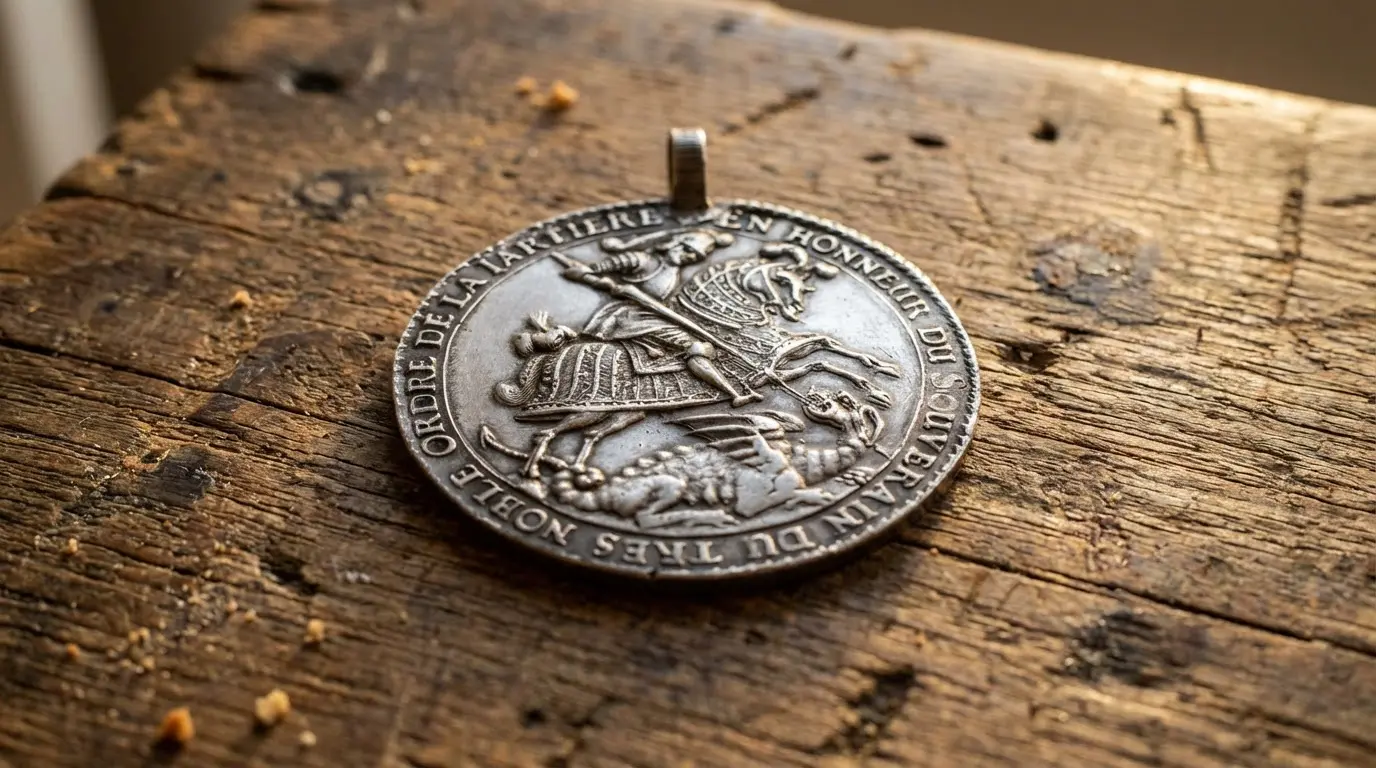
One piece of physical evidence gave particular weight to McQuiston's theory. A 1671 British knighthood medallion was found in the ground near an unexplained stone foundation at New Ross, Nova Scotia, approximately twenty miles upriver from Oak Island along the Gold River.
The New Ross site has long been a subject of debate. Some researchers have attributed the foundation to Vikings or Templars. McQuiston believed the evidence pointed to a later date: 1623, when Alexander's settlers first explored the Nova Scotia coastline. Three separate traditions, from the Alexander family, the Nauss family of Nova Scotia, and the Mi'kmaq First Nations, all describe a "secret estate" built at the New Ross site for Sir William Alexander during that period.
 New Ross→
The medallion, in McQuiston's analysis, connected not to the original construction but to a later visit. He linked it to Sir William Phips, a knight who recovered a fortune from the sunken Spanish galleon Concepción in the Caribbean and returned the bulk of it to King James II. McQuiston believed Phips visited the New Ross site not to bury treasure of his own, but to search for Alexander's.
He noted a tantalising genealogical thread: Phips' father was named James, but no further family history is known. Alexander's private secretary was named James Philp, and nothing is recorded of him after Alexander's death in 1640, when Philp sold his Scottish land. The names Phips and Philp are contractions of Phillips, and in the records of this period, they were used interchangeably.
 1671 Order of the Garter Medallion→
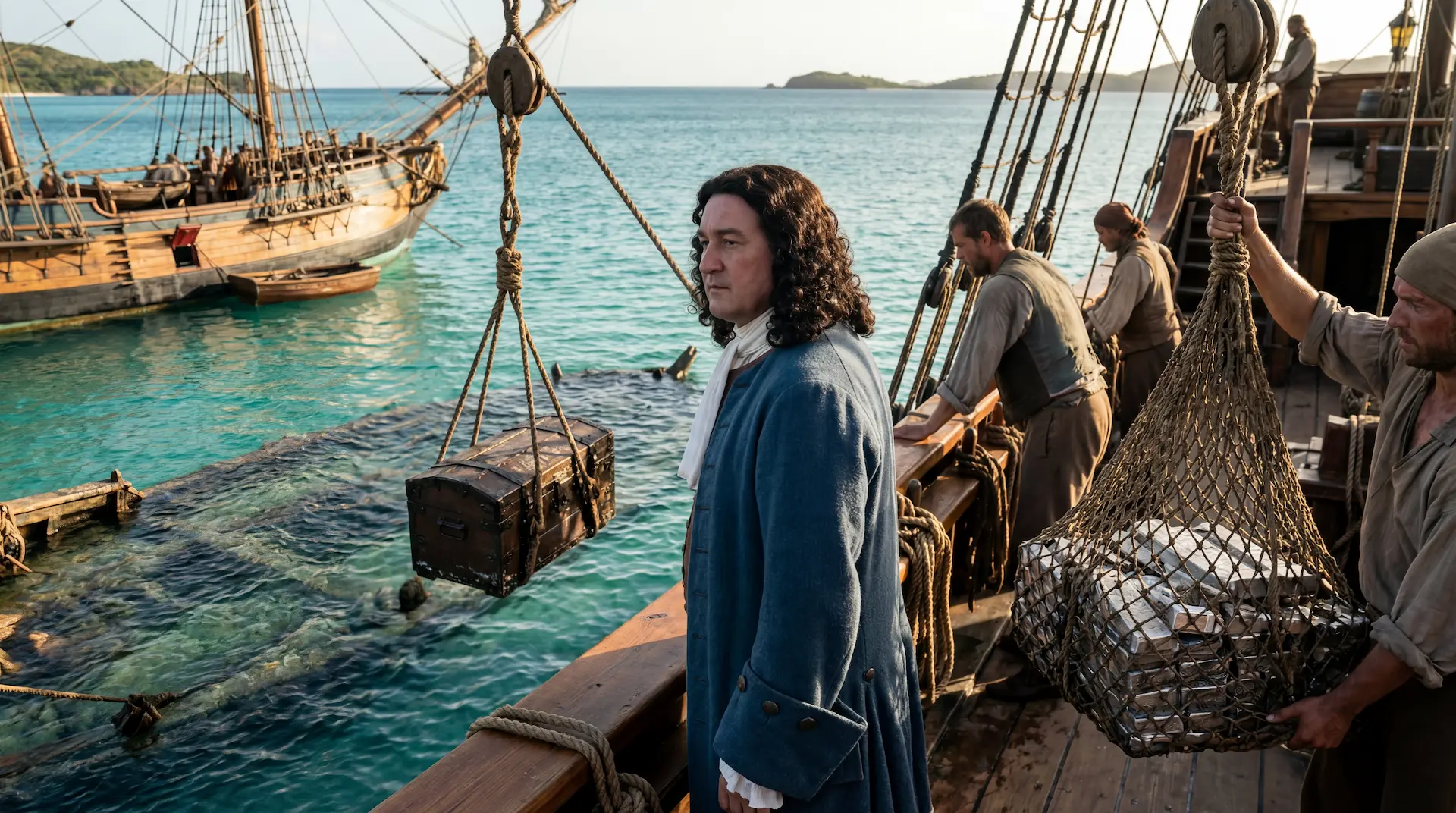 William Phips, the Treasure of the Concepción→
The Carbon Dating Window
1 min
McQuiston's theory also aligned with the physical evidence from Oak Island itself. Carbon dating of wood and other materials recovered from the Money Pit and surrounding structures has repeatedly returned dates clustering around 1620 to 1660. This window matches almost exactly with the active period of the Knights Baronet colonisation effort and the construction timeline McQuiston proposed.
If the Money Pit was built during this period, it was constructed at a time when the Knights Baronet held legal authority over the island, when Scottish settlers with Templar-connected lineages had both the motive and the means to hide something of great value, and when the political turmoil of the English Civil War made secure storage outside of Britain an urgent practical concern.
A Theory Built on Records, Not Romance
1 min
What distinguished McQuiston's work from many other Oak Island theories was its foundation in documented history. The charter of 1621 is a matter of public record. The creation of the Baronetage is documented in detail. The genealogical connections between the Baronets and the earlier knightly orders can be traced through Scottish archives. The carbon dating evidence from Oak Island sits within the timeframe his theory predicts.
None of this proves that the Knights Baronet built the Money Pit. But it establishes something that few other theories can claim: a documented group of people with legal authority over Oak Island, with traceable connections to medieval military orders, operating within the exact time period indicated by the physical evidence, and with a plausible reason to construct a hidden vault on a remote island in the North Atlantic.
The Knights Baronet theory does not ask you to believe in lost fleets, undocumented ocean crossings, or treasure maps drawn from memory by eccentric English authors. It asks you to follow the paper trail. And for that, we owe a great debt to James McQuiston, who followed it further and more carefully than anyone before him.