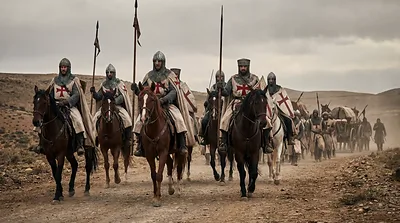
In the War Room, the team connects by phone with Jerry Glover, the Templar expert who guided Rick Lagina, Alex Lagina, and Peter Fornetti through the 14th-century prison at Domme, France. Glover confirms that the lead cross Gary Drayton found at Smith's Cove closely matches carvings made by imprisoned Templars, and agrees the object resembles a mortuary cross, a type worn during times of plague to ward off evil, commonly dated between the 13th and 16th centuries. He stops short of calling it definitively Templar, recommending that religious iconography specialists weigh in. The team also shows the cross to Dan Blankenship, who at 94 remains the first person consulted whenever a significant artifact surfaces.
Rick and Charles Barkhouse travel to Waverley, Nova Scotia, to meet Tom Nolan, the son of the late treasure hunter Fred Nolan. Tom agrees to work with the Laginas and grants full access to his father's 16 acres on the island, including the area surrounding Nolan's Cross. He also produces Fred's survey maps, representing 50 years of fieldwork that charted virtually every visible rock, survey line, and point of interest across the property. The maps have no legend, scale, or compass orientation, making interpretation a challenge without Fred to guide them. Before Rick leaves, Tom shows him a folding skeleton key that Fred found on the island, its blade cut in the shape of a cross that becomes visible when the key is folded. Rick and Charles then examine the maps with Dave Blankenship, identifying what they believe are the survey stakes Fred discovered in the swamp, stakes that were carbon-dated to as early as the 1500s.
Armed with the maps, Rick, Marty Lagina, Charles, and Gary Drayton search Lot 12 on Tom's property, targeting a location Fred Nolan described as an ancient dumpsite. Jim Meagher, Tom's associate, operates a backhoe to cut a trench while Gary sweeps the spoils. Charles begins pulling pottery shards from the cross section of the trench, quickly amassing a large collection. The dump is exactly where Fred's maps indicated, confirming both the accuracy of his surveys and the old accounts that treasure hunter Gilbert Hedden found pottery with traces of mercury at this site in 1936, a detail that connects to the theory that Sir Francis Bacon preserved documents in mercury before burying them on Oak Island.
In Halifax, Alex and Jack Begley meet medieval bookbinding expert Joe Landry and his apprentice Katherine Taylor at the Dawson Printshop at the Nova Scotia School of Art and Design. Landry immediately identifies the H-8 scraps as genuine parchment and vegetable-tanned calf leather consistent with materials used in books that can survive for 2,000 years. The purple wood fragment from the H-8 spoils draws the strongest reaction. Landry compares it to Tyrian purple, an ancient dye so costly it was restricted to church documents and royal decrees. He suggests the purple staining could result from ecclesiastical leather bleeding into a book board, and notes that the thickness of the wood is consistent with a book cover. Taken together, the parchment, leather, and purple-stained wood form what Landry considers compelling evidence of an ancient bound volume.
At the Money Pit, the Irving Equipment crew begins oscillating the first caisson into the DMT shaft, positioned in the unexplored area south of H-8 where the team believes the Chappell Vault may have been pushed during the earlier dig. The hole is named for Drake Tester, whose initials mark the shaft. Rick declares this location their best-informed target yet, refined by the full Geotech dataset and the lessons of H-8.