With 44 Geotech boreholes completed and Borehole H-8 confirmed as the primary target, representatives from Irving Equipment Limited return to Oak Island to inspect the drilling pad and begin delivering equipment for a large-scale 50-inch caisson excavation to a target depth of 200 feet. In the War Room, area historian Paul Speed presents a theory linking the Money Pit to Sir Francis Drake. Speed argues that 16th-century Cornish miners possessed the coastal mining techniques needed to construct the island's tunnels and flood systems, and that Drake, who raided Spanish gold from Nombre de Dios in Panama, may have used the island as a vault. Speed's most provocative claim is that Drake himself may be buried on Oak Island in a lead coffin filled with mercury, noting that the coffin has never been found and that Gilbert Hedden recovered mercury flasks from the island's north side decades earlier. Rick Lagina keeps an open mind but commits only to further research.
Rick, Marty Lagina, and Craig Tester return to Saint Mary's University, where Dr. Christa Brosseau and Dr. Xiang Yang examine the fibrous scraps and leather fragment that Jack Begley and Dan Henskee recovered from the H-8 spoils. Under the scanning electron microscope, the paper-like material reveals collagen fibers and traces of nitrogen, identifying it as animal-skin parchment rather than plant-based paper. Parchment was historically reserved for documents of high importance, and its presence 150 feet underground suggests deliberate placement. The leather fragment proves even more striking: one side is dimpled animal skin, while the other shows bundled textile fibers spun together and bonded to the leather, a construction consistent with bookbinding. The discovery revives the longstanding theory that manuscripts connected to Sir Francis Bacon and William Shakespeare may be buried in the Money Pit. Rick notes that of all the H-8 artifacts tested, the bookbinding material is the most intriguing.
On Lot 26, once owned by privateer Captain James Anderson and later by Samuel Ball, Jack Begley, Charles Barkhouse, Gary Drayton, and archaeologist Laird Niven discover a well-defined, perfectly square depression in the ground near a flat stone wall that Gary suspects may have served as a ramp or dock for Anderson's schooner. The depression is roughly the size of a chest, and the team recalls the four keys found with Anderson's sea chest, three of which remain unmatched. Marty and Alex Lagina join the dig, and a backhoe peels away layers of soil under Gary's metal detector watch. The excitement fades when the team hits slate and then bedrock with no artifacts, though Marty speculates the impression may mark where something was buried and later removed, possibly by Ball, who became one of Nova Scotia's wealthiest men despite starting as a simple cabbage farmer.
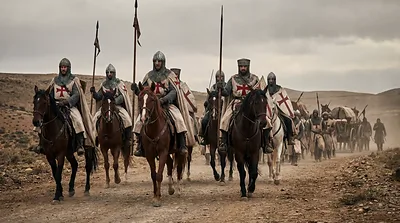
Two days later, Rick, Dave Blankenship, Laird Niven, and Marty by video receive results from Dr. Timothy Frasier, an associate professor of biology at Saint Mary's University, who has performed advanced DNA sequencing on the two bone samples from H-8. One individual appears to be of European descent and the other of Middle Eastern origin. The Middle Eastern result stuns the team. Dave and Rick immediately connect it to the Knights Templar, the 12th-century military order that operated across Western Europe and the Holy Land and is believed to have amassed sacred treasures including the Ark of the Covenant and the Golden Menorah. A person of Middle Eastern origin buried deep in the Money Pit, below any known searcher activity, lends unexpected physical evidence to what had previously been speculation. The team agrees that H-8 must be excavated on a larger scale, and as Irving Equipment begins delivering 35 loads of heavy machinery, the full dig is set to begin.