How This Site Approaches Oak Island
Oak Island has attracted serious investigators and eccentrics in roughly equal measure for over two centuries. This site exists to separate signal from noise. The goal is accuracy, clarity, and intellectual honesty about what we know, what we suspect, and what remains unknown.
What follows is an overview of the method behind the content on these pages.
The approach described below comes from three decades of fieldwork on both sides of the Atlantic. The sites, archives, and locations referenced throughout this site have, with very few exceptions, been visited and investigated in person. That research led to a bestselling book with Watkins and Penguin Random House and eight years of on-screen investigation for the History Channel series. It is the same approach applied to every page on this site. More about the research behind this project can be found on the about page.
The Hierarchy
Primary sources first: Original documents, archaeological reports, laboratory analyses, land records, contemporary accounts. If something can be verified against paper or physical evidence, that forms the foundation. Everything else builds on top.
Credible secondary sources second: Published historians and researchers who cite their own sources and show their work. Not television summaries, not forum speculation, not “some say.” Authors who have done the archival digging and can point to where they found what they found.
Informed hypothesis third: Once the documented record is exhausted, there is room for reasoned conjecture. But only conjecture that builds on what came before, not conjecture that ignores it. The hypothesis must fit the evidence. When it does not, the hypothesis is wrong.
This is not a radical methodology. It is how serious historical research has always worked. It is also the only methodology that produces conclusions worth defending.
The Starting Point
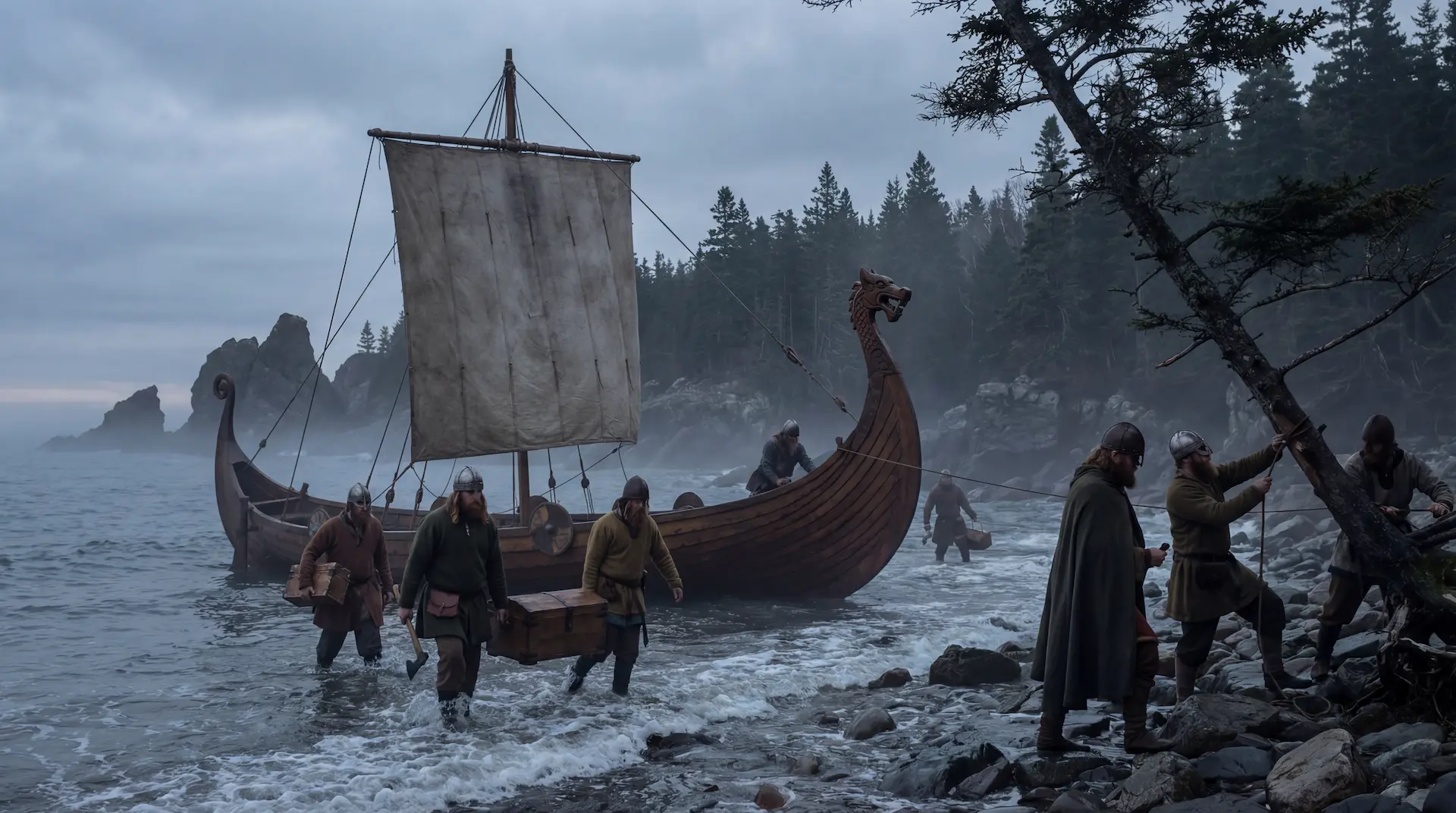
This site begins from a position that would have been controversial fifty years ago but is now established fact: Norse expeditions reached North America around 1000 CE. From that foundation, a growing body of evidence suggests contact extended beyond the Norse, and Oak Island sits within that broader context.
L’Anse aux Meadows proved Norse presence around 1000 CE. Helge and Anne Stine Ingstad spent years being dismissed as fantasists before the evidence became overwhelming and the doubters went quiet. The same pattern has repeated with subsequent finds suggesting contact beyond the Norse. Some remain disputed. Others have quietly moved from “impossible” to “plausible” to “accepted.”
Oak Island shows evidence of sophisticated engineering activity predating known colonial settlement. Carbon dating has returned medieval-era results from wood found deep underground. Artifacts point to European origins that do not fit the standard colonial timeline.
None of this proves what was buried there, or by whom. But it establishes that the question is legitimate. This is not the fever dream of treasure hunters. It is a real historical puzzle with physical evidence that demands explanation.
 Vikings→
What This Means for the Site
On these pages, content is treated according to its evidential weight. Documented facts are presented as facts, with sources identified. Working hypotheses are clearly identified as hypotheses, representing the current best understanding, subject to revision as new evidence emerges. Speculation is labeled as speculation and never presented as fact.
The sourcing scales with the claim. An article about the geography of Oak Island relies on survey data and satellite imagery. An article proposing that the Ark of the Covenant potentially ended up beneath a small island in Mahone Bay relies on a chain of historical connections stretching across two millennia, three continents, and several civilisations that left incomplete records. The further a theory reaches from the established record, the more thoroughly each step is documented, the more carefully conditional language is applied, and the more explicitly the gaps are identified. A weakly sourced article about an uncontroversial subject does little harm. A weakly sourced article about the Ark of the Covenant does a great deal.
This site is not interested in pretending certainty where none exists. It is also not interested in false balance, treating every fringe theory as equally valid or dismissing solid evidence because it challenges comfortable assumptions.
Sources are mentioned inline and/or in a dedicated "Sources" section at the bottom of the article.
Use of AI to Reconstruct Scenes and Images
Most of what this site covers happened before photography existed. The Templar fleet sailed from La Rochelle in 1307. Henry Sinclair’s voyages, if they happened, took place around 1398. The Order of Christ rose in Tomar in the 14th century. Razilly landed at La Hève in 1632. Versailles reached its height under Louis XIV. Mi’kmaq communities lived along Mahone Bay for centuries before any European arrived. None of this was ever in front of a camera. The daguerreotype process did not exist until 1839, and most of the deep history relevant to the Oak Island story predates it by hundreds of years.
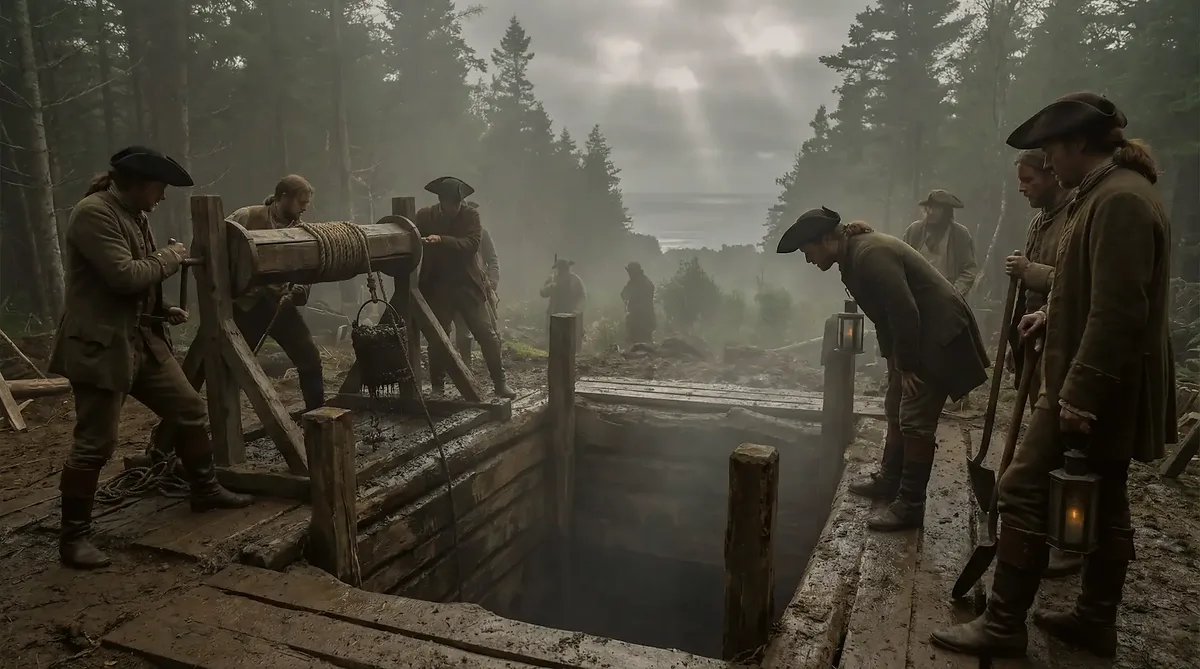
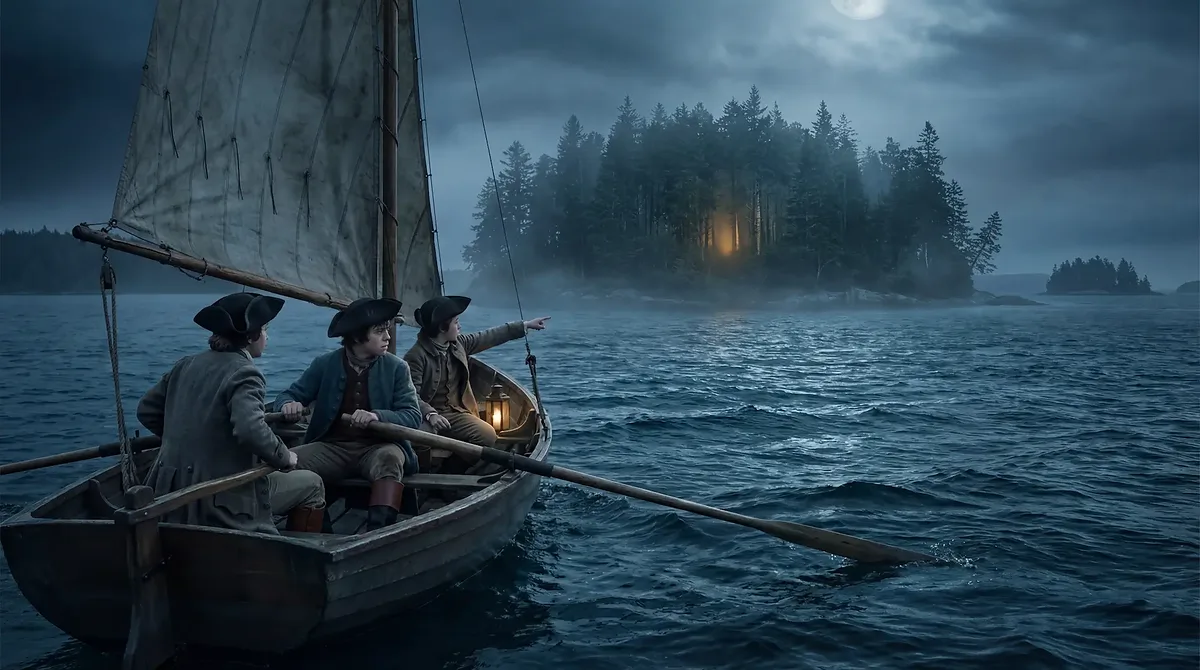
This site uses AI-generated images to visualise that world. They are reconstructions, not photographs.


The practice is older than the technology. Historical illustrators have rendered scenes from textual records since books were printed. Documentary filmmakers commission reenactments. Museums build dioramas and commission paintings. What has changed is the level of visual fidelity available to a single researcher working without a studio budget.
Each image begins with the documentary record. Before generation, the relevant primary and secondary sources are reviewed: the clothing of the period and place, the tools and weapons in use, the architecture, the terrain as it would have appeared in that decade, the social conventions of the scene. A Templar commandery in Aquitaine looks different from a Hospitaller priory in Provence. A Portuguese caravel rigs differently from a Basque whaler. A Mi’kmaq summer camp on the coast looks nothing like a French fortified post on the same shoreline. The aim is an image a historian familiar with the period would recognise as consistent with it.
What this site does not do: it does not invent events. It does not depict speculative or contested incidents as though they were established. It does not place real named individuals in scenes for which there is no documentary basis. Where an image deviates from a strict reading of the record, the caption says so.
The honest alternatives would be a site of pure text about a visual subject, or the common practice of borrowing unrelated period art and hoping the reader does not notice. A researched reconstruction, labelled clearly and grounded in cited sources, is the more accurate choice. The reader is invited to weigh each image against the documentation it depicts.
What This Site Is Not
This is not a fan site. It is not a platform for every theory that has ever attached itself to Oak Island. It is a research resource, available for everybody. The goal is not to convince anyone of a particular answer, but to present what is known, what is substantiated, what is plausible, and what remains open, as faithfully as the available record allows. This is not a site where content is behind a paywall.
Corrections
When errors are identified, they are corrected. Corrections are made directly in the text.
If you find an error or have evidence that contradicts something on this site, please get in touch through the contact page. Good research depends on people willing to share what they know.
A Note on Making Television
This site covers the History Channel series The Curse of Oak Island extensively, with episode guides, timelines, and background material. But the site is independent of any television production.
Television has its own logic. Episodes are edited for drama. Cliffhangers are manufactured. Findings are teased across multiple episodes for maximum suspense. The historical research that viewers see presented in the War Room is an extremely condensed edit of what are usually many hours of discussion, debate, and analysis. This is the nature of the medium.
The goal here is to document what is actually known, separate from how it was presented on screen. Where the show’s narrative diverges from the documented record, the documented record takes precedence.