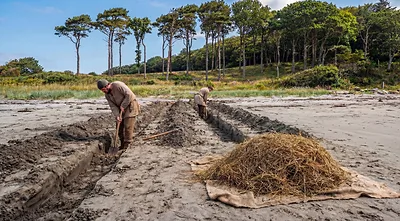
Craig Tester and Jack Begley meet the Centre of Geographic Sciences team at the Oak Island marina to conduct a marine survey of the waters off the island's southern shore. Using lidar and side-scan sonar equipment arranged in a systematic grid of 30 lines five meters apart, the COGS crew scans the seabed for evidence of a second flood tunnel system, a theory championed by author Randall Sullivan. The scans detect several anomalies, including what appears to be an underwater hole consistent with the ice holes Dan Blankenship observed during winter operations in 1980, a triangular formation, and a possible ship's anchor. Craig notes the data will require post-processing before they can determine whether any of the objects are man-made.
In the War Room, Rick Lagina gathers the team as Dr. Christa Brosseau, an analytical chemist from St. Mary's University in Halifax, presents her analysis of recent H-8 finds. Sample 15, initially thought to be bone, proves to be iron slag with seven percent sulfur content, suggesting a refining process. Samples 13 and 19, suspected to be leather, turn out to be plant material. Sample 17, however, is confirmed as cellulose-based cotton rag paper, an older form of paper used in book production from as early as the 12th century. The discovery echoes the piece of parchment bearing the letters V-I found by treasure hunters William Chappell and Frederick Blair when they drilled into a wooden vault in 1897.
Alex Lagina and historian Doug Crowell visit medieval book expert Joe Landry at the Nova Scotia School of Art and Design. Working with his apprentice Katherine Taylor, Landry soaks and carefully unfolds the paper fragments using surgical forceps. He identifies what appears to be a red spot and a possible ink line on one piece, and determines the paper dates to the mid-to-late 1700s. A follow-up visit to St. Mary's University with Marty Lagina proves more revealing. Using a polarized light microscope at 100 times magnification, lab technician Fergus Tweeddale and Landry identify a crystalline substance on the paper that may be cinnabar, a red mineral used in medieval and Renaissance ink production from as early as the 9th century. Landry estimates the paper could date anywhere from the 1300s to the 1600s.
At the H-8 wash table, Jack, Gary Drayton, Craig, Marty, and Dan Henskee continue sifting spoils from roughly 170 feet deep. Among the finds are a chunk of blue pottery, possible leather fragments, and a square ship nail that Gary identifies as a decking nail, the first of its type recovered from the Money Pit. The discovery supports the long-standing theory that the original treasure shaft may have been constructed using wood salvaged from a large sailing vessel.
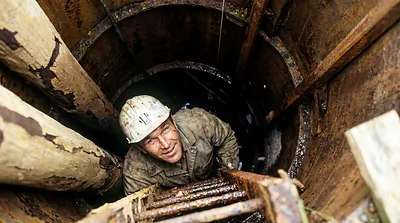
The week takes a dangerous turn when the ground surrounding the H-8 shaft begins to cave in. What starts as 18 inches of subsidence around the caisson rapidly expands. The Irving Equipment crew stops oscillating and switches to the hammer grab to avoid further destabilizing the area. That night, Charles Barkhouse calls Rick to the site after the sinkhole grows dramatically, and Danny arranges to move the crane and excavator as a precaution. By the following morning, the collapse has reached eight feet deep and over ten feet across, with voids visible underground. Rick, Marty, Craig, and Dave Blankenship survey the damage and agree to halt operations pending an engineering assessment, confronting the possibility that two centuries of searcher activity have left the entire Money Pit area dangerously unstable.