About This Artifact
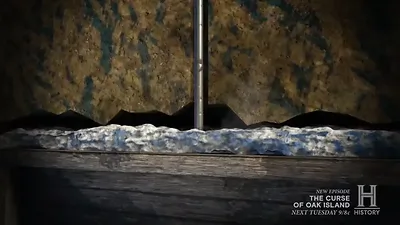
The parchment fragment is a tiny piece of animal-skin writing material recovered from the Money Pit at approximately one hundred and fifty-three feet during drilling by the Oak Island Treasure Company in 1897. It had been rolled into a ball no larger than a grain of rice and was discovered only after a meticulous examination of the auger borings by company official T.P. Putnam.
On September 6, 1897, over thirty men assembled at the Amherst courthouse in Nova Scotia to witness the examination. Dr. A.E. Porter, a local physician, slowly flattened the tiny fragment under a strong magnifying glass and found that it bore writing in black ink. The visible letters appeared to read either "vi" or "wi." The parchment was subsequently sent to Boston, where writing experts confirmed it had been inscribed with a quill pen using India ink. Frederick Blair, who would devote most of his life to the Oak Island search, told the Toronto Telegraph: "That is more convincing evidence of buried treasure than a few doubloons would be. I am satisfied that either a treasure of immense value or priceless historical documents are in a chest at the bottom of the Pit."
Parchment, made from prepared animal skin, was the standard medium for documents of high importance throughout the medieval and early modern periods. Its presence within the cement vault layer, alongside traces of gold on the drill bit, led to theories that the Money Pit contains manuscripts or archives rather than, or in addition to, monetary treasure. Proposed connections have included Freemasonic records, Knights Templar documents, and Francis Bacon's alleged custody of original Shakespearean manuscripts. In Season 5, animal-skin parchment was again recovered from borehole H-8 at a similar depth. Dr. Christa Brosseau confirmed the material as collagen-fibre parchment under scanning electron microscopy, and medieval bookbinding expert Joe Landry at the Dawson Printshop in Halifax identified it as genuine parchment consistent with materials used in bound volumes capable of surviving for two thousand years. The original 1897 fragment's current whereabouts are unknown.
Historical Context
Oak Island Treasure Company
Where It Was Found
Found at Money Pit, 153 ft depth. Location: the original 1795 excavation shaft on Oak Island, Nova Scotia.