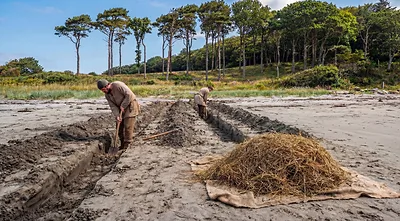
At Smith's Cove, while excavating the area around the slipway, archaeologist Laird Niven makes a surprising discovery: a concrete wall buried approximately three feet below the ocean floor. The wall is five inches thick and three feet tall, and embedded in the bottom are two connected rubber tubes. Laird notes he has found rubber artifacts dating to the 1850s, and the team considers the possibility that the concrete may have been made using techniques first developed by the ancient Romans, mixing volcanic ash with minerals to create a compound that sets underwater. Rick Lagina and Dave Blankenship visit veteran treasure hunter Dan Blankenship to discuss the find, but Dan has no records of it and suggests it may predate Robert Restall, noting that earlier searchers were often too focused on treasure to keep proper records.
In the War Room, Rick updates Marty, Craig Tester, Charles Barkhouse, Gary Drayton, and others on the Smith's Cove developments. The team puzzles over why tubes would run through a concrete wall beneath the tide line. Marty raises the possibility that the concrete is far older than the rubber tubes, and that a later searcher may have drilled through an existing structure. Gary offers his theory that the slipway served as a ramp for rolling heavy cargo from ships directly up to the Money Pit, and the team agrees to excavate beneath it. The episode marks the latest in a series of structures uncovered during the Smith's Cove excavation, including the U-shaped and L-shaped structures first found by Dan Blankenship in the 1970s.
At the Money Pit, Rick, Marty, Craig, and the Irving Equipment crew, including Vanessa Lucido, continue excavating borehole H-8 in an effort to recapture the Chappell Vault, the seven-foot-tall wooden structure first reported by treasure hunters William Chappell and Frederick Blair in 1897. The team raises the steel caisson to allow material to fall back into its path, then uses the hammer grab to extract spoils from depths below 168 feet. Craig recovers wood fragments he believes could be part of the vault. Jack Begley and Charles Barkhouse, sorting through the spoils, find what appears to be a scroll-like piece of fibrous organic material along with additional pieces of possible parchment and leather.
At the Oak Island Research Center, Craig, Jack, Paul Troutman, and Doug Crowell examine the H-8 finds under a digital microscope at up to 2,000 times magnification. They identify what appears to be leather bookbinding with traces of color, and paper fragments with red and yellow pigment. Doug notes the coloring resembles the illuminated drop caps used in medieval manuscripts, where large decorative letters marked the opening of chapters in religious texts. The team agrees the samples require expert evaluation to determine the age and composition of the pigments.
Investigative journalist and author Randall Sullivan returns to the island with the first copies of his new book on the Oak Island mystery. In the War Room, he presents his research to Rick, Marty, and the team, emphasizing the Francis Bacon theory. Bacon's posthumously published "Sylva Sylvarum" contains a passage instructing the reader to "dig a hole on the seashore," which Sullivan considers too specific to be coincidental. He also argues the primary flood tunnel system originates offshore on the south side near the stone triangle and the ice holes Dan Blankenship observed in 1980. When Rick asks where Sullivan would dig with one chance, he answers that he would look for an entry now underwater. Later, Jack, Charles, and Dan Henskee continue sifting H-8 spoils and recover what may be a third piece of human bone, identifiable by its porous texture and hollow center consistent with bone marrow.