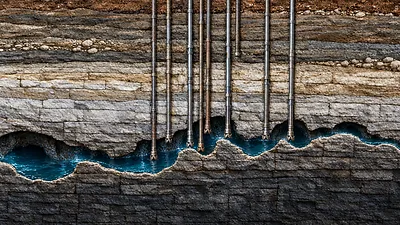
At the Money Pit, Rick Lagina, Charles Barkhouse, and Terry Matheson oversee a drilling operation that yields a striking result: 28 feet of loose material from 179 down to 207 feet in depth. Terry Matheson describes it as the closest thing to a true open void the team has encountered, and the same type of material into which the H8 caisson plug was lost three years earlier when the team believed they had contacted the legendary treasure vault. With the surrounding bedrock too dense for anything to move through, the loose zone within the solution channel represents exactly the kind of environment where heavy objects like gold (density 20) or silver (density 11) could migrate downward through material with a density of only three or four.
On Lot 13, metal detection expert Gary Drayton and Peter Fornetti search a recently cleared area near where author and researcher Corjan Mol and researcher Chris Morford presented their theory about Knights Templar artifacts. Within a 15-foot radius, Drayton recovers four British ox shoes that he dates to the early 1700s or possibly the 1600s, along with a finial or lynchpin strikingly similar to the decorative harness piece found weeks earlier on Lot 15. The finds all line up in sequence, leading Drayton to conclude they mark a trail used for hauling cargo from the beach and old wharf area toward the swamp, replicating the ox shoe trail discovered on Lot 15 near the pine tar kiln.
Alex Lagina, Tony Sampson, Jack Begley, and Peter Fornetti conduct a dive operation targeting two sonar anomalies. At the first site off Boulderless Beach on the north shore, Tony and Alex descend with a Pulse 8X metal detector and receive multiple hits across a broad area near two large, isolated boulders on the seabed. Communications with the boat fail during the dive, and a sudden wind shift destroys visibility, forcing the divers to surface. Marty later notes that such widespread detector response suggests either a single large metallic object or a substantial debris field below the ocean floor.
Tony dives the second target alone off the south shore near the swamp, where sonar had identified a square-shaped structure. He visually confirms rocks arranged in a square formation that he believes may be the remains of an old cribbed wharf leading into the swamp area. Alex connects the feature to the flat stone surface Rick Lagina and Dr. Ian Spooner identified while probing the swamp's southeastern corner the previous week. In the War Room, the team reviews both targets and agrees that further investigation with improved technology and better weather conditions is warranted.
Doug Crowell alerts the team to a mysterious mound he discovered on the highest elevation of Lot 15, not far from the pine tar kiln. Roughly 130 feet long with a hollow centre and covered in soil over large boulders, the structure sits off any known property line. Tom Nolan confirms via video that the mound is not the result of his father Fred's excavation work. Archaeologists Laird Niven, Liz Michels, and Aaron Taylor arrive to assess the feature, and Taylor notes its resemblance to the serpent mounds in Keene, Ontario, ceremonial features dating back as much as 2,000 years built by the ancient Point Peninsula culture. Rick and Marty inspect the site with Dan Henskee and agree it warrants further study, directing the team to metal detect the mound while Steve Guptill and Taylor produce a 3D model for analysis.