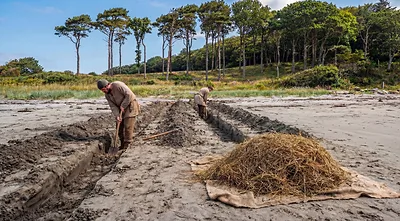
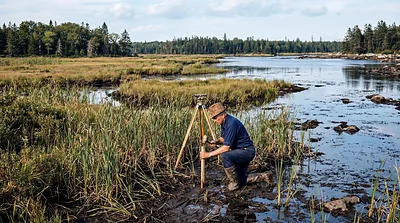
Along the swamp's southern edge, Rick notices axe-cut wood in Billy's excavated spoils and observes that the ground is unusually peaty. Billy points out it is the only peat layer in the area before transitioning to mud. Ian Spooner arrives and concludes the stratigraphy is inverted: if the shoreline were moving naturally landward, sand would lie over peat, not the reverse. He theorizes someone deliberately laid peat over sand so that boats could be hauled ashore, and recommends digging three to four feet deeper. At the Garden Shaft, Ryan Hooker and Clint Molyneaux of Minova Global join Marty, Craig, and Roger Fortin to begin sealing the voids with Geofoam, an industrial material engineered for mining and underground construction that expands to fill and stabilize cavities.
Borehole K6, drilled 7 to 8 feet southwest of H8, targets the muon-detected low-density anomaly at 180 feet. This is the zone where the H8 caisson struck a large object at 170 feet in 2017, which the team believes may be the Chappell Vault first reportedly encountered by Frederick Blair and William Chappell in 1897 when parchment and traces of gold were recovered. A core at 118 feet pushes through 20 feet of rock. Alex notes that the cobble matches Blair's 1897 description of a manmade flood tunnel at 111 feet: three feet wide, four feet high, and packed with large cobblestones. At 183 feet the drill hits a void with ten feet of bedded material that appears mostly natural except for low-density material below bedrock. The team suspects this disturbed zone may contain part of the 12-foot plug lost from H8 in 2017, which could have driven the Chappell Vault deeper. In the War Room, Terry explains the findings and Alex proposes putting another borehole directly through the H8 plug.
On Lot 5, Helen shows Marty contrasting soil layers in the feature: one area has darker, looser soil yielding larger artifacts, while the adjacent section is tightly packed as though it had been walked on. Laird asks Marty to use the backhoe to move some large rocks so excavation can continue. Helen later finds a strike-a-light, a piece of European flint struck against metal to create sparks, while Alex sifts thin decorative copper fragments whose fragility suggests ornamental use. Alex notes that Peter and David previously found copper sheeting on the high side of the Lot 5 beach.
Back in the swamp, Billy uncovers stacked rocks at what appears to be the terminus of the stone road. Gary recovers a tack with a round or triangular shank that is too long for a boot and too thin for a horseshoe nail. As they dig deeper, Rick pulls out multiple pottery fragments including pieces of a bowl with a matching handle, hoping the archaeologists can reassemble the vessel and find a maker's mark to help date it. Gary observes that the pottery appears to grow older at greater depth. Jack, Gary, and Billy return the next day and find cut wood that Gary says could be a roller for moving heavy objects, along with possible decking or planking. Billy then pulls up a scoop containing both swamp muck and gravel with a clear line between them, and Jack spots wood from what could be a structure. The formation may be the wall Fred Nolan discovered in 1969 after draining the swamp, when he found walls at both the northern and southern ends and concluded the swamp was artificially created centuries ago to conceal something beneath it.