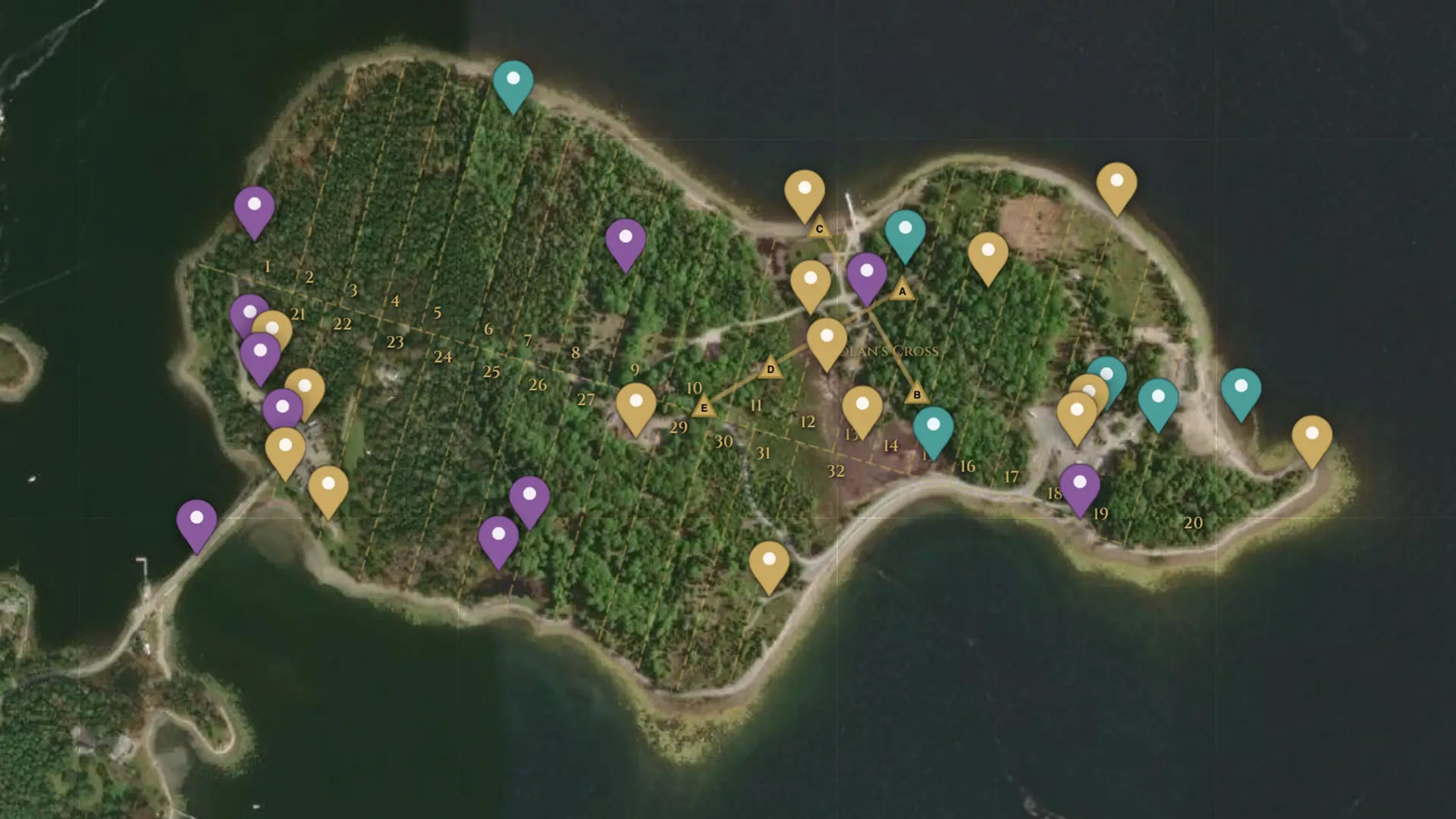
Oak Island Locations
This interactive map requires JavaScript. Below is a list of all mapped locations.
-
Lab & Interpretive Center (Lot Lot 21) — The Oak Island lab is a small, purpose-equipped laboratory located within the Interpretive Centre. It serves as a workspace for artifact analysis and testing, including metallurgical studies, soil and
-
Lot 5 Stone Feature (Lot Lot 5) — The stone feature on Lot 5 is a large, rectangular buried structure (30-40 ft long) with a smaller circular stone depression nearby. It appears deliberately constructed and concealed.
-
Stone Road (Lot Lot 15) — The team uncovered a stone-paved roadway feature beneath swamp muck during excavations beginning in 2020-2021, thought to be a deliberately laid stone path possibly used to move heavy loads from a swa
-
Eye of the Swamp (Lot Lot 11) — A roughly circular depression in the swamp, often filled with water, that appears distinctly different from the surrounding terrain. It is considered a central feature of the swamp’s mystery, with tre
-
Boulderless Beach (Lot Lot 19) — A roughly 100-foot-long stretch of beach on Oak Island's northeastern shore that is curiously devoid of large rocks, while the surrounding shoreline is littered with boulders. The anomaly has puzzled
-
Kingdom Stone — A large flat stone of red granite, buried just below the surface near the southern end of Nolan's Cross. The stone was discovered in May 2003 by Norwegian researcher Petter Amundsen during a three-day
-
Cave-in Pit (Lot Lot 19) — In 1878, a farmer named Sophia Sellers was ploughing a field when the ground suddenly collapsed beneath her oxen, revealing a deep sinkhole approximately 350 feet east of the Money Pit. The site was n
-
Isaac's Point (Lot Lot 20) — Isaac's Point is the easternmost tip of Oak Island, a rocky promontory jutting into Mahone Bay. Named after one of the island's early settlers, it has become a productive metal detecting area for the
-
Joudrey's Cove (Lot Lot 11) — Joudrey's Cove is a sheltered inlet on the northern shore of Oak Island, facing the mainland across the narrow channel. Historically one of the island's primary landing points before the causeway was
-
McGinnis Foundation (Lot Lot 21) — The stone ruins of the homestead built by Daniel McGinnis, the man traditionally credited with discovering the Money Pit in 1795. McGinnis, recorded as Donald McInnes in tax records, was not the teena
-
Quadrilateral boulder formation (Lot Lot 13) — A buried 32-foot boulder formation discovered by Fred Nolan in 1993, consisting of three layers of deliberately stacked multi-ton stones sealed with blue clay. Excavated in Season 10, the site yielded
-
Old Saw Mill site (Lot Lot 1) — Site of a sawmill built by Clarence James Beamish after he purchased the lot in the 1930s. Beamish operated the mill for lumber on the island. Stone foundation remains and hand-forged nails have been
-
Oak Island Memorial (Lot Lot 22) — Monument erected in 1995 by Dan Blankenship to mark the bicentennial of the Oak Island treasure hunt. The memorial honours the six men who lost their lives in pursuit of the treasure. The inscription
-
Former Dan Blankenship house (Lot Lot 22,23) — Former home of legendary treasure hunter Dan Blankenship, located at Lot 23. After reading a Reader's Digest article in 1965, Blankenship left his contracting business in Florida and moved to Oak Isla
-
Stone Cairns (Lot Lot 15) — Five pyramid-shaped stone constructs arranged on Lot 15, originally dubbed "Pirate Piles" by the late Fred Nolan. The cairns point toward the swamp. In Season 11, archaeoastronomer Professor Adriano G
-
Well on Lot 11 (Lot Lot 11)
-
Well on Lot 21 (Lot Lot 21)
-
The Garden Shaft (Lot Lot 18) — The Garden Shaft is one of several shafts dug in the immediate vicinity of the Money Pit by various treasure-hunting expeditions. Named for its location near what was once a garden area, the shaft has
-
Research Center (Lot Lot 2) — Research Center of the Oak Island Team
-
Large Boulder (Lot Lot 8)
-
Rock Wall (Lot Lot 26) — Dry stone wall near the 13th-century well on Lot 26. Charcoal from within the wall has been carbon-dated to as early as 1464. Portuguese researcher Francisco Nogueira identified the double-wall constr
-
Dave Blankenship House (Lot Lot 23) — House of Dan Blankenship's son Dave.
-
Tom Nolan's House
-
The Money Pit (Lot Lot 9 / Lot 10) — The original excavation site discovered in 1795 by Daniel McGinnis, John Smith, and Anthony Vaughan. They found a circular depression beneath an oak tree with a tackle block hanging from a branch. Dig
-
Smith's Cove (Lot Lot 4) — The eastern beach area where an elaborate drainage system was discovered. Beneath the sand, searchers found five box drains converging into a single tunnel that led to the Money Pit - an ingenious f
-
The Swamp — A triangular swamp near the island's center that Fred Nolan believed was man-made. Draining and excavation revealed it may have been a dry dock or ship repair facility. The swamp has yielded some of t
-
Nolan's Cross (Lot Lot 10 / Lot 14) — Five large, cone-shaped boulders arranged in the form of a cross were identified by surveyor Fred Nolan in the 1980s. The formation measures approximately 360 feet from top to bottom and 290 feet acro
-
Borehole 10-X (Lot Lot 5) — A 235-foot deep shaft drilled by Dan Blankenship in 1970. An underwater camera lowered into a cavity at the bottom captured controversial images that some believe show a severed hand, wooden chests, a
-
The Stone Triangle (Lot Lot 19) — A triangle formed of beach stones on the island’s south shore was documented in the latter half of the 19th century. It was reportedly noted by Captain Welling sometime in the late 1800s, though no ex
-
The War Room (Lot Lot 21) — The research and operations center used by the Lagina brothers and their team. This is where the team meets to discuss findings, review evidence, and plan excavation strategies. Featured prominently i
-
Samuel Ball's Property (Lot Lot 25) — The former property of Samuel Ball, a freed enslaved person who settled on Oak Island in the late 18th century and became one of Nova Scotia's wealthiest landowners. His unexplained wealth has led to
-
The Stone Well (Lot Lot 26) — A stone-lined well on the western side of the island, more than half a mile from the Money Pit. The water in this well never freezes during Nova Scotia's harsh winters. Water sampling revealed signifi
-
The Causeway (Lot Western End) — The man-made causeway connecting Oak Island to the mainland at Crandall's Point. Built in 1965, it replaced the need for boat access. Before the causeway, the island's isolation was a key factor in th