About This Artifact
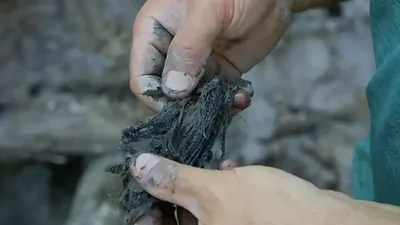
A second set of parchment-like fragments recovered from continuing Borehole H-8 sifting work during Season 6 Episode 13, aired 12 February 2019. Jack Begley and Charles Barkhouse, sorting through spoils extracted from depths below 168 feet during the Irving Equipment crew's effort to recapture the Chappell Vault, identified a scroll-like piece of fibrous organic material together with additional pieces of possible parchment and leather. The recovery extended the H-8 organic record beyond the Season 5 fragments that medieval bookbinding expert Joe Landry had earlier identified as genuine parchment and vegetable-tanned calf leather consistent with materials used in books that can survive two thousand years.
At the Oak Island Research Centre, Craig Tester, Jack Begley, Paul Troutman, and Doug Crowell examined the finds under a digital microscope at magnifications of up to 2,000 times. They identified what appeared to be leather bookbinding with traces of color, and paper or parchment fragments bearing red and yellow pigment. Doug Crowell observed that the coloring resembled the illuminated drop caps used in medieval manuscripts, where large decorative letters marked the opening of chapters in religious texts. The red and yellow palette is consistent with the iron oxide and orpiment or vermilion pigments commonly used in European illumination from the early medieval period onward.
Alex Lagina and historian Doug Crowell brought the fragments to medieval book expert Joe Landry at the Nova Scotia School of Art and Design in the following episode, Season 6 Episode 14, aired 26 February 2019. Working with his apprentice Katherine Taylor, Landry soaked and unfolded the paper fragments using surgical forceps, then examined them with lab technician Fergus Tweeddale under a polarized light microscope at 100 times magnification. Tweeddale and Landry identified a crystalline substance on the paper that they considered likely to be cinnabar, a red mineral used in medieval and Renaissance ink production from as early as the 9th century. On the basis of the cinnabar identification and the fragments' construction, Joe Landry estimated the paper could date anywhere from the 1300s to the 1600s. The estimate is consistent with the Season 5 H-8 finds Landry had earlier identified as parchment and vegetable-tanned calf leather of the type used in books that can survive for two thousand years. A subsequent recovery in Season 6 Episode 19 of purple-stained wood from a separate borehole was identified by Landry as colored with an ancient dye used in manuscript production throughout the Middle Ages, extending the documented record of medieval-era manuscript materials in the Money Pit area.
Historical Context
Jack Begley and Charles Barkhouse recovery; Craig Tester, Paul Troutman, and Doug Crowell microscopic examination at the Oak Island Research Centre; The Curse of Oak Island Season 6 Episode 13 "The Paper Chase" (12 February 2019)
Where It Was Found
Found at Borehole H-8 spoils, Money Pit area. Location: the original 1795 excavation shaft on Oak Island, Nova Scotia.