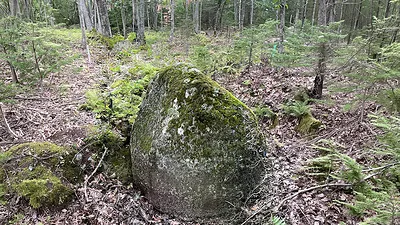
On Lot 8, archaeologist Fiona Steele continues excavating beneath the site of the 40,000-pound boulder removed one week earlier from its artificially placed ring of support stones. As she clears backfilled soil, a tightly packed layer of flat stones emerges in a mosaic-like pattern unlike anything previously encountered on the island. Dr. Ian Spooner visits the dig and confirms the formation is not natural, noting organic matter surrounding the stones and a circular cradle of rocks visible around the base. When Rick Lagina sees the feature for the first time, he calls it culturally significant and almost certainly European, pointing to the knowledge of physics and geometry required to build such a platform. Marty Lagina, joining by phone, draws a comparison to the stone road uncovered in the southeast corner of the swamp in 2020, a feature believed to be at least 500 years old and possibly of Portuguese origin. With no artifacts recovered from the immediate area, the team interprets the absence as a further sign of age.
In the northwestern swamp, Tom Nolan leads a search near Cone D, one of the six massive boulders forming Nolan's Cross. Digging along the projected line of the cross, the team uncovers a large stone that appears deliberately split in two, sitting precisely on the alignment. Below it, a concentrated pocket of grayish-blue clay emerges, matching material previously found on Lot 5 and in 19th century Money Pit excavations; blue clay was historically used to seal shafts and chambers against water penetration. An axe-cut wooden survey stake also turns up pounded into the ground alongside the split rock, roughly 75 to 100 feet from Cone D. The stake is consistent with the octagonal survey stakes found elsewhere in the swamp, which Professor Adriano Gaspani recently argued were placed in the 13th century by members of the Knights Templar as part of the same layout that produced Nolan's Cross. Rick notes the find makes sense as a sighting post for anyone laying out the cross line across the bog.
In the Money Pit area, the Karma-1 shaft pushes steadily deeper. At roughly 155 feet, the caisson encounters hard resistance, and metal detection expert Gary Drayton and Terry Matheson recover metal plate fragments that may be pieces of a shoe, or bottom brace, from the Chappell Shaft, the nearly 160-foot excavation built in 1931 by Frederick Blair, William Chappell, and his son Melbourne. Gypsum appears in the spoils around 160 to 170 feet, confirming the shaft has reached the bedrock plateau above the solution channel. Once through, pipe fragments surface at around 180 feet; Rick observes the pipe is thinner than the six-inch variety Dan Blankenship used in the 1960s, suggesting an earlier origin, possibly from the mid-1800s Truro Company operation during which foreman James Pitblado reportedly recovered a 14th century Portuguese silver coin. By day's end the shaft reaches 212 feet, and Adam Embleton's crew from Soletanche Bachy Canada lifts the caisson to let suspended material settle overnight before cleaning the bottom with a dig bucket the following morning.
At the wash plant near Smith's Cove, where Billy Gerhardt's industrial grizzly bars, chopper, and shaker deck process Karma-1 spoils, the team recovers two pieces of hand-forged chain from the deep material. Bailey spots the first, a length of small, non-uniform links that Charles Barkhouse and Jack Begley believe could predate the 1850s. Aaron finds the second, which Gary examines closely, identifying striations and individually made links consistent with 1600s or 1700s craftsmanship. He points to the small gauge as telling: too light for hauling, it is the type of chain that might have secured a chest with a lock. Craig Tester and Steve Guptill monitor operations through the day as Quinton relays updates from the drilling crew.