About This Artifact
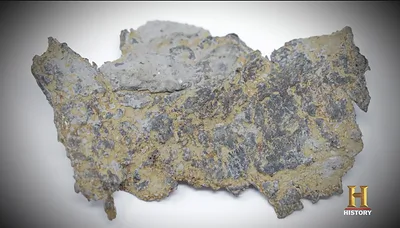
Two sections of hand-forged iron chain recovered from the spoils of the Karma-1 shaft during Season 13. The chains were found at depth in material processed through Billy Gerhardt's industrial wash plant near Smith's Cove. Bailey spotted the first piece, a length of small, non-uniform links that Charles Barkhouse and Jack Begley believed could predate the 1850s. Aaron found the second, which Gary Drayton examined closely, identifying striations and individually made links consistent with 1600s or 1700s craftsmanship. He pointed out that each link had been forged separately rather than machine-produced, a hallmark of pre-industrial ironwork.
Blacksmithing expert Carmen Legge examined both chain sections in the lab and identified elongated end links consistent with basket-style rigging used for lowering items into a shaft or hold. He concluded that two different blacksmiths had made the chains, based on differences in link shape and forging technique. Emma Culligan's compositional analysis dated the iron to the late 1600s to mid-1700s and confirmed a European origin. Doug Crowell connected the date range to the Duc d'Anville expedition of 1746, in which a French naval fleet with Templar family connections sailed to Nova Scotia.
The Karma-1 chains joined a growing inventory of chain artifacts recovered from Oak Island across multiple seasons, including gold chain links from the original Money Pit excavations, an iron chain link from borehole S-6, a lifting chain from a wharf structure, and hand-forged oval chain links found on Lot 8 near the massive boulder feature. Carmen's identification of basket-style rigging links carried particular weight: it suggested the chains were not merely stray hardware but functional equipment used for moving heavy objects vertically, consistent with the lowering of cargo into a deep shaft.
Historical Context
Carmen Legge, Emma Culligan, Gary Drayton
Where It Was Found
Found at Karma-1 shaft spoils. Location: the original 1795 excavation shaft on Oak Island, Nova Scotia.