On Lot 8, archaeologists Laird Niven and Fiona Steele continue excavating the cradle-shaped stone feature beneath the 40,000-pound boulder, with Alex Lagina and Craig Tester observing. Fiona reports they are not yet near the bottom and notes that tests on mortar found within the cradle could date the construction to the 1200s. After Alex helps remove a large rock, Fiona uncovers several layers of slate beneath it, and Laird points out that the soil and rock composition in her working area differs from other sections of the feature. Rick Lagina and Scott Barlow arrive to inspect the progress, and Rick instructs the team to keep digging deeper.
In the Money Pit area, the Peacock-1 shaft approaches 150 feet, the depth at which a ten-foot void was identified earlier this season and where an underwater camera recorded what appeared to be man-made workings and metallic objects. A bucket of spoils comes up loaded with cobble, but Gary Drayton detects no metal. Terry Matheson notes how water-washed the boulders are, suggesting an open space. The following day the shaft reaches 170 feet, and Charles Barkhouse arrives with a piece of cement recovered from the Peacock-1 spoils at the wash plant, pulled from roughly 150 feet down. The team considers whether it could be a fragment of the cement vault that William Chappell and Frederick Blair reportedly drilled through in 1897, when traces of gold and a piece of parchment were found on the drill bit. Peacock-1 eventually reaches bottom at 210 feet without revealing the structure the team had hoped for, and Rick, visibly disappointed, tells the group they need to decide where to dig next.
On the western side of the swamp, Peter Fornetti, Gary Drayton, and Billy Gerhardt work to expose more of the sand-covered road. As Billy removes material, Peter pulls out two eight-sided stakes that appear to mark the edges of the road, which is now well defined by rows of rocks on either side. Alex Lagina notes the road appears to be heading toward the Portuguese stone road in the southeast corner of the swamp. The next day, Dr. Ian Spooner joins Rick and other team members at the site and requests a crosscut trench to look for datable organic material beneath the sand. Billy digs the trench, revealing a clear layered construction: sand on top, organic material beneath, and rocks at the base. Metal detection expert Katya Drayton recovers what appears to be an ox shoe nail, and the team finds pieces of cut wood embedded in the road. Billy points out that the layered construction matches the Portuguese stone road, and Spooner collects an embedded stick for carbon-14 dating before requesting a second trench in a different area.
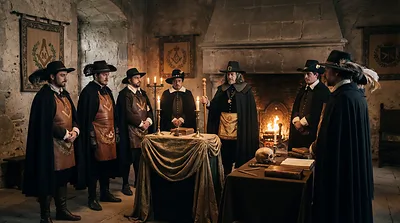
In the War Room, the team meets by video with Canadian researcher and 32nd-degree Mason Scott Clarke, who presents findings he calls "From Nazareth to Nova Scotia." Clarke revisits the 1762 map of Mahone Bay drawn by Charles Morris, highlighting a letter A with a distinctive V-shaped crossbar that points directly at Oak Island when extended. He identifies the same symbol on the Titulus Crucis, a wooden tablet housed in Rome's Basilica of the Holy Cross believed to have been placed above the head of Jesus during the crucifixion. Clarke connects the symbol to Templar churches across Europe, to A-shaped carvings photographed by Corjan Mol at the Convent of Christ in Tomar, Portugal, and to pentacles engraved on Portuguese Templar gravestones. He notes that Portugal and the Azores are the only regions whose flags incorporate the five wounds of Christ, and Doug Crowell ties the Azores connection to the Pitblado coin. Clarke concludes that a piece of the true cross may have been buried alongside Templar treasure on Oak Island.
At the wash plant, Derek Couch recovers a round stone from the Peacock-1 spoils, and Charles Barkhouse identifies it as a possible Portuguese stone shot similar to examples previously found in the Money Pit and on Lot 15, both traced to the Azores and Madeira Islands. In the lab, archaeometallurgist Emma Culligan performs a CT scan and identifies peck marks consistent with stonemasonry. Laird Niven dates stone shot of this type to the 14th and 15th centuries, and Jack Begley notes the timeframe aligns with the Pitblado coin. Rick Lagina later updates Marty Lagina by video, and Marty suggests sending the stone shot to Dr. Raeside at Acadia University for geological analysis to determine whether it matches the volcanic origin of the earlier finds, while also recommending that Dr. Ian Spooner and Dr. Christa Michels advise on the next drilling location.