In the Money Pit area, Rick and Marty Lagina and their team drill borehole BN-14 in the Peacock, just three feet west of where a ten-foot void was discovered at 148 feet two weeks earlier, an area that yielded sonar images of a possible offset treasure chamber. Driller Adam pushes through increasingly soft material, but the void is not encountered at the expected depth. Steve Guptill and the team continue downward into the solution channel at roughly 198 feet, where an unusual deposit of sand suggests a clear path of water movement. Dr. Ian Spooner notes that the water in this area carries high metal content and explains that if a till containing gold were washed, the precious metals would be left behind in the sediment. He collects a large soil sample for lab analysis, supplementing the new XRF testing procedure he has already begun on deep solution channel soils from boreholes drilled 50 feet to the southwest.
On Lot 8, Rick, Peter Fornetti, and archaeologists Laird Niven and Fiona examine the massive boulder that Laird discovered one week ago sitting atop a ring of evenly spaced stones. Peter feeds an inspection camera into the void beneath the boulder and follows it for roughly four feet before hitting compact soil, which the team interprets as possible backfill. Doug Crowell connects the feature to the December Triangle marked on a 14th-century map attributed to the Knights Templar that the late researcher Zena Halpern presented to the team in 2016. In a later visit, the archaeological team uncovers flat granite slabs near the boulder that geologist Terry Matheson identifies as flagstones, a stone type he has not seen elsewhere on the island. The find echoes the original 1795 discovery of the Money Pit, when Daniel McGinnis, Anthony Vaughan, and John Smith encountered a uniform layer of flagstones at two feet depth that appeared to seal whatever was buried below.
In the northern region of the swamp, Craig Tester, Tom Nolan, and the team uncover another eight-sided survey stake pointing toward the brick-and-slate vault discovered the previous year. Excavator operator Al exposes a stone structure at least three rocks thick built on top of swamp peat, prompting the team to call in Dr. Spooner, who collects a cut piece of wood from the peat layer for dating. Multiple bricks resembling those from the nearby vault are also recovered, strengthening the possibility that a second vault may exist in this area.
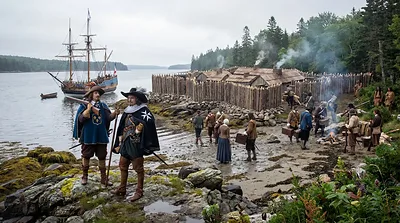
In the War Room, historian Emiliano Sacchetti presents the results of nearly a year of research conducted in Rome, the Vatican archives, Ottawa, and Library and Archives Canada into the presence of the Knights of Malta in Nova Scotia. He focuses on Isaac de Razilly, a wealthy French naval captain and Knight of Malta who in 1632 led 300 men to establish the colony of Acadia and built his headquarters at Fort Point on the LaHave River, just 15 miles south of Oak Island. Emiliano cites a journal kept by de Razilly's companion Nicolas Denys that describes sailing from LaHave to the head of Mahone Bay, where they found 'some other island with big oaks.' He then reveals his most significant finding: two inventories of de Razilly's possessions compiled after his sudden death in July 1636, one taken in Nova Scotia and one upon delivery to the family in France, show that several items went missing between the two, including a copper astrolabe, two flintlock muskets, and two leather-covered chests. Emiliano connects the missing flintlock muskets to the 17th-century flintlock plate Gary Drayton and Marty found on Lot 8 in 2021. The team agrees to visit Fort Point to pursue the de Razilly connection further.
Gary Drayton and Scott Barlow search Lot 8 near the boulder and recover a lead splash that may be related to the 700-year-old bag seal found nearby by Katya, and then pull from the ground several links of hand-forged oval iron chain, found roughly 20 yards west of the boulder. In the lab, Emma Culligan's CT scan reveals the links were forged with no butt-ends or visible welding, and the composition reads 99 percent pure iron with traces of phosphorus, all indicators pointing to a pre-1800s date. Emma places the chain comfortably in the 1600s with the technical possibility of the 1500s. Heavy wear patterns on the curved sections indicate the chain endured significant workload, and its proximity to the boulder and the recently discovered line of ox shoes leading toward the feature raises the possibility that it was used to haul or position the massive stone. Rick notes the dates align with Isaac de Razilly and the Knights of Malta, adding another layer of circumstantial evidence linking the order to Oak Island.