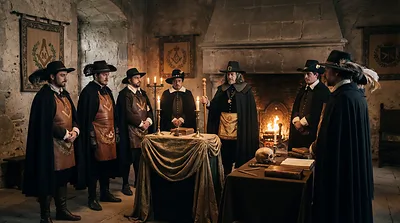
The season's most ambitious Money Pit operation runs into an immediate obstacle when the TPF-1 caisson seizes up at just 25 feet, pinned in compacted backfill gravel from a previous shallow excavation. Unable to advance the steel casing or extract it, Rick and Marty Lagina, Craig Tester, and Scott Barlow convene to reassess. With the equipment needed to free the original shaft still two days away, the team moves to a new location designated Karma-1, positioned near borehole H.5-8.5 where drilling earlier in the season recovered a section of pipe possibly connected to the Truro Company's 1849 operation, the same year that drilling foreman James Pitblado reportedly brought a 14th-century Portuguese silver coin up from the original Money Pit. Karma-1 also sits within a zone of elevated silver and precious metal readings in the solution channel, and Peter Fornetti and Charles Barkhouse oversee operations as the auger begins its descent.
In the northern region of the swamp, Craig joins Tom Nolan, Gary Drayton, Alex Lagina, and Billy Gerhardt as work continues on the cobblestone pathway and the growing line of eight-sided wooden survey stakes emerging along the swamp's edge. Surveyor Steve Guptil records the precise position of each stake, building a map intended to test whether they correlate with other swamp features: the brick-and-slate vault, the stone road in the southeast corner, and the paved area near the center carbon-dated to as early as the 13th century. While clearing material near the cobble, Gary's detector registers a nonferrous signal. The recovered object is a small, encrusted disc of copper alloy bearing a visible design on one face, resembling a crest or coat of arms, and Alex and Gary transport it directly to the lab.
On Lot 8, archaeologist Laird Niven grants permission to lift the 40,000-pound boulder using a 130-ton crane. Prior weeks of hand excavation had already revealed evenly spaced stones holding the boulder in position and a backfilled void beneath it. When the crane raises the boulder clear, the ground below contains dark organic material where undisturbed glacial soils from 10,000 years ago should be. Laird states the conclusion is unambiguous: the natural substrate was deliberately removed, confirming the boulder was moved into its position by human hands. Gary sweeps the pit with his metal detector and records no signals, though Alex notes this is consistent with other known hand-dug shafts on the island where no surface metal has ever been recovered. Fiona Hile and the archaeology crew begin careful sampling of the exposed soils, and Dr. Ian Spooner returns later with a Vanta XRF spectrometer. His scan detects silver and copper alongside the elevated lead already documented in earlier samples, prompting Fiona to suggest the metals may be leaching upward from something buried considerably deeper below the feature.
In the lab, Laird and Emma present their findings on the swamp artifact. It is not a coin but a piece of exonumia, a nongovernment-issued commemorative token: specifically a Washington Funeral Medal dated 1800 and designed by Jacob Perkins of Newburyport, Massachusetts, a Mason and inventor known for his anti-counterfeiting work on U.S. currency. The medal bears the likeness of George Washington on one face and a funerary urn on the reverse, with a deliberate hole at the top designed for wearing at the official memorial service on February 22, 1800. Marty connects the find to a persistent pattern of Masonic involvement in the Oak Island story, noting that figures such as Daniel McGinnis, Melbourne Chappell, and Franklin D. Roosevelt have been linked to nearly every major treasure hunt on the island. Researcher Cort Lindahl's 2018 theory, that members of the Rochefoucauld family with Templar ties dating to the 12th century may have introduced George Washington to knowledge connected to Oak Island, takes on new weight. Rick notes that whoever carried a memorial token of Washington's 1800 funeral service into the north end of the bog did so just five years after the Money Pit was first discovered, and likely had direct knowledge of activity on the island.
Two days later, the team gathers for a War Room videoconference with archaeoastronomy expert Professor Adriano Gaspani, accompanied by translator Marzia Sebastiani. Emiliano Secondini had commissioned the analysis following Gaspani's 2022 peer-reviewed study, which concluded that the six boulders of Nolan's Cross were placed around 1200 AD based on their historical alignment with Deneb in the Cygnus constellation. Gaspani now applies the same methodology to Steve Guptil's GPS survey of the swamp stakes: the eight-sided stakes divide into two groups, both sharing stellar alignments with Deneb consistent with a 13th-century construction date, and matching the alignments found in Nolan's Cross. His conclusion is that both features were created by Europeans with Templar cultural knowledge, working to a coordinated plan. Steve observes that if the stakes represent a survey from the 1200s, a broader master plan of the island must once have existed and may still. Rick calls for investigation of the stem of Nolan's Cross, which passes through the bog not far from where the stakes were recovered, and the team agrees the swamp will remain a central focus as the season advances.