Teams from ROC Equipment and Soletanche Bachy Canada arrive on Oak Island with a 135-ton telescoping drill rig to begin excavating the TPF shaft, a seven-foot-diameter steel caisson aimed at reaching the solution channel more than 200 feet below the Money Pit. Two boreholes, I-9.5 and K-9.5, have already yielded elevated traces of silver in soil samples, and the team believes the source may be connected to a 14th-century Portuguese coin reportedly found in the Money Pit in 1849 by foreman James Pitblado, a coin linked to the Knights Templar. Rick Lagina invites metal detection expert Gary Drayton and Katya Drayton to officially start the drill, which Gary names "Top Pocket Find." Progress is swift at first, but the auger locks up at just 20 feet after hitting dense gravel backfill from a previous excavation. Vanessa Lucido of ROC and Adam Embleton of SBC explain that a hydraulic oscillator could break through, but the reduction inserts needed to fit the eight-and-a-half-foot canisters are delayed by at least two days. Marty Lagina, Craig Tester, and Scott Barlow weigh whether to wait or move to a second target location where no cobble backfill is expected.
In the northern region of the swamp, Rick, Craig, Gary, and Tom Nolan continue following the cobblestone path lined with octagonal wooden survey stakes that led them to an empty brick-and-slate vault the previous year. Rick spots pieces of old leather shoe with hobnail holes rather than stitching, recalling a similar European-origin boot fragment found near the Portuguese stone road in 2023. The excavator bucket then drops roughly five feet into a man-made void surrounded by solid ground, and another octagonal stake surfaces from the spoils, aligning with the projected stake line. Further digging produces three thick wood planks, each over an inch thick and twelve inches wide, joined by a nail that Rick believes could indicate a chest or structure. Katya then recovers a heavy iron object from deep in the peat that appears to be a key, its shape and weight consistent with older ironwork. Rick calls it the most unique find in this end of the bog to date and notes its proximity to the vault discovered the year before.
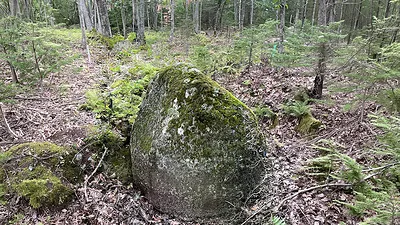
In the lab, blacksmithing expert Carmen Legge examines a possible knife handle that Rick and Katya found south of the Lot 8 boulder feature, in the same area where potentially 16th-century chain links were recently discovered. Carmen identifies it not as a knife but as a component of a ratcheting mechanism, possibly part of a pulley or lever system, made from clean European iron consistent with the 1700s or earlier. On Lot 8, Rick, Marty, and the team then meet with crane operator Corey Robart to plan the removal of the massive boulder, which sits above a ring of evenly spaced stones and covers a backfilled void where a snake camera previously recorded images of possible tools and a gold-colored material. Archaeologist Laird Niven has authorized the lift, and Corey proposes using a 130-ton crane with steel pins and a chain sling system while Billy Gerhardt clears the access road and surrounding trees.
In the War Room, Craig presents preliminary carbon-14 results on the leather shoe fragments recovered from the swamp. The primary date range falls between 1148 and 1216 AD, with some readings extending back as far as 1047, placing the leather potentially over 800 years old. Rick connects the dates to the work of Italian archeoastronomy professor Adriano Gaspani, whose peer-reviewed research concluded that the megalithic formation known as Nolan's Cross was likely constructed in the early 13th century by members of the Knights Templar. The paved area in the swamp, scientifically dated to approximately 1200 AD, aligns with the same period. Craig urges caution, noting that Beta Analytical has been asked to run additional cleaning methods and retest the samples to confirm the results, but Rick sees a run of 13th-century data points that places large-scale activity on Oak Island squarely within the era of Templar power.
'