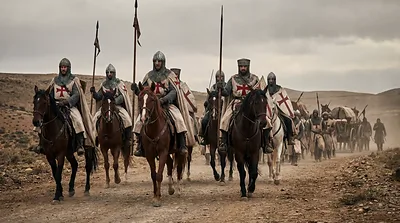
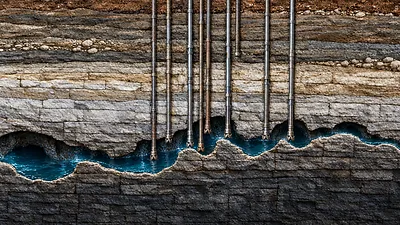
In the War Room, Rick and Marty Lagina, Craig Tester, and their team meet virtually with Vanessa Lucido of ROC Equipment and Adam Embelton of Soletanche Bachy Canada to plan the season's pivotal Money Pit excavation. Marty sets a target depth of 230 feet for every hole, aiming to reach the bottom of the solution channel where recent soil testing has confirmed a massive source of silver. Lucido and Embelton outline a telescoping method: an 8.5-foot-diameter caisson for the first 130 feet, narrowing to seven feet for the remaining depth. The operation will deploy a giant auger bit mounted on a 135-ton rotary drill rig capable of grinding through gypsum and anhydrite far more efficiently than the hammer grab tool used in previous seasons. A drilling bucket with rock teeth will replace the auger once the solution channel is reached to safely remove spoils. Marty notes the serendipity of using an auger given the Pitblado incident, the 1849 operation during which drilling foreman James Pitblado reportedly recovered a 14th-century Portuguese coin linked to the Knights Templar from auger cuttings in the Money Pit area.
Dr. Ian Spooner joins the team on Lot 8 to collect soil cores from beneath the massive boulder feature, where a snake camera has previously captured images of a possible iron stake and what appeared to be a pearl. Spooner extracts sediment from directly under the boulder, looking for elevated metals including gold, silver, lead, zinc, copper, and tin that might reveal a human signature and help date when the boulder was placed. Nearby, Billy Gerhardt has plowed the topsoil so that Marty and Gary Drayton can search for artifacts connected to the feature. Gary recovers a small iron chopping knife he dates to the mid-1700s and a hand-forged iron pintle, a type of pivot pin used for door and gate hinges dating as far back as 2000 BC, similar to one found on Lot 15 earlier in the season. The blistering on the pintle suggests considerable age, and its proximity to the boulder supports the view that the feature was deliberately constructed.
In the northern region of the triangle-shaped swamp, Rick, Tom Nolan, Peter Fornetti, and members of the team continue excavating sections of cobblestone pathway marked by eight-sided survey stakes. The cobble appears to form two distinct platforms with a possible road between them, and the stake line turns west toward Lots 5 and 8, suggesting a potential connection to the boulder feature. Gary recovers a hand-forged iron tool from the same depth as the cobblestones, reminiscent of the pickax fragment pulled from the spoils of TOT-1 the previous year at roughly 160 feet, an artifact that may predate the discovery of the Money Pit by more than two centuries. He also finds a heavy lead object bearing mold marks that neither he nor Rick can immediately identify, and two pieces of wooden keg barrel, one a top and the other a bottom, recovered from deep in the bog. Gary notes that the French, English, and Spanish historically used kegs to transport and store treasure coins, and suggests that lab analyst Emma Culligan may be able to determine through XRD testing what the keg once contained.
Back in the War Room, Dr. Spooner presents his preliminary findings to the full team. Lead levels in the organic matter beneath the boulder register at 140 parts per million, more than eleven times the normal baseline of 12 parts per million measured elsewhere on the island. Spooner attributes the anomaly to burning or smelting activity, which would have deposited lead through condensing smoke. Rick proposes the boulder may cover a ventilation shaft, citing the ancient practice, dating to at least classical Greece, of setting fires at the base of mine shafts to force air circulation. Spooner finds the theory plausible and describes the boulder as one of the most interesting rocks on the island. The team reaches consensus that the feature must eventually be lifted, though the archaeologists, including Laird Niven, stress the importance of completing their excavation work before any heavy equipment is brought in.
Returning to the boulder site, Rick, Laird Niven, and archaeologist Fiona reinsert the snake camera after Fiona has cleared additional soil from beneath the stone. The camera reveals an extensive network of voids stretching well beneath the boulder, described as a matrix that would not occur naturally. Then, at greater depth, the camera captures images of lumps with golden, yellowy veins running through them. The team observes that the material has the color and luster of gold. Rick calls it potentially the most substantial discovery ever made on the island and argues there is no longer any reason to delay lifting the boulder. The archaeologists agree they have reached the limit of what can be accomplished without removing it and give their approval to proceed. The team begins planning to bring in a crane to lift the boulder.