About This Structure
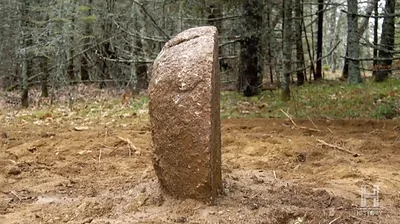
Massive boulder feature on Lot 8 that has become one of the most significant investigative targets on Oak Island. The boulder was manipulated by human hands and held in place by smaller stones placed evenly around its perimeter, a construction technique reminiscent of megalithic sites in France and northern Spain where large stones were deliberately positioned and supported by smaller keystones. The formation conceals a large void underneath that extends into an extensive network of chambers described as a matrix that would not occur naturally. Dr. Ian Spooner conducted soil analysis of sediment extracted from directly beneath the boulder. Lead levels registered at 140 parts per million, more than eleven times the normal baseline of 12 parts per million measured elsewhere on the island. The lead is migrating through layers of ash and coal consistent with burning or smelting activity. Rick Lagina proposed the boulder may cover a ventilation shaft, citing the ancient practice dating to classical Greece of setting fires at the base of mine shafts to force air circulation while smoke rose through a separate channel. Spooner found the theory plausible and described the boulder as one of the most interesting rocks on the island.
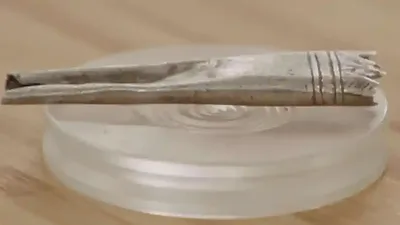
A snake camera inserted beneath the boulder captured images of a possible iron stake, what appeared to be a pearl, and at greater depth, lumps with golden, yellowy veins that the team observed had the color and luster of gold. Rick called it potentially the most substantial discovery ever made on the island. The archaeologists, including Laird Niven, gave approval to proceed with lifting the boulder using a crane, setting the stage for one of the most anticipated operations in the history of the Oak Island treasure hunt. Artifacts recovered from the surrounding soil include a hand-forged iron chopping knife dated to the mid-1700s and a hand-forged iron pintle of a type dating as far back as 2000 BC, both found by Gary Drayton after Billy Gerhardt plowed the topsoil to allow metal detection.
Following the crane operation, archaeologist Fiona Steele excavated directly beneath the boulder's former position, uncovering a tightly packed mosaic-like layer of flat stones unlike anything previously documented on the island. Dr. Spooner confirmed the formation is not natural, noting organic matter surrounding the stones and a circular rock cradle at the base. Rick described the feature as culturally significant and almost certainly European, citing the geometry and physics knowledge required to construct such a platform. The absence of artifacts from the immediate area was taken as a further indicator of age.
Continued excavation of the cradle revealed layers of slate beneath the stones, and Laird Niven noted that the soil and rock composition varies across different sections of the feature. Tests on mortar found within the cradle could date the construction to the 1200s, consistent with the earliest activity detected elsewhere on the island.
In S13E22, archaeologist Fiona Steele continued bisecting the cradle to study its construction in cross section, eventually reaching what appeared to be the C horizon, the sterile natural soil layer marking the base of cultural activity. Without striking bedrock, the team could not confirm that the feature did not extend further. In S13E23, Marty Lagina dug an adjacent trench beside the cradle and struck slate bedrock at six feet, a level noticeably higher than the depth Fiona's hand excavation had reached inside the cradle without finding rock. Because eastern Oak Island bedrock runs flat and uniform, the drop-off at the cradle's interior is strong evidence that the boulder feature sits inside an earlier excavation and may cap a man-made shaft.
In the season finale (S13E25), Dr. Spooner used a hammer drill to test the cradle floor. Two three-foot test holes returned material that Laird Niven judged too soft for bedrock, and a control hole in nearby slate confirmed the reading by hitting significantly harder material. The cradle's floor is not natural rock. Marty Lagina ended the season by stating the feature could not be considered finished until the team understood what lay at its base, and signalled an intent to eventually excavate beneath the stone.
Material analysis from beneath the boulder also returned trace metals: silver and copper alongside the previously documented elevated lead, prompting Fiona Steele to suggest the metals may be leaching upward from something buried considerably deeper. Soil compositional analysis by Emma Culligan placed the binder material between post-1200s and pre-mid-1700s, with both Culligan and Spooner describing the feature as premodern and possibly medieval. The dating window aligns with the carbon-14 floor of 1148 to 1216 AD established by leather shoe fragments recovered in S13E15, with Adriano Gaspani's archaeoastronomical date of 1236 AD for the Lot 5 round foundation, and with the Pitblado coin's striking date of no later than 1371.
Historical Context
Dr. Ian Spooner, Laird Niven, Rick Lagina, Gary Drayton, The Curse of Oak Island Season 13
Where It Was Found
Found at Lot 8. Location: Oak Island, Nova Scotia, Canada.
Gallery