In the War Room, Rick and Marty Lagina and their team review snake camera footage captured beneath the massive boulder on Lot 8, where archaeologists Laird Niven and Fiona Steele have exposed a void after removing disturbed soil. The footage reveals a linear blue-tinted object that Alex Lagina believes could be an iron spike, possibly the last remnant of a wooden structure that has decayed in Nova Scotia's highly acidic soil. Searches near the boulder have already uncovered links of a chain that could be 500 years old and a potentially 700-year-old English bag seal. Rick presses to lift the boulder, but Laird and Fiona insist on completing careful hand excavation first, warning that archaeological context cannot be restored once destroyed. Marty notes that he and Rick have reached the same conclusion about the feature's importance but differ only in approach: Marty would lift the rock immediately while Rick accepts the need for patience.
In the Money Pit area, Terry Matheson and Charles Barkhouse drill borehole CN-12.5 in the Peacock, eight feet northwest of borehole BN-13.5, where three weeks earlier the drill entered a ten-foot void at 148 feet that yielded sonar images of a possible larger chamber and underwater camera images of potential metallic objects. Of 30 feet drilled between 138 and 168 feet, only 12 feet of core is recovered, the rest having washed away in loose slurry that Terry considers consistent with an opening or collapsed chamber. The poor recovery spans roughly 145 to 160 feet, a depth range the team believes corresponds to a potential offset treasure chamber connected by tunnel to the original Money Pit. Deeper cores from 188 to 208 feet show the same unconsolidated material through the solution channel, with bedrock encountered at 204 feet. Charles runs a pinpointer over the cores but detects no metal. The team collects soil samples from the loose material for lab analysis, noting that gold and other heavy objects would pass through such soft sediment with ease.
On Tom Nolan's property in the northern region of the swamp, Rick, Craig Tester, Gary Drayton, and the team recover an extraordinary volume of pottery. Laird identifies transfer-printed pearlware from the 1840s and, more significantly, pieces of coarse redware that he believes could be North Devon gravel ware dating from the 1600s to 1700s. Rick connects those dates to Isaac de Razilly and the Knights of Malta, a line of investigation the team has been pursuing since finding Venetian trade beads, buttons, and a folded coin on Lot 5. Gary also recovers a heavy curved iron object that both he and Rick interpret as a possible lifting or hauling device, perhaps a shackle or hook. Its proximity to the brick-and-slate vault discovered the previous year raises the possibility that heavy objects were moved in this area.
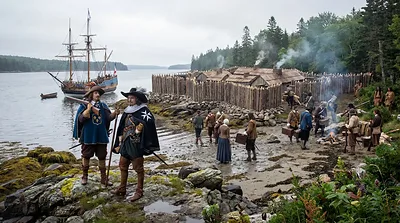
Alex Lagina, Peter Fornetti, Judi Rudebusch, and Emiliano Sacchetti travel 15 miles south to the historic site of Fort Point in LaHave, Nova Scotia, originally established as a French stronghold in 1632 by Isaac de Razilly, a high-ranking Knight of Malta who arrived with 300 elite men. Local historian and author Joan Dawson confirms that the Venetian beads found on Lot 5 are the same type de Razilly would have used for fur trading with the Mi'kmaq. She notes that de Razilly wrote to the leader of the Knights of Malta suggesting they establish a monastery in Nova Scotia, that he sailed into Mahone Bay with two local priests and that a journal from the expedition describes an island filled with oaks. Joan confirms that several of de Razilly's possessions, including chests, went missing after his unexpected death in July 1636. Emiliano presents the French flintlock plate found on Lot 8, which Joan considers consistent with de Razilly's well-armed forces. When shown one of the volumes from researcher John Edwards' book series containing Masonic codes, Hebrew writings, and a hand-drawn map of Oak Island, Joan recognizes the author Josephus and says such a book is exactly what a Knight of Malta would have kept in his library.
Back on Lot 8, Peter Fornetti operates the snake camera as Fiona guides it beneath the boulder, now more accessible after the removal of surrounding stones. At roughly two feet in, the camera captures a bright blue object that does not resemble a rock, and then, deeper still, a near-perfect circular form with an almost luminescent quality that Rick immediately identifies as looking like a pearl. Gary agrees. The team discusses next steps and decides to use a shop vacuum to clear more material from beneath the boulder, which would simultaneously collect any small objects and open enough space to push the camera further and allow Gary to reach in with a metal detector. Rick concludes that the feature was clearly created by humans who wanted to conceal something beneath the stone, and that every available resource should be applied to understanding what lies below it.