Frederick Leander Blair was born in 1867 at Thomson Station, a small community in Cumberland County, Nova Scotia. His father William and mother Susan raised him in Amherst, where he would live for most of his life and where he would eventually die, still holding the document that had defined his existence: the treasure trove license to Oak Island. Between those two points lay nearly sixty years of relentless effort, conducted almost entirely from behind a desk, that made Blair the single most important figure in the Oak Island story between the original discoverers and the Lagina brothers. He never found the treasure. He never stopped believing it was there.
Uncle Isaac's Stories
2 min
Blair first heard about Oak Island as a boy in Amherst, from his uncle Isaac Blair. Isaac had been part of the Oak Island Association and Halifax Company crews that worked on the island during the 1860s, and he carried firsthand memories of what the men had found underground. As Isaac wrote to his nephew in 1896: "I saw enough to convince me that there was treasure buried there and enough to convince me that they will never get it." The first half of that sentence lit a fire in the young Frederick Blair. The second half he chose to ignore.
Blair moved to Massachusetts as a young man and established himself in the insurance business, working out of an office in Boston. He was twenty-six years old when, in 1893, he formed the Oak Island Treasure Company, drawing on the connections and knowledge he had accumulated through his uncle and through veterans of earlier searches. One of those veterans was Adams A. Tupper, who had worked on the island in the summers of 1850, 1851, and 1863, and who swore under oath in a notarized affidavit dated November 23, 1893, that the account of operations Blair had compiled was accurate. Another was J.W. Andrews, a consulting engineer then living in Brooklyn, who had watched the digging as a nine-year-old boy in 1849 and confirmed the story of the oak tree with block and tackle, the circular cavity, and the flooding at depth.
Blair was a meticulous researcher, and he made it his business to gather as much verbal and written testimony as he could from anyone who had been involved in the earlier searches. The archive he assembled over the following decades would become the foundation on which every subsequent account of the Oak Island story was built, from the 1958 book by the Halifax lawyer R.V. Harris to the histories of the journalist D'Arcy O'Connor to the modern television series. Without Blair's records, much of the 19th-century history of the island would have been lost.
The Treasure Company Years
3 min
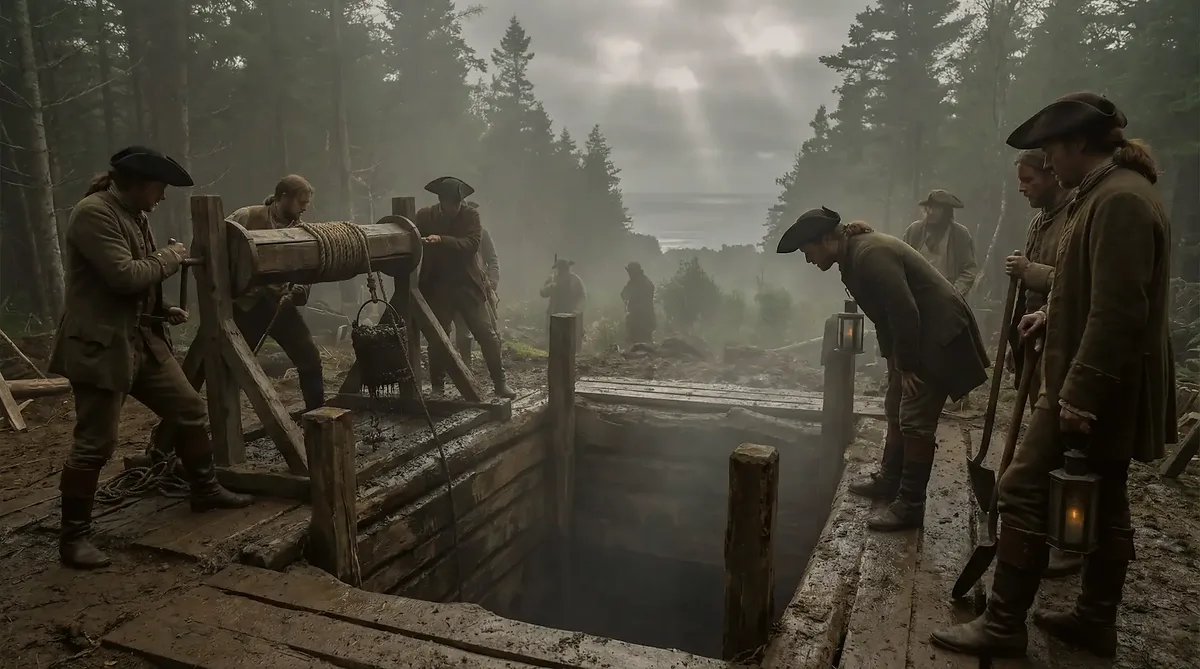
The Oak Island Treasure Company conducted operations on the island through the late 1890s, and Blair was present for some of the most significant discoveries of the era. In 1897, Captain John Welling, a member of the company, and the Treasure Company crew sank shaft number thirteen and discovered a man-made tunnel flowing with saltwater into the Money Pit. The same year, a scrap of parchment with writing in India ink was pulled from a drill bit probing the depths of the Pit, and a substance identified by the London firm of A. Boake Roberts and Company as primitive man-made cement was recovered from another boring. Blair would carry that scrap of parchment with him for the rest of his life, and it would become the single most cited piece of physical evidence in the case for a deliberate deposit.
The company's first objective was to cut off the water. Graham Harris and Les MacPhie, the geotechnical engineers who reconstructed the Treasure Company's work in Oak Island and its Lost Treasure, describe the most dramatic attempt. In 1897 the crew drilled five holes fifteen feet apart across the presumed line of the flood tunnel, about fifty feet inland from the high-water mark at Smith's Cove, each to between 80 and 95 feet. Only the center hole met anything but hard ground: at 80 feet it struck salt water and rocks, and the water in the hole rose to the level of the tide. Charges of dynamite were set off in all five holes, with 160 pounds packed into the center one. Observers at the Money Pit reported that the water in the pit began to boil and foam. The inflow slowed, but it never stopped. That same year a water diviner named Chapman, from Medford, Massachusetts, walked the island and mapped the positions of tunnels. Harris and MacPhie note that several of his tunnels matched known workings and that he placed the flood tunnel's entry into the Money Pit at 110 feet, which later work confirmed.
Convinced that a second, lower flood tunnel was feeding the pit, the company sank Shafts 14 to 20 in 1898 and 1899, to depths between 95 and 160 feet. Every one was lost, to old tunnels bursting with water or to seams of running sand near the bottom. When Shaft 18 flooded at 160 feet, the water in the Money Pit dropped fourteen feet and then rose again. The crew then pumped water into Shaft 18, expecting it to appear at Smith's Cove. Instead muddy water, and later red dye, came up at three places off the South Shore. The company took this as proof of a second engineered tunnel. Harris and MacPhie read it differently: no filter bed or drains have ever been found on the South Shore, and they attribute the connection to natural channels dissolved in the soluble anhydrite beneath the island by generations of pumping.
Maynard Kaiser, a worker on the 1897 crew, became the second person to die during treasure-hunting operations on the island when a hoist rope broke on March 26, 1897, and he fell to his death down one of the shafts. The Treasure Company was besieged by creditors and collapsed in 1898, with many investors declaring bankruptcy. Blair responded by buying out all the remaining shareholders in 1900, consolidating his hold on the operation at a time when no one else wanted it.
Small finds kept turning up on the island during these years. In 1901 a whistle said to be shaped like a violin was found, a separate object from the bone or ivory whistle picked up on the shore of Smith's Cove in 1885. At some point after 1895 a heavy copper coin, weighing an ounce and a half and dated either 1317 or 1713, was also recovered. Neither can be tied to the Money Pit, and neither survives in any known collection.
Securing the Rights
2 min
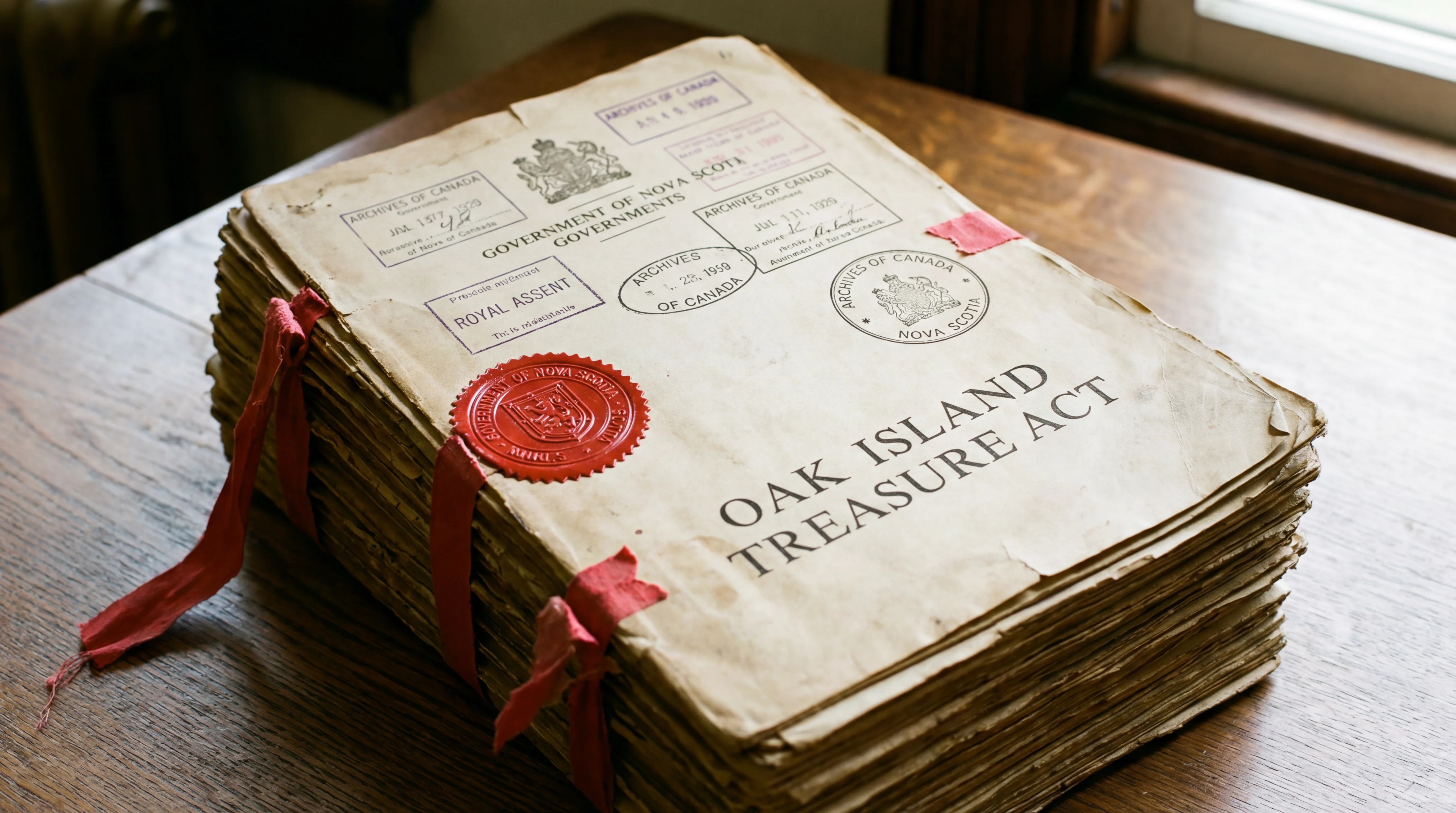
The legal framework governing treasure hunting in Nova Scotia presented Blair with a problem that would consume years of his life. The difficulty traced back to England's Law of the Treasure Trove, enacted in 1276 under Edward I, which declared that hidden treasures with no known owner belonged to the Crown. The royal prerogative had passed to the provincial governments in Canada, and in September 1895 the Nova Scotia Attorney General, J.W. Longley, declared that any treasure discovered at Oak Island would belong to the government.
Blair fought this through a decade-long bureaucratic campaign. He applied for a lease under Nova Scotia's Mines Act covering an area 450 feet by 500 feet that contained the Money Pit and all the surrounding shafts. That lease was not secured until late 1905. It had a forty-year life span, but it only protected precious metals. Convinced that the island's treasure might be something other than gold and silver, Blair then negotiated a separate agreement giving him the exclusive right to search for an undefined "trove," in exchange for paying the government two percent of whatever he found. That agreement was signed in 1909. He also signed a lease with Henry Sellers, whose wife Sophia had inherited the east end of the island, that allowed him to dig on the east end of Oak Island for one hundred dollars a year.
In his own 1930 manuscript, titled "With Reference to Attempts Made at Various Times to Recover a Treasure Supposed to Be Buried on Oak Island, Nova Scotia," Blair set out his case in characteristically direct language. "There is no map, no mythical story, no dream, nothing handed down from a sailor, or any other person, indicating the burial of anything on Oak Island, at any location," he wrote. "The discovery of the pit was accidental." He went on to summarize the physical evidence: the circular pit twelve or thirteen feet in diameter, the layers of charcoal, putty, and beach stones at twenty-five feet, the coconut husks and fiber dug up at the shore. "It is certain that a vast amount of work was done to bury something," he concluded. "The artificial conditions were there to be seen, and were exposed at both the pit and the shore."
 The Treasure and the Law: The Oak Island Treasure Act→
Bowdoin and the First Betrayal
1 min
With his legal position secured, Blair needed a partner with money and engineering skill. In 1909, he found one in Captain Henry Bowdoin, a New York mining and marine engineer who announced his involvement in the treasure hunt in the New York Herald on March 18, 1909. Bowdoin formed the Old Gold Salvage and Wrecking Company, capitalized at $250,000 in one-dollar shares, with Blair and Captain Welling on the board of directors. Among the shareholders was a young law clerk named Franklin Delano Roosevelt, who purchased ten shares.
Bowdoin drilled more than two dozen boreholes around the Money Pit, reaching depths of 171 feet, but found nothing beyond layers of cement. By November 1909, the money was gone. Bowdoin agreed to resume work the following summer, then wrote from England that he could not return before the end of 1911. Blair demanded proof of additional financing before granting any extension. Bowdoin's reply carried a barely veiled threat: if Blair did not cooperate, the company would publish a report that would make future fundraising impossible.
Blair was not the sort of man to be intimidated. "Your letter almost conveys a threat," he wrote back. "Let me say that anything that can be said against Oak Island has already been written, and the publication of any article you might be able to bring forth would not in the least jar those of us who own the lease." Bowdoin made good on his threat with a long article in Collier's Magazine in August 1911, in which he declared there had never been any treasure. Blair answered with his own article in the Amherst Daily News in February 1912, accusing Bowdoin of writing in revenge after the two fell out.
The Long Middle
2 min
Around 1912, Blair moved his insurance business to Calgary, Alberta. Even at a distance of three thousand miles, he maintained his grip on the treasure trove license and continued to field inquiries from prospective searchers. He negotiated a new eight-year lease with Sophia Sellers in 1913, followed by a revised agreement in 1921 that gave him control of the Money Pit area until 1931. In 1915, he signed a partnership agreement with a Rochester, New York syndicate headed by engineer William S. Lozier. The Rochester Group drilled at four locations during the summer of 1916 but made no new discoveries. In 1921, he struck a deal with another engineer, Edward Brown of Newark, New Jersey, who proposed to sink a shaft fifteen feet from the Pit. Brown's crew went to work on July 4, 1922, but when Blair visited and found that the drill had never gone deeper than seven feet, he terminated the agreement.
The period between the Bowdoin fiasco and Blair's return to Nova Scotia was marked by what the author Randall Sullivan called "a whiff of desperation and even, perhaps, a slight degree of hucksterism." On December 7, 1922, Blair placed an advertisement in the Boston Journal of Commerce under the heading "Buried Treasure." The text read: "Speculative venture, partly proven, requires $50,000 for half interest. If successful, will produce millions within one year; otherwise possible eighty per cent loss. Satisfactory credentials, proofs partially successful efforts, will prove good sporting proposition for party financially able to take chance." The accompanying article described Blair as a native of Nova Scotia who had come to New York "to find men with imagination enough to risk some funds in a venture."
Blair returned to Amherst in 1931. He immediately partnered with William Chappell, the drill operator who had brought up the famous parchment scrap in 1897. William's son Melbourne helped organize operations, and they sank a new shaft on the island. Blair visited the site and concluded at once that the Chappell shaft was not properly located, telling Chappell so when the shaft was only ten feet down. They discussed moving it, but Chappell decided he was close enough. Blair later described this as "one great big mistake."
The Hedden Partnership
3 min
Gilbert D. Hedden, a wealthy New Jersey steel manufacturer, first read about Oak Island in a 1928 New York Times Magazine article and carried the clipping with him for years. In early 1934, he traveled to Nova Scotia, inspected the Money Pit area, and began assembling his own thirty-one-page monograph on the island's history. Blair shared his entire archive with Hedden. On March 1, 1935, the two signed an agreement guaranteeing each a share of any treasure recovered.
The partnership began promisingly but was immediately complicated by a political fight. The Nova Scotia government proposed amending the Mines Act to give the Minister of Mines authority over treasure troves as well as minerals. Blair saw the move as a direct threat. In a letter to R.V. Harris dated March 13, 1935, he compared the potential discovery on Oak Island to the opening of Tutankhamun's tomb: "It is high time that the Gov't of the Province of Nova Scotia awakened to the fact that they possess at their front door, a possible means of bringing the province before the world in a manner equaled only by the discovery of Tut-ankh-Amen's tomb. No mining proposition is in its class." The Mines Act amendment died in committee, but the fight consumed time and energy that Blair could ill afford.
Simultaneously, Blair was fighting to acquire the land itself. The heirs of Sophia Sellers demanded what Blair considered an outrageous price. An offer of $900 cash for the twenty acres containing the pit area was refused. The only price the Sellers family would accept for the entire 150-acre property was $5,500. Blair lobbied for the government to use its expropriation powers, arguing that the land was worth $200 at most and that the owners were blocking a $100,000 project that would employ local labor. In a memorandum submitted to the legislature by E.T. Parker on April 23, 1935, Blair estimated that a quarter of a million dollars had already been spent on the Oak Island search, most of it benefiting the local economy. Hedden, determined to proceed regardless, eventually paid the Sellers heirs close to ten times the land's appraised value.
Hedden's excavations during 1936 and 1937 were the most systematic to date. He believed he was very close to solving the mystery when work stopped abruptly in September 1937. He left for England, and by March 1938, he informed Blair that he would postpone operations indefinitely. The agreement between the two men was allowed to expire without renewal.
Blair was furious. In a letter to Harris on April 19, 1938, he described Hedden's withdrawal as "nothing more or less than a downright betrayal and by a brother mason at that." He accused Hedden of playing a "freeze out" game, waiting for Blair to die so that he could operate without sharing. "Mr. Hedden has taken his cue from the former owners and now proposes to stand pat awaiting developments fully realizing my age as compared with his," Blair wrote. "Now you see me and now you don't; yes we have no bananas today." His closing line was defiant: "All I can say at the moment is that I am not going to be defeated by a foreigner if I can help it."
Blair suspected financial motives behind Hedden's retreat. In a letter dated May 16, 1938, he observed that by closing down and "throwing up the sponge" publicly, Hedden could deduct his losses from income tax under American law. "Matters are not good in the United States," Blair noted, "and by closing down and throwing up the 'sponge' ostensibly, he can deduct his loss from income and materially reduce his income tax." Hedden had spent approximately $40,000 on the project, exclusive of the land purchase. Blair believed the man was still confident treasure lay beneath the surface, but could afford to wait. Blair could not.
Hamilton and the War
2 min
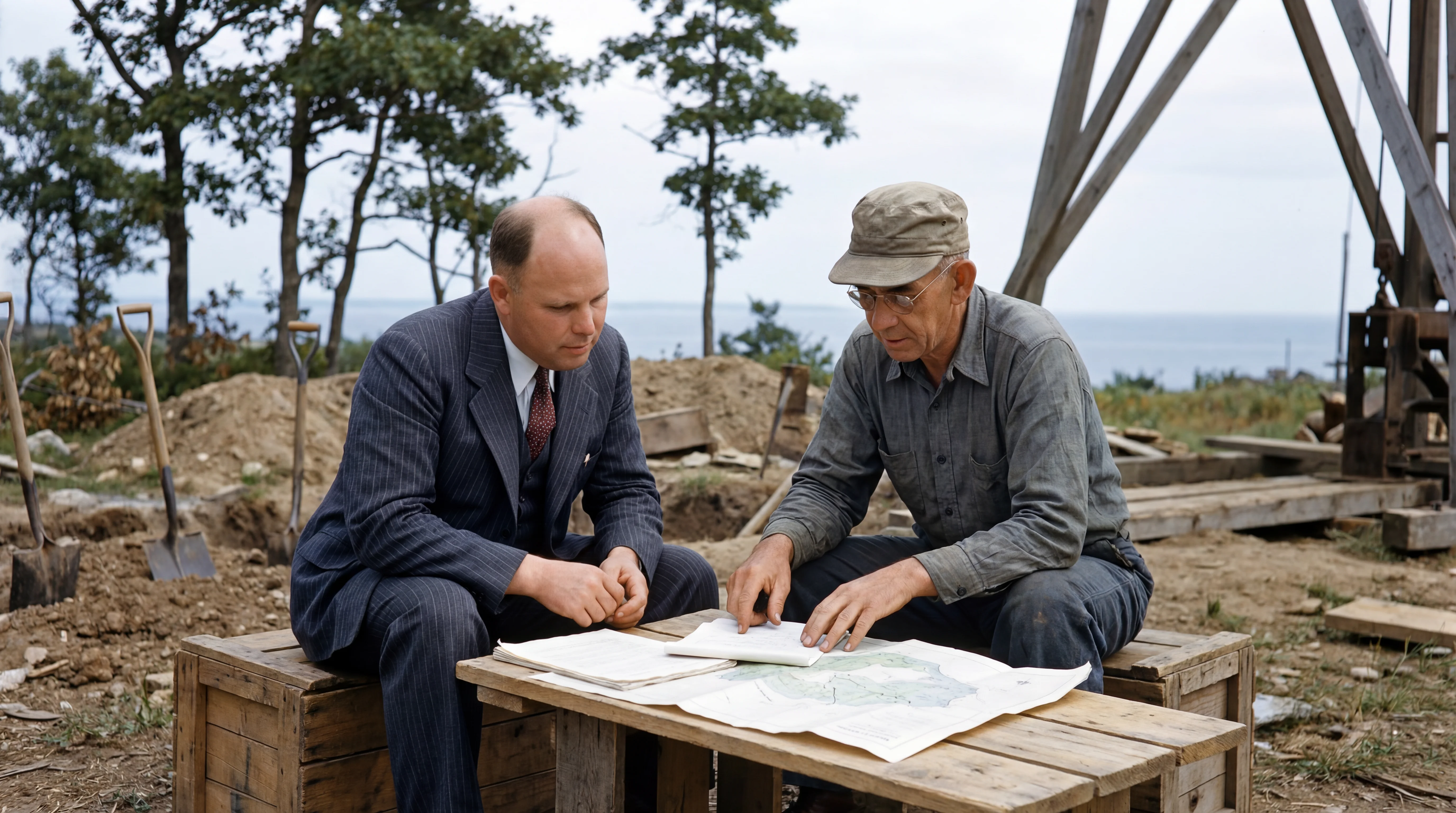
Professor Erwin H. Hamilton, an associate professor of engineering at New York University and a high-ranking Freemason, negotiated a working arrangement with Hedden (who still owned the property) and Blair (who still held the license) and arrived on the island in 1938. The proposed division of any treasure caused immediate friction. Blair objected to a three-way equal split, arguing that Hamilton was merely carrying on Hedden's unfinished work. "I do not want two men living under the stars and stripes dictating just what shall be done in the way of disposing of all that may be recovered," Blair wrote to Harris on August 6, 1938. "I realize it may be their money and efforts that made possible the recovery, but they will be well paid with 60% of the proceeds without giving them all to say in the disposal." He proposed that he should receive 40 percent, with Hedden and Hamilton splitting the remaining 60 percent.
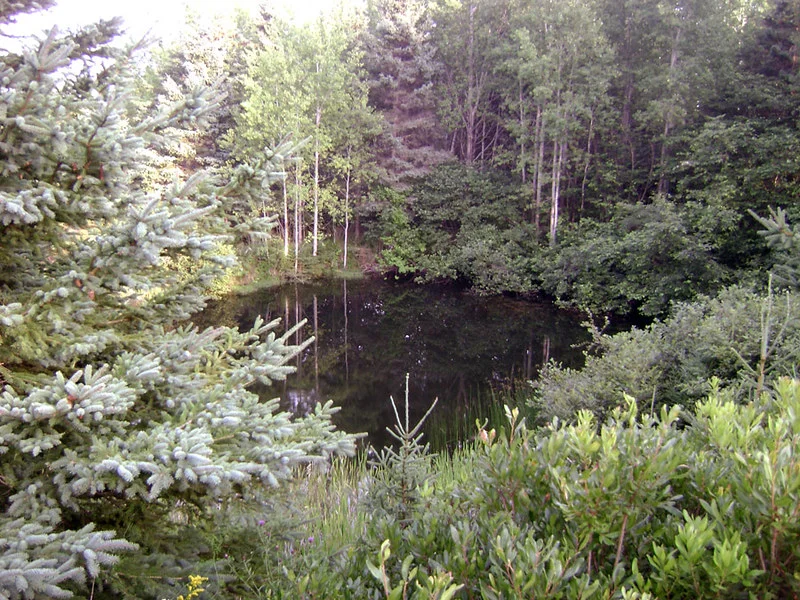
By November 1939, Blair was disappointed with Hamilton's progress. "I am very much disappointed in Hamilton's work this summer, and have so advised Hedden," he told Harris. "He seems to have been working for information or evidence, in other words, on an exploring expedition, rather than going at the job in a business-like manner." In the same letter, Blair revealed that he had always known the Chappell shaft was mislocated, and he offered a precise technical analysis of the tunnels Hamilton had encountered, including his belief that a "cave in pit" discovered during Hedden's operations was connected to the original pirate tunnel and that the men had come within reach of solving the problem without realizing it.
Hamilton spent six years and more than $60,000 on the island. His drilling brought up chips of oak from below the bedrock at more than 200 feet, which Harris and MacPhie call the first direct evidence of man-made workings below the bedrock surface, and his dye tests traced a water connection from the Money Pit to the sea off the South Shore. The war halted operations in 1943, and Hamilton covered the shafts and returned home. He later settled near Chester, where he went into boatbuilding.
 Gilbert Hedden and Edwin Hamilton: The Engineers Who Mapped the Oak Island Money Pit→
 Cave-in Pit→
Registrar of Probate
1 min
Alongside his Oak Island work, Blair had established a second career in public service. Sometime around 1936, he was appointed Registrar of Probate for Cumberland County, operating from the Court House in Amherst. His letterhead changed from "Fred L. Blair, General Insurance" at the Maritime Block to "Frederick L. Blair, Registrar of Probate, County of Cumberland." The Halifax Chronicle-Herald later noted that although Blair was not a lawyer, "he made himself intimately acquainted with all the responsibilities of that important position and fulfilled them to the better." His colleagues described him as an exceptionally capable official who worked long hours to manage the court's heavy caseload. Blair was also a past master freemason of Alexandra Lodge No. 87 A.F. and A.M. and an active member of the First Baptist Church in Amherst.
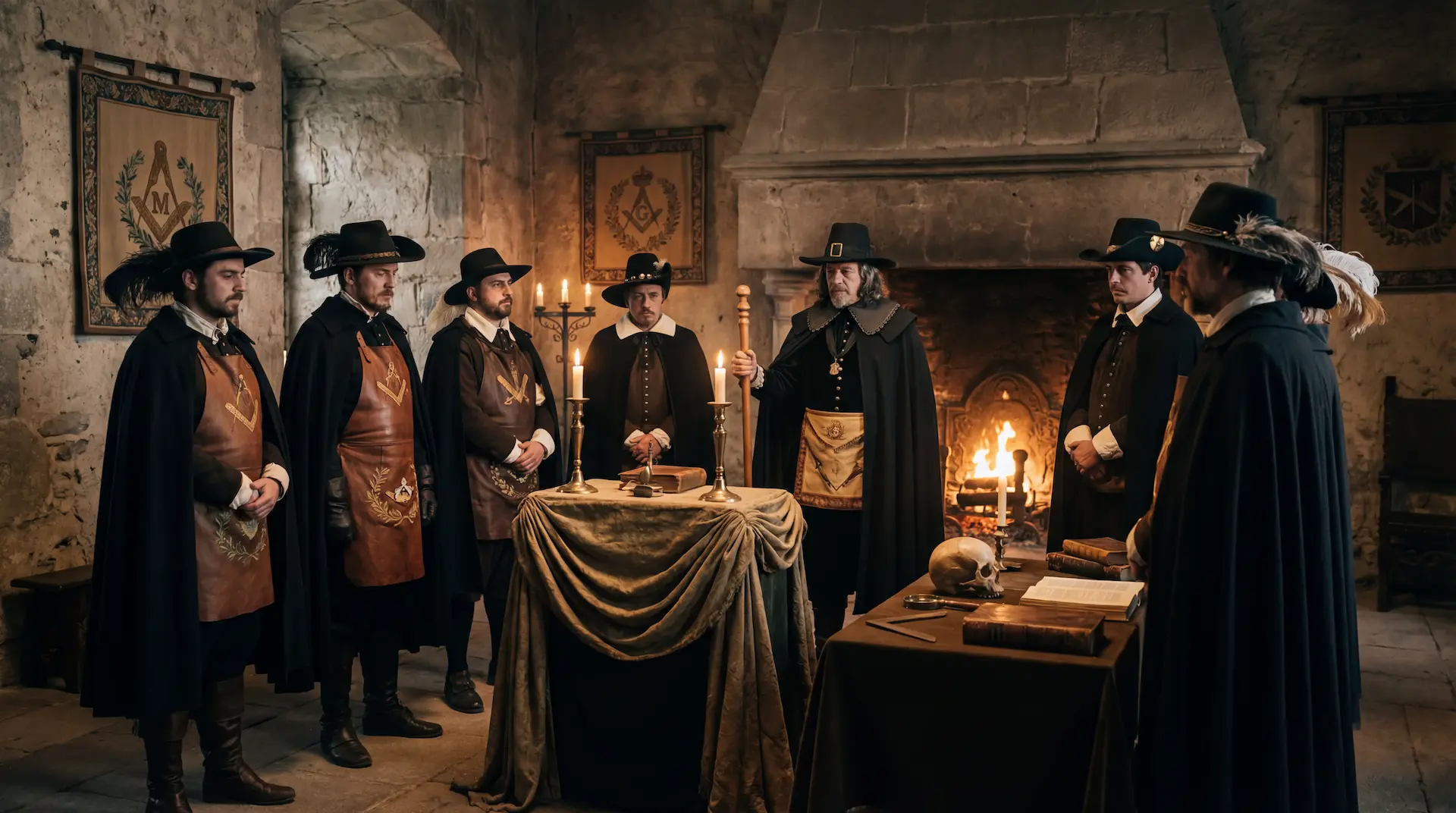 Freemasons on Oak Island→
The Last Decade
2 min
Blair's wife, known in family records as Ann or Colin, predeceased him in 1943. Their son Gordon worked in finance at the Traders Finance Corporation in Saint John, New Brunswick. By the late 1940s, Blair was in his eighties but still answering the mail. In a letter dated August 4, 1947, replying to an inquiry from a Texas mining man named L. Elbert Smith, Blair wrote that Smith's letter was "just one more added to the hundreds which I have received from parties scattered all over this continent and even so far away as New Zealand, containing ideas and suggestions of procedure in the work of recovery of the treasure supposed to be buried at Oak Island." The difficulty, Blair wrote, was "not so much the method of recovery as is the financing of the work. Scientific engineering and modern equipment will do the work if properly financed." He still held the right of recovery. He was "fully convinced that a treasure of vast proportions is buried on Oak Island."
In April 1947, a peculiar episode demonstrated Blair's fame. Edward R. Snow, a Boston author and authority on New England coastal history, announced in a radio broadcast that the lessee of Oak Island had died of a broken heart after failing to find the treasure. Blair, who happened to be listening, immediately wrote to Snow to inform him that the lessee was very much alive. Snow flew to Amherst by way of Borden Price, apologized in person, and then flew with Blair to Oak Island to take photographs for a book he was writing on the treasure hunts of the South Shore.
In May 1950, Hedden finally sold the Oak Island property to John Whitney Lewis, an elderly New York mining engineer, for $6,000. Hedden told Lewis that Blair's treasure trove license had expired, which it had at the time. Blair, hearing of the sale, acted immediately to renew his license with the province. Lewis's own application was refused on the grounds that a license had already been reissued to Blair. The standoff was resolved when the Nova Scotia legislature, after lobbying by Blair and Melbourne Chappell, passed an amendment to the Treasure Trove Act that gave the license holder legal access to property owned by another party. Lewis, outmaneuvered, eventually sold the land at cost to Chappell.
Frederick Leander Blair died on the morning of Sunday, April 1, 1951, at the Victoria General Hospital in Halifax. He was eighty-three years old. He had been ill for nearly a month and had been transferred from Highland View Hospital in Amherst to Halifax on March 21. He was survived by his son Gordon, one sister (Mrs. Reina Quinn of Bayside, Long Island), and one granddaughter, Marie. His funeral was held at Colonial Hall in Amherst on the following Wednesday.
The Oak Island Legacy Of Frederick Blair
3 min
The British United Press wire story by Ted Shields, filed from Halifax on April 3, 1951, ran under the headline "Nova Scotian's Dream of Solving Oak Island's Riddle Ended By Death." The story described fifty-five years of watching one expedition after another end in failure, noting that none of it had dimmed Blair's conviction that treasure lay buried in the flint-hard clay of Oak Island's south coast.
The Halifax Chronicle-Herald editorial that followed was more personal. It described Blair's tall, spare figure as a familiar sight on the streets of Amherst, and noted that his many and varied experiences and excellent memory had made him an interesting conversationalist. "Mr. Blair had, in the course of sixty-five years, gathered a vast amount of information respecting the efforts to find the Oak Island Treasure," the editorial stated. "He believed implicitly in its existence and in its ultimate recovery." R.V. Harris, who had served as Blair's attorney, friend, and colleague for almost a quarter century, added: "Mr. Blair received thousands of letters from eccentric as well as sane people who had suggestions to make for the sure and certain recovery of the treasure. In answering them, he was invariably courteous as well as lucid."
Shortly after Blair's death, Melbourne Chappell acquired the treasure trove license. For the first time in Oak Island history, both the license and the land belonged to a single person. Blair's personal archive, including his journals, the correspondence with Bowdoin, Hedden, Hamilton, Harris, and hundreds of others, and the parchment scrap recovered in 1897, passed first to Gordon Blair and then, after Gordon's death, largely into the Nova Scotia Archives. Grace Blair, Gordon's wife, told Dorothy MacDonald, who was helping O'Connor with his research, in 1977 that most of what her father-in-law had collected had been lent to R.V. Harris for his book, and that very little had been returned. What Harris did not use wound up with the Chappell family in Sydney, Cape Breton.
In his later years, Blair had become fixated on a theory about the origin of the Oak Island treasure. He believed it consisted of royal and church plate removed from England during the Protectorate of Oliver Cromwell, after the execution of King Charles I in 1649. In his 1930 manuscript, he described the treasure as "royal and church plate and valuables, known to have been removed from England and hidden during the Protectorate of Cromwell, after the execution of Charles I. This treasure simply vanished from the face of the earth and has never been recovered. Very probably it now lies buried on Oak Island." He estimated its value at five million dollars, calling that figure "a very conservative appraisal." Whether or not he was right about the contents, Blair's conviction never wavered. "A treasure of vast proportions is buried on Oak Island," he wrote in 1947, at the age of eighty, and he believed it until the day he died.
Blair never owned any portion of Oak Island. He paid licensing fees for the right to search. His daughter-in-law clarified this point years after his death, noting that the distinction mattered. He was not a landowner or an investor in the conventional sense. He was a guardian: a man who held the legal keys to the mystery for six decades, who recruited and vetted every expedition that set foot on the island during that time, who collected and preserved the historical record, and who answered every letter that arrived at his desk in Amherst, whether it came from a president of the United States or a mining prospector in Texas. The Oak Island story as it is known today is in large part the story Frederick Blair chose to tell.
Sources
7 min
Primary documents (Frederick L. Blair papers, Nova Scotia Archives, MG1 Vol. 381–384, R.V. Harris Papers):
- Frederick L. Blair, "With Reference to Attempts Made at Various Times to Recover a Treasure Supposed to Be Buried on Oak Island, Nova Scotia," typescript manuscript, 1930 (MG1 Vol. 383). Blair's own five-page synopsis of the treasure hunt from 1795 to his time, written after thirty-seven years of involvement. Includes his statement that "there is no map, no mythical story, no dream, nothing handed down from a sailor" and his summary of the physical evidence at the pit and shore.
- Affidavit of Adams A. Tupper, sworn November 23, 1893, First District Court of Southern Middlesex, Massachusetts (MG1 Vol. 383). Tupper, of South Framingham, Mass., confirms he worked on Oak Island in the summers of 1850, 1851, and 1863 and vouches for the accuracy of Blair's account.
- Statement of J.W. Andrews, C.E.M.E., Consulting Engineer, 1453 East Third St., Brooklyn, New York, October 1, 1916 (MG1 Vol. 383). Andrews, who as a nine-year-old boy watched the 1849 operations, confirms the oak tree discovery, the circular cavity, the flooding, the boring that produced coins and a piece of gold, and the coconut fibre on the plank platforms. Handwritten annotation notes Andrews was 76 years old in 1916.
- Frederick L. Blair to Reginald V. Harris, letter, March 7, 1935 (MG1 Vol. 381). Blair reports on the size of Oak Island (120–130 acres, three-quarters of a mile long) after visiting the Mines office, and discusses the Sellers family's refusal to sell the east-end lots.
- Frederick L. Blair to Reginald V. Harris, letter, March 13, 1935 (MG1 Vol. 381). Contains the Tutankhamun comparison: Blair argues that the province should use expropriation powers to clear the way for operations, calling Oak Island's potential "equaled only by the discovery of Tut-ankh-Amen's tomb."
- Memorandum re: Bill to Amend the Mines Act Relating to Treasure Trove, submitted by E.T. Parker, April 23, 1935 (MG1 Vol. 382). Legislative brief arguing for the Mines Act amendment. States that $250,000 had been spent on the Oak Island search and that an additional $100,000 was available from private backers if land access could be secured.
- Frederick L. Blair to Reginald V. Harris, letter, April 19, 1938 (MG1 Vol. 381). Blair's reaction to Hedden's withdrawal, calling it "nothing more or less than a downright betrayal and by a brother mason at that." Contains the "freeze out" accusation and the line "I am not going to be defeated by a foreigner if I can help it."
- Frederick L. Blair to Reginald V. Harris, letter, May 16, 1938 (MG1 Vol. 381). Blair's analysis of Hedden's financial motives, including the observation that by closing down operations publicly, Hedden could deduct his losses from U.S. income tax. Notes Hedden had spent approximately $40,000 on the project exclusive of the land purchase.
- R.V. Harris to Gilbert D. Hedden, letter, May 18, 1938 (MG1 Vol. 381). Harris writes to Hedden on Blair's behalf, urging him to renegotiate the agreement. Notes Blair "feels that he is getting old and that the indefiniteness of your letter as to your future plans in connection with the Island actually means the end of your operations there."
- Frederick L. Blair to Reginald V. Harris, letter, July 9, 1938 (MG1 Vol. 381). Blair objects to the proposed three-way equal split of treasure proceeds with Hedden and Hamilton, arguing that a 20 percent cut to his share is "going more than half way" and proposing a 40/30/30 division. Notes Hedden told him he would spend at least $100,000 and had expended approximately $40,000 by September of the previous year.
- Frederick L. Blair to Reginald V. Harris, letter, August 6, 1938 (MG1 Vol. 381). Blair objects to the draft agreement: "I do not want two men living under the stars and stripes dictating just what shall be done in the way of disposing of all that may be recovered." Handwritten annotation on the letter reads "Hedden = 30%, Hamilton = 30%, Blair = 40%."
- Frederick L. Blair to Reginald V. Harris, letter, August 24, 1939 (MG1 Vol. 381). Blair quotes from his own letter to Hedden of July 11, warning that the government agreement expires in 1944 and that the present administration will insist on 25 percent rather than 2 percent in any future license. Blair writes: "I have reached the allotted span while Mr. Hedden is in his prime and now owns the property. Delay means a lot to me and very little to him."
- Frederick L. Blair to Reginald V. Harris, letter, November 17, 1939 (MG1 Vol. 381). Blair expresses disappointment with Hamilton's work: "He seems to have been working for information or evidence, in other words, on an exploring expedition, rather than going at the job in a business-like manner." Contains Blair's analysis of the Halifax Company tunnel, the Chappell shaft location error, and the "cave in pit" theory.
- Frederick L. Blair to Reginald V. Harris, letter, February 24, 1940 (MG1 Vol. 381). Blair reports that Hedden is not paying outstanding accounts, despite repeated promises.
- Frederick L. Blair to Reginald V. Harris, letter, April 6, 1940 (MG1 Vol. 381). Blair reports Hamilton unable to obtain written renewal from Hedden for continued operations.
- Frederick L. Blair to Reginald V. Harris, letter, December 16, 1940 (MG1 Vol. 381). Blair discusses the tunnel system in detail, states he told Chappell in 1931 that the shaft was mislocated, and calls the decision not to move it "one great big mistake."
- L. Elbert Smith (American Commodities, Dallas, Texas) to Frederick L. Blair, letter, July 26, 1947 (MG1 Vol. 382). Inquiry from a Texas mining man about pirate caching methods and the dimensions of the Money Pit.
- Frederick L. Blair to L. Elbert Smith, letter, August 4, 1947 (MG1 Vol. 382). Blair describes Smith's letter as "just one more added to the hundreds" received from around the world. States the original pit was 12 or 13 feet in diameter, uniform in size to at least 90 feet, dug in "very hard blue clay," and not shored by timber. Confirms he still holds the right of recovery and is "fully convinced that a treasure of vast proportions is buried on Oak Island."
- Gordon Blair to Reginald V. Harris, letter, May 15, 1951 (MG1 Vol. 384). Gordon, writing from Traders Finance Corporation in Saint John, encloses a photograph of the parchment and asks Harris to measure the original.
- Reginald V. Harris to Gordon Blair, letter, May 18, 1951 (MG1 Vol. 384). Harris confirms the parchment measures 5/16ths of an inch and reports slow progress on his history of the treasure hunt.
- D'Arcy O'Connor to Mr. Blair (Gordon), letter, June 21, 1976 (MG1 Vol. 384). O'Connor, recently moved to Mahone Bay, requests access to Frederick Blair's papers for a book he is writing. Handwritten reply from E. Grace Blair (Mrs. Gordon B. Blair) notes that Gordon had passed away, that most of Frederick Blair's materials had been lent to R.V. Harris and never returned, and that "Mr. Blair never owned any portion of Oak Island — he paid license fees for search."
- Dorothy MacDonald to D'Arcy O'Connor, letter, October 20, 1977 (MG1 Vol. 384). Encloses Grace Blair's letter and confirms the family connection.
Blair's 1922 Wall Street advertisement:
- Frederick L. Blair, classified advertisement under heading "Buried Treasure," Boston Journal of Commerce (and Commercial Bulletin), December 7, 1922, p. 1. Source: New York Public Library microfilm, W 43rd St. Annex. The accompanying article, titled "Can Buried Treasure Lure Wall Street?", appeared on page 3 of the same issue.
Newspaper obituaries and articles:
- "Fred L. Blair Dies Suddenly in Hospital," Amherst Daily News, April 2, 1951. Obituary giving Blair's birth year as 1867, birthplace as Thomson Station, parents as William and Susan Blair, career as insurance agent and Registrar of Probate, Masonic membership (Alexandra Lodge A.F. and A.M.), and survivors (son Gordon of Saint John, sister Mrs. Reina Quinn of Bayside, L.I., granddaughter Marie).
- "The Late F.L. Blair," editorial, Halifax Chronicle-Herald, April 4, 1951. Contains R.V. Harris's tribute to Blair's courtesy, memory, and sixty-five years of involvement with Oak Island.
- Ted Shields, "Nova Scotian's Dream of Solving Oak Island's Riddle Ended By Death," British United Press wire story, datelined Halifax, April 3, 1951. Reports Blair's death at age 83, his role as "judge of the Probate Court in Amherst, Nova Scotia for the past 15 years," the 1950 sale to John Whitney Lewis, and the mention of Franklin D. Roosevelt as a former searcher.
- "Finds Oak Island's Boss Much Alive," Halifax Herald, April 25, 1947. Article about Edward R. Snow of Boston announcing Blair's death on radio, only to receive a letter from Blair correcting him.
- "Finds Treasure Island Lessee Very Much Alive," Halifax Chronicle, April 25, 1947. Parallel account of the Snow episode with additional details about Snow's visit to Amherst and flight to Oak Island with Blair.
Books:
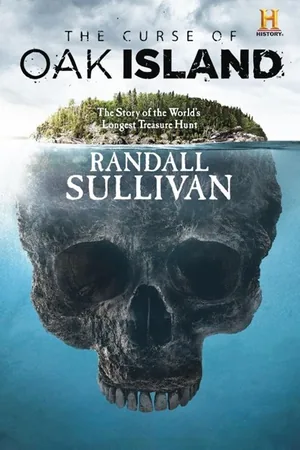
- Randall Sullivan, The Curse of Oak Island: The Story of the World's Longest Treasure Hunt (Atlantic Monthly Press, 2018). Chapters 6–8 and 13 draw extensively on Blair's papers. Sullivan provides the most complete published account of the Bowdoin partnership, the Hedden years, and Blair's death.
- Mark Finnan, Oak Island Secrets (Formac Publishing, 1995; revised edition 2002). Chapter 6 ("A Vault and Parchment") and Chapter 7 ("Another Century Begins") cover Blair's formation of the Treasure Company in 1893, the Bowdoin episode, and the Hamilton years.
- R.V. Harris, The Oak Island Mystery (Ryerson Press, 1958; revised edition 1967). Harris was Blair's attorney and collaborator for nearly twenty-five years. His book draws directly on Blair's archive, much of which he retained after Blair's death.
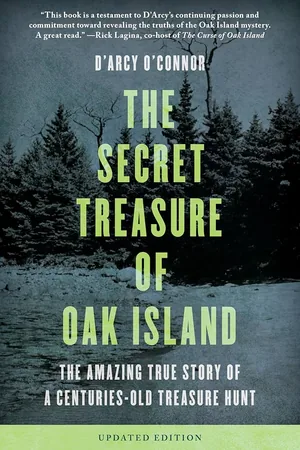
- D'Arcy O'Connor, The Secret Treasure of Oak Island (Lyons Press, 1978; revised as The Big Dig, 1988; further revised 2004). O'Connor sought access to Blair's papers through the family and through Dorothy MacDonald, as documented in the 1976–1977 correspondence.