About This Structure
The stone road in the southeastern corner of the Oak Island swamp is one of the most substantial pre-1795 features documented on the island. The feature was first identified underwater by diver Tony Sampson during Season 7 work in the swamp. Systematic excavation began in Season 8 Episode 9 (January 2021) after the Lagina team obtained permits to drain and dig the southeastern corner of the triangle-shaped bog. By the end of Season 9, surveyor Steve Guptill had exposed approximately 580 feet of the feature running along the eastern border of the swamp.
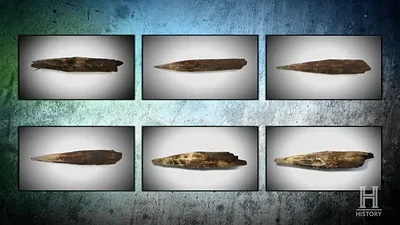
The construction is two to three courses of stacked stone roughly six feet wide, laid atop a deliberate wood-cribbing substructure of perpendicular and parallel beams driven into the swamp floor. Archaeologists Dr. Aaron Taylor and Laird Niven identified the road as a definitive man-made construction. Heavy equipment operator Billy Gerhardt's trenching exposed the layered profile: cobblestone surface over wood cribbing, with cut stakes driven into the boggy ground to anchor the framework. The road sits at an elevation of roughly one and a half to two feet above sea level, consistent across the exposed sections measured by surveyor Steve Guptill.
The route runs from the southeastern corner along the eastern border of the swamp before turning uphill into the uplands toward the interior of the island. At one point the team identified what appeared to be a fork, with one branch angling toward the Eye of the Swamp.
Carbon-14 dating places the construction in the 15th to 17th century. A root growing beneath the road returned a date of 1474 to 1638 (Season 9 Episode 6), which establishes the earliest possible date for construction since the road was built on top of the living root. Wood from beneath the pathway returned 1489 to 1654 (Season 8 Episode 20). Two wooden survey stakes recovered along the road dated to 1636 to 1684 and 1719 to 1826 (Season 8 Episode 18). A wooden T-square recovered from the road's spoils dated to 1632 to 1668 (Season 8 Episode 22).
Antiquities researcher Terry Deveau, former president of the New England Antiquities Research Association, inspected the feature in Season 8 Episode 17 and concluded the construction technology does not match French or British colonial roadbuilding practices documented in Nova Scotia. In his assessment, the road reflects a European stone-roadbuilding tradition from the 1500s or earlier. In Season 9 Episode 23, Portuguese archaeologist Jorge Figueiredo, who was restoring a Roman stone road in Alqueidao Da Serra, examined photographs of the Oak Island road and agreed that Portuguese builders could have built it using technology of European origin. The team's working name for the feature became the Portuguese Road.
Function is indicated by the consistent recovery of ox shoes and ox shoe nails along its length, identified by metal detection expert Gary Drayton and dated to a French or Scottish origin between the 1600s and mid-1700s by blacksmithing expert Carmen Legge. The road was suited for draft animals hauling heavy cargo. Other finds recovered in and around the road include a hand-forged iron ringbolt identified by Legge as a wharf pin, multiple wooden survey stakes, a Spanish 8 maravedi coin from 1652, late 17th and early 18th century copper coins, fragments of Dutch onion bottle glass, wooden keg pieces, red earthenware pottery of possible Spanish or Portuguese origin, and a charcoal and coal assemblage.
The road records organised, European-tradition construction of a working transport route across the swamp before the Money Pit was discovered in 1795. Who built it, and the exact decade of construction, remain open.
Historical Context
Tony Sampson, diver; Dr. Aaron Taylor, archaeologist; Laird Niven, archaeologist; Dr. Ian Spooner, geologist; Miriam Amirault, archaeologist; Billy Gerhardt, heavy equipment operator; Steve Guptill, surveyor; Terry Deveau, antiquities researcher; Gary Drayton, metal detection expert; Carmen Legge, blacksmithing expert; Jorge Figueiredo, archaeologist (Portugal); History Channel Seasons 7 through 13
Where It Was Found
Found at Southeast corner of the triangle-shaped swamp, running along the eastern border and turning uphill toward the interior of the island. Location: the triangle-shaped swamp on Oak Island's southeastern quadrant.