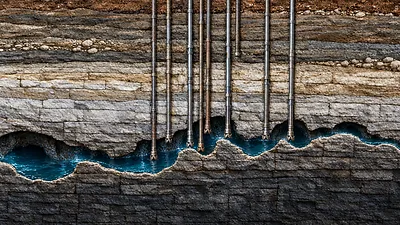
Rick and Marty Lagina and their team begin drilling borehole BN-13.5 in the area Marty has dubbed the Peacock, 45 feet northeast of recent drilling locations and in a zone where new water tests have revealed more evidence of precious metals. The Peacock is defined by heavily slushy, unconsolidated soil between 55 and 150 feet that geologist Terry Matheson cannot explain geologically, which sits directly above the solution channel at roughly 170 feet. As driller Adam pushes from 148 to 158 feet, the drill rods sink and all core material washes out, yielding only ten feet of recovery from 20 feet drilled. Terry and Charles Barkhouse identify this as an effective water-filled void approximately ten feet high, sitting above the solution channel but far deeper than any known searcher activity. Steve Guptill notes the area has returned elevated results for copper, lead, and zinc associated with treasure, and suggests it could be a candidate for sonar investigation.
In the southwest corner of the swamp, Katya Drayton, Derek Couch, and Billy Gerhardt continue searching near the stone formation uncovered three weeks earlier. Billy discovers a five-sided stake still standing at its original depth, roughly three feet below the surface, with the pit around it clearly pre-existing and not created by the excavator. The team also recovers a large eight-sided stake matching those found near the brick-and-slate vault the previous year, reinforcing the connection between the two areas. Derek spots a tapered piece of wood that Billy suspects could be an oar or paddle, possibly related to the ship's railing found a few yards east in 2020 that was carbon-dated to as early as the 7th century.
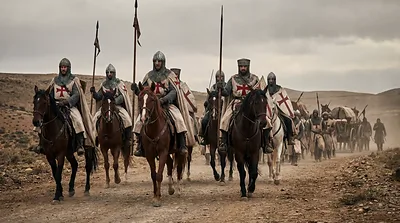
In the lab, Laird Niven and Emma Culligan report on a folded copper artifact recovered from spoils of the round feature on Lot 5. Emma's CT scan reveals no visible relief or coin markings, but the composition, a copper alloy with zinc, arsenic, and lead, places the object definitively post-medieval and pre-mid-1800s, with the arsenic content potentially pushing the date to the late 1600s. In a separate meeting at the research center, coin expert Sandy Campbell confirms the artifact is a coin folded three times in a ritual dating to early medieval times, in which evil was believed to be trapped inside the folds. Campbell explains that the practice was connected to Christianity, the Crusades, and the Knights Templar, who honored Saints George and Bernard through folded coin offerings. He dates this particular coin to the 1600s or 1700s but says it carries the same religious and spiritual meaning as its medieval predecessors. Rick notes that the Lot 5 round feature is oriented east to west, matching the alignment of Templar-associated constructions the team observed during their research in Europe.
On Lot 8, Rick and Katya Drayton search the area where Gary Drayton and Peter Fornetti recently found part of a possible barrel along a straight line leading from a potential 12th-century marker stone on Lot 5. Rick recovers a hand-forged iron object with two square holes that he suspects is a knife handle, and the pair then unearth a lead bag seal, the third found on Oak Island following one on Lot 5 and another on Lot 32 that was scientifically matched to the 14th-century lead cross. Rick finds this seal more intriguing than the others because it was found in the middle of the lot, far from the ocean and from any known homestead, suggesting whatever it contained was needed at a work area on the interior of the island.
Returning to borehole BN-13.5, Rick, Craig Tester, Terry Matheson, and the team work with underwater imaging expert Ken Deboer to investigate the ten-foot void at 148 feet. Ken lowers a high-definition camera capable of 360-degree rotation and captures images of what appears to be a wall-like structure with an opening leading into a larger cavity. Terry interprets the footage as a possible view into a man-made structure around which the Peacock soils have washed out. Ken then deploys a Blue Robotics Ping360 scanning sonar, which produces full-scale images confirming a cavity with openings extending in two directions and measuring roughly two feet across. Terry emphasizes that there is no geological reason for the void to exist at this depth, and Steve Guptill notes it is in the same area where gold and silver have been detected in the water. Rick designates it a priority target and arranges for Prohawk Technology Group to enhance the video footage, concluding that there is every indication the treasure could be in this specific area.