In the Money Pit area, Rick and Marty Lagina and the team drill borehole G-4.5, targeting the solution channel between 168 and approximately 212 feet below grade. Terry Matheson and Steve Guptill monitor as the drill descends through rock and rubble with minimal water. The borehole hits bedrock at 206 feet, with the final core spanning 206 to 208 feet. The recovered material proves to be mostly solid rather than the loose, unconsolidated zone the team had hoped to penetrate, and Charles Barkhouse's pinpointer yields no metal hits across any of the sections. The result is a disappointment for Rick, who had called this location "treasure central" based on its proximity to borehole F-4 where the highest gold and silver levels were detected in water. Later, Marty finds Rick sitting alone at Smith's Cove looking out over the water. The two brothers reflect on the season's drilling results and reaffirm that while no piece of treasure has surfaced, the drilling program is successfully defining the shape and extent of the solution channel, which remains the critical step in determining where a collapse could have deposited the original Money Pit contents.
In the Oak Island lab, Rick Lagina and members of the team join Laird Niven and Emma Culligan for their analysis of the iron artifact recovered from the western swamp the previous week. Emma's XRF reveals a clean composition with minimal impurities and a natural spike in sulfur content, both indicators of pre-blast-furnace manufacture dating to the 1700s or older with likely European origin. Her CT scan proves decisive, revealing a touch hole consistent with a hand cannon, a single-shot firearm invented in China and adopted across Europe by the 14th century before being replaced by flintlock muskets in the 15th century. Gary Drayton, who initially suggested the identification in the field, is vindicated by the imaging. The team later presents the findings via video conference to Matthew Balzan, a Maltese military historian who examined the team's pickaxe find in 2024. Balzan confirms the artifact could be as old as the 1200s, a pre-Columbus date that would place Europeans on Oak Island centuries before recorded history suggests. Rick raises the possibility that the weapon was repurposed to break rocks for the construction of the paved area in the swamp, which has been dated to as early as the 13th century.
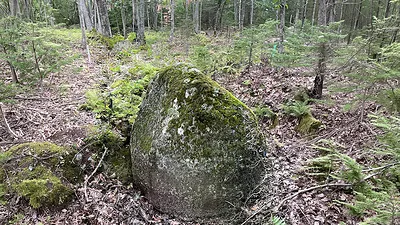
On Lot 5, Marty Lagina, Laird Niven, and members of the team continue investigating the circular stone formation discovered the previous week near the area where six Roman coins were found. After removing sod and a large boulder with a backhoe, the team uncovers angular, hand-cut rocks packed tightly around a split stone that was deliberately propped upright. Laird determines the feature is six feet in diameter and oriented on an east-west axis, matching the orientation of the Lot 5 round feature and consistent with Templar freemasonry traditions in which all structures were aligned east-west. Rick connects the six-foot diameter to the rule of 72, noting that six feet equals 72 inches, and references researcher John Edwards' 2023 presentation demonstrating that Nolan's Cross was designed using measurements divisible by 72, a number sacred to the Templars through the 72 directives of the Latin Rule written by founding members Hugues de Payens and Bernard of Clairvaux. Terry Matheson and Katya Drayton join the examination, and Terry confirms the stones were deliberately piled. The hand-cut rocks resemble those found in the wall on Lot 26, which was carbon-dated to as early as 1474 and identified by researcher Francisco Nogueira as having a distinct European origin.
In the western region of the swamp, Gary Drayton, Billy Gerhardt, and Derek Couch search near the area where the hand cannon and wooden stakes were found. Billy uncovers cut logs with peeled bark laid across clay with rocks underneath, which Gary identifies as a possible corduroy road, a transportation method first designed in Europe during the 11th century for moving wagons and heavy cargo across marshy terrain. The team recovers coal or charcoal from the area, matching samples previously found along the stone road in the southeast corner of the swamp and along the cobblestone path, suggesting a connection between these features. Gary detects a heavy iron artifact with sharp cut angles that he identifies as a possible large buckle, the kind that could have been attached to a chest or box. He also recovers a small iron needle. Rick and Marty arrive to examine the finds, and Marty, a self-described swamp skeptic, acknowledges that flooding a treasure in swamp-like conditions would leave no trace and that it remains possible the treasure they seek lies in the bog.
The episode marks a turning point in the season as the team reconciles the absence of treasure in the solution channel drilling with the evidence accumulating at the surface. The hand cannon, confirmed by both lab analysis and a military historian as potentially dating to the 1200s, joins the paved area, the stone road, the cobblestone path, and the newly discovered corduroy road as evidence of organized European activity in the swamp centuries before the Money Pit was discovered. On Lot 5, the circular stone feature with its east-west orientation, six-foot diameter tied to the Templar rule of 72, and hand-cut rocks matching the 15th-century Lot 26 wall adds another data point to an island-wide pattern. Rick acknowledges that while the drilling program has not yet produced a piece of treasure, the second objective of defining the solution channel is progressing, and the team resolves to continue both the deep drilling and the surface investigations that are steadily building a case for pre-Columbian European activity on Oak Island.