Of all the theories surrounding Oak Island, the Masonic connection may be the most deeply embedded in the story itself. Freemasonry does not simply appear at Oak Island as an external theory imposed by outsiders. It is woven into the island's documented history, into the men who surveyed it, into the symbols found upon it, and into the very structure of the legend as it has been told for over two centuries.
The evidence for their presence is documented. The meaning of that presence is not.
Freemasonry Arrives in Nova Scotia
1 min
The story of Freemasonry in Nova Scotia begins with a single man: Major Erasmus James Philipps. A military officer and member of the Nova Scotia Council, Philipps was initiated into "The First Lodge" of Boston on November 14, 1737, during a visit to settle boundary disputes between Massachusetts and Rhode Island. Henry Price, the Provincial Grand Master of Masons in North America, saw in Philipps a proper agent to carry the fraternity northward.
On March 13, 1738, the Boston Gazette announced that "Major Philipps is Appointed Provincial Grand Master over the Free and Accepted Masons, in the Province of Nova Scotia, and that a Deputation is getting ready for that purpose." Philipps returned to Annapolis Royal in June 1738, where he established the first Masonic lodge on Canadian soil. It was the fifth lodge chartered from Massachusetts and it was, in membership, virtually a military lodge, its brothers drawn almost entirely from the garrison.
Among the earliest members were names that would matter to the Oak Island story. John Easson, "made" a Mason in 1738, was a Master Artificer in the employ of the Board of Ordnance. Dr. William Skene, who had served at Annapolis Royal since 1715, was a member of the prominent Aberdeen Masonic family. The Craft took root quickly in the military and administrative elite of colonial Nova Scotia.
Philipps served as Provincial Grand Master until his death in 1760. In his final years, he developed a close personal relationship with another figure whose shadow falls directly across Oak Island: Charles Morris.
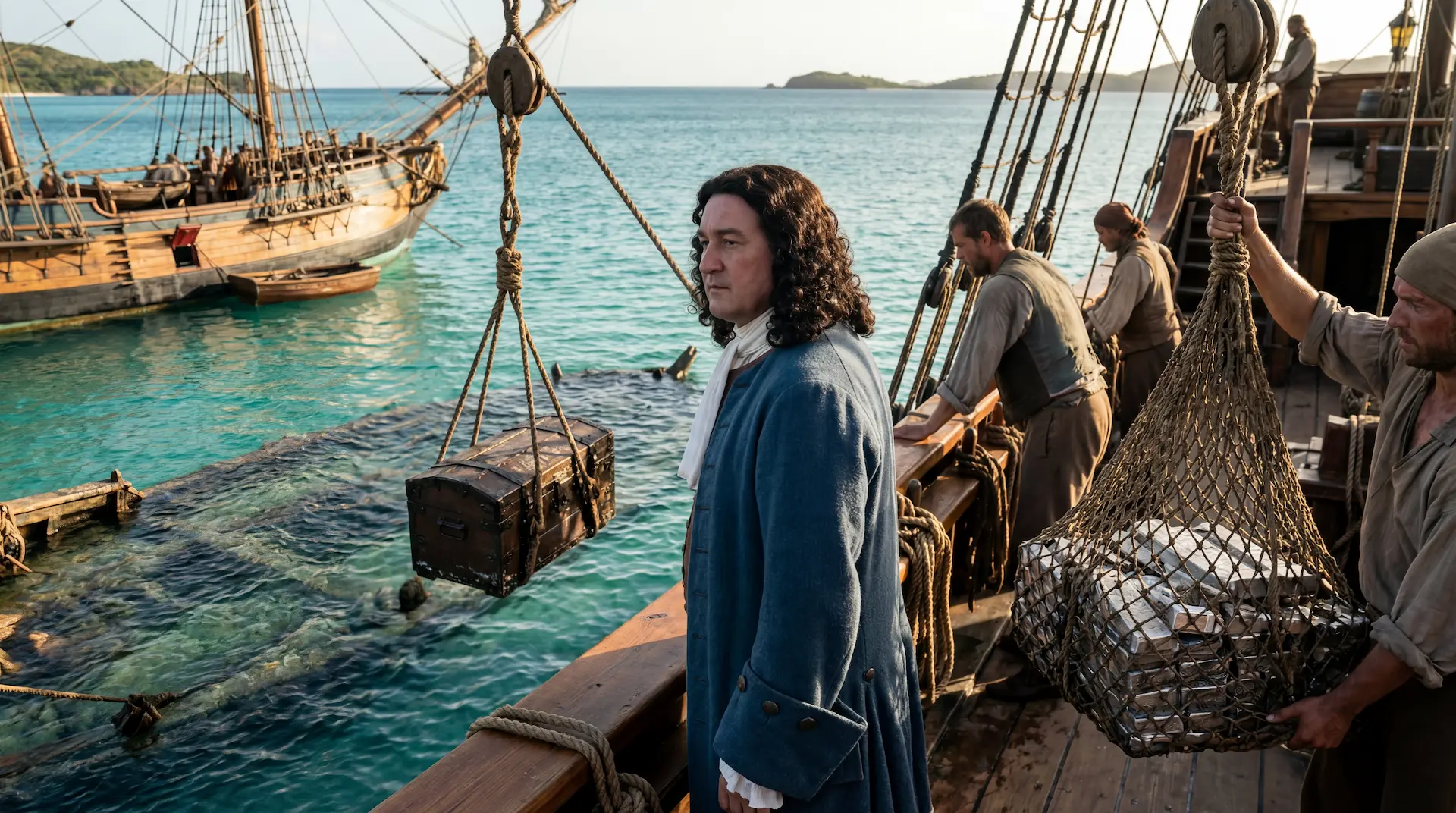 William Phips, the Treasure of the Concepción→
Charles Morris and the Survey of Oak Island
2 min
Charles Morris was Nova Scotia's Surveyor General for over 32 years. Born in Boston in 1711, he came to the colony as a military officer and rose to become one of its most powerful administrators, serving simultaneously as a member of the Nova Scotia Council, Justice of the Peace, and eventually Chief Justice of the Nova Scotia Supreme Court. He designed the layout of Halifax, Lunenburg, Lawrencetown, and Liverpool. He was, by any measure, the man who drew the map of colonial Nova Scotia.
Morris was also a Freemason, deeply connected to the fraternal networks that Philipps had established. And in 1762, he did something that no one has satisfactorily explained.
That year, Morris traveled 45 miles from Halifax to Oak Island and surveyed it into 32 lots of approximately four acres each, most abutting a common road and all with water frontage. No other island in Mahone Bay was ever surveyed in this manner. There were over 350 islands in the bay. Morris chose to divide this one, and only this one, with the precision and formality normally reserved for planned settlements.
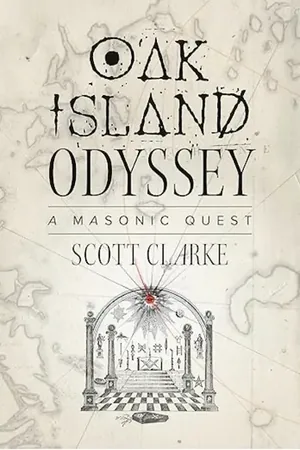
The timing carried its own Masonic signature. On December 27, 1753, Lieutenant-Governor Charles Lawrence had granted Island 28 (later known as Oak Island) to New York fishing agents John Gifford and Richard Smith. As researcher Scott Clarke documented in Oak Island Odyssey: A Masonic Quest, Lawrence was a Freemason, and December 27 is the feast day of Saint John the Evangelist, one of the two most important dates in the Masonic calendar. It is traditionally the day when Freemasons begin auspicious undertakings, install Grand Masters, and grant lodge warrants. The United Grand Lodge of England was formed on December 27, 1813. Chester Lodge No. 9, the lodge nearest to Oak Island, received its warrant on December 27, 1784.
Morris's superior was Lieutenant-Governor Jonathan Belcher Jr., himself a Freemason and the most powerful Mason in Nova Scotia as Grand Master of the Grand Lodge. Belcher was the grandson of Captain Andrew Belcher, who had worked closely with Sir William Phips, the English privateer knighted for recovering Spanish treasure from the wreck of the Concepcion in the 1680s. Clarke found that Belcher Jr. had graduated from Harvard in 1728 alongside William Phips's own grandson (also named William) and alongside Jonathan Seccombe, who later became the first known lot owner on Oak Island. According to Seccombe's diary, held in the Nova Scotia Archives, he drew lot 7 on Oak Island on June 17, 1765. Shortly after arriving in Chester, Seccombe noted that he dined with a lodge of Freemasons and regularly visited his close friend, governor and Masonic Grand Master Jonathan Belcher Jr.
Clarke's research established that at least six of the pre-1795 lot owners on Oak Island were Freemasons, and that Masons may have owned close to half the island before anyone reported finding the Money Pit.
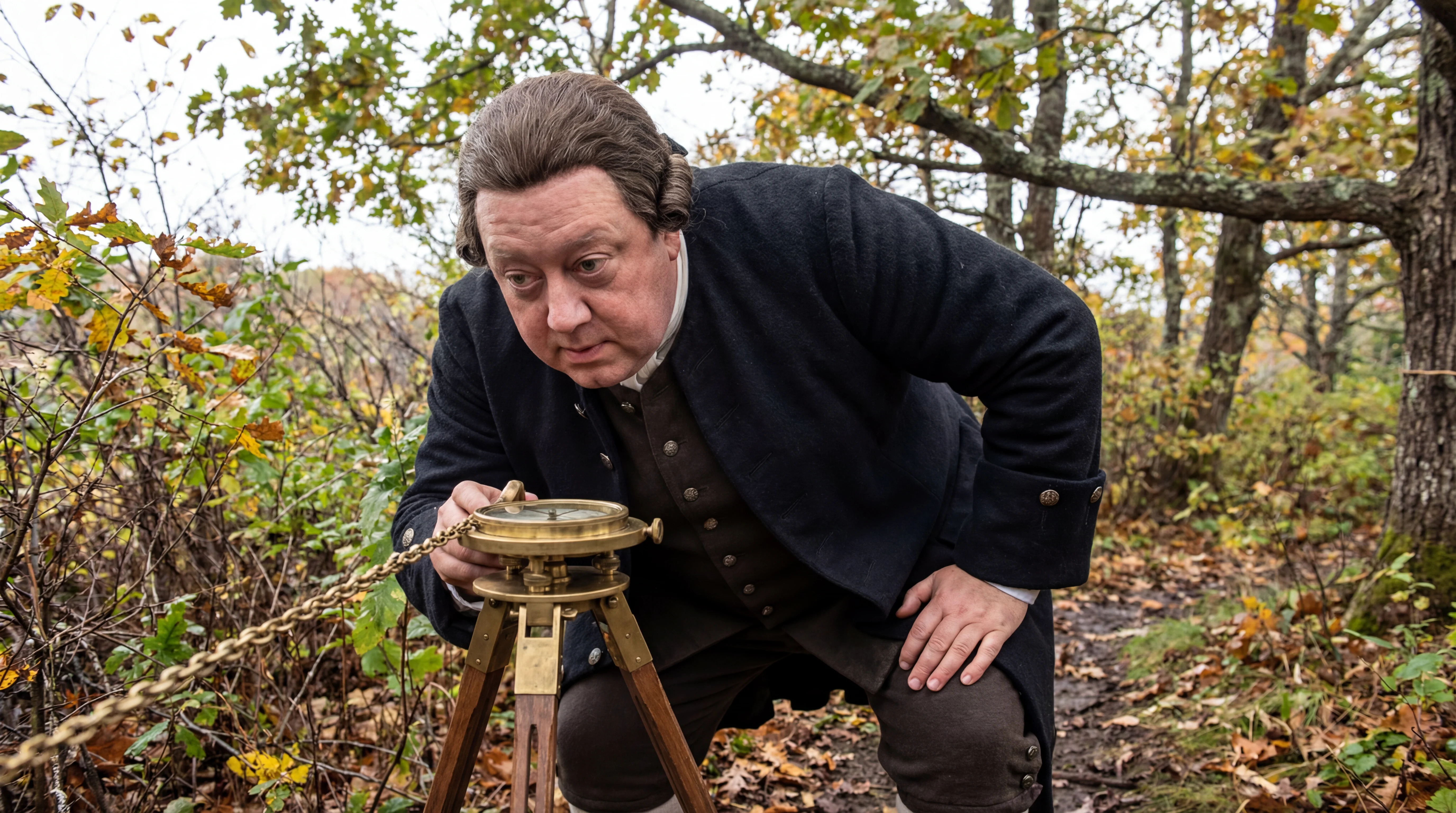 Charles Morris: The Man Who Mapped Oak Island→
The First Lodge Near Oak Island
1 min
The first Masonic lodge meeting near Oak Island took place on December 8, 1784, led by Adam Fife, a Scotsman serving in the Royal Regiment of Artillery. Clarke traced Fife's career through the lodges with striking results. In 1781, Fife attended a meeting of the Antient Grand Lodge of England in New York, apparently the only recorded meeting of that body ever held outside England. That same year, Lodge No. 213 of the Antient Grand Lodge was created within the 4th Battalion of the Royal Regiment of Artillery, with Fife chosen as its first master. The warrant was issued by the Grand Master of the Antient Grand Lodge, John Murray, 4th Duke of Atholl, who had simultaneously served as Grand Master of the Grand Lodge of Scotland for the preceding three years.
While in New York, Fife became a founding member of the Grand Lodge of New York and a senior member of the first Grand Chapter of the Royal Arch Masons in New York. A letter from Fife and two other representatives of the Grand Chapter sits as item No. 4 in the Grand Lodge of New York's collection of original autographed letters. The letter immediately before it, item No. 3, is a signed letter from George Washington, written from his headquarters at Morristown in February 1780.
Of the hundreds of documents in the Grand Lodge of New York's possession, only one relates to all of Nova Scotia. That document is a Master Mason's certificate issued in February 1787 by Chester Lodge No. 9, signed by three men, two of whom were Oak Island lot owners in 1787. One was Alexander Pattillo, master of the lodge at that time, whose original Masonic apron, over 235 years old, is currently displayed on a wall in Clarke Lodge No. 61 in Chester, Nova Scotia.
The Mason Privateer
1 min
The New York certificate is not the only surviving Chester Lodge No. 9 document to have travelled with its bearer. Captain James Anderson, a Maryland privateer who had taken the American patriot's oath in 1776, defected to the British in 1778, and been charged with high treason by Virginia Governor Thomas Jefferson, escaped to Halifax after the war and joined Chester Lodge No. 9 in December 1784. In 1785 he took possession of Lot 26 on Oak Island and moved his family onto the property, where they lived for three years before he sold to Samuel Ball in 1788. Anderson's own Master Mason certificate, issued by the same lodge on June 24, 1791, sat for more than two centuries inside the sea chest he carried with him from Baltimore to Nova Scotia. It is signed by Thomas Thomson and Roger English, bears its original red wax seal, and remains today in the possession of his direct descendants in Wolfville. Clarke transcribed it in full from the original during a 2009 visit to the family.
Of the men who owned Oak Island lots before the Money Pit was discovered in 1795, Anderson is the only one the documentary record identifies as both a Mason and a working pirate, and the only such figure known to have owned part of Oak Island.
 Captain James Anderson: The Pirate Oak Island Owner→
The Scottish Thread
1 min
Where Clarke traces the Masonic connections forward from 18th-century Nova Scotia lodges, author James McQuiston works backward from 17th-century Scotland. Across twelve books on Oak Island and a dedicated volume on the Templar-Freemason connection, McQuiston has built a case linking the founding of Nova Scotia itself to the emergence of Freemasonry as an organised body.
McQuiston's research centers on a pivotal event in 1563: the Grand Prior of the Order of the Knights of St. John and the Temple in Scotland transferred all possessions of both knighthoods to Mary, Queen of Scots. Within two generations, heirs of four men involved in that transfer became Knights Baronet of Nova Scotia. By July 3, 1634, the first recorded Freemasons appeared in Edinburgh, all with documented connections to Nova Scotia. McQuiston argues that Freemasonry was established between 1618 and 1634, overlapping precisely with Nova Scotia's founding period under that name, and that the people responsible were also responsible for hiding treasure (and perhaps the works of William Shakespeare and Francis Bacon) on Oak Island.
Among McQuiston's more striking findings is the rediscovery of Mary, Queen of Scots' cipher sheets. Working through British archives, he prompted the sorting and digitisation of 104 cipher sheets from a collection of over 400 of Mary's papers that had been stored unsorted in a back room of the National Archives of the United Kingdom. The cipher symbols, according to McQuiston, include characters matching those reportedly found on the 90-foot stone in the Money Pit. His work has earned him acceptance into the Scottish Rite Research Society and fellowship with the Society of Antiquaries of Scotland, with access to the British Museum, Oxford University, and the National Archives of Scotland, England, and Nova Scotia. McQuiston, who has appeared on the History Channel fourteen times, is not a Freemason himself.
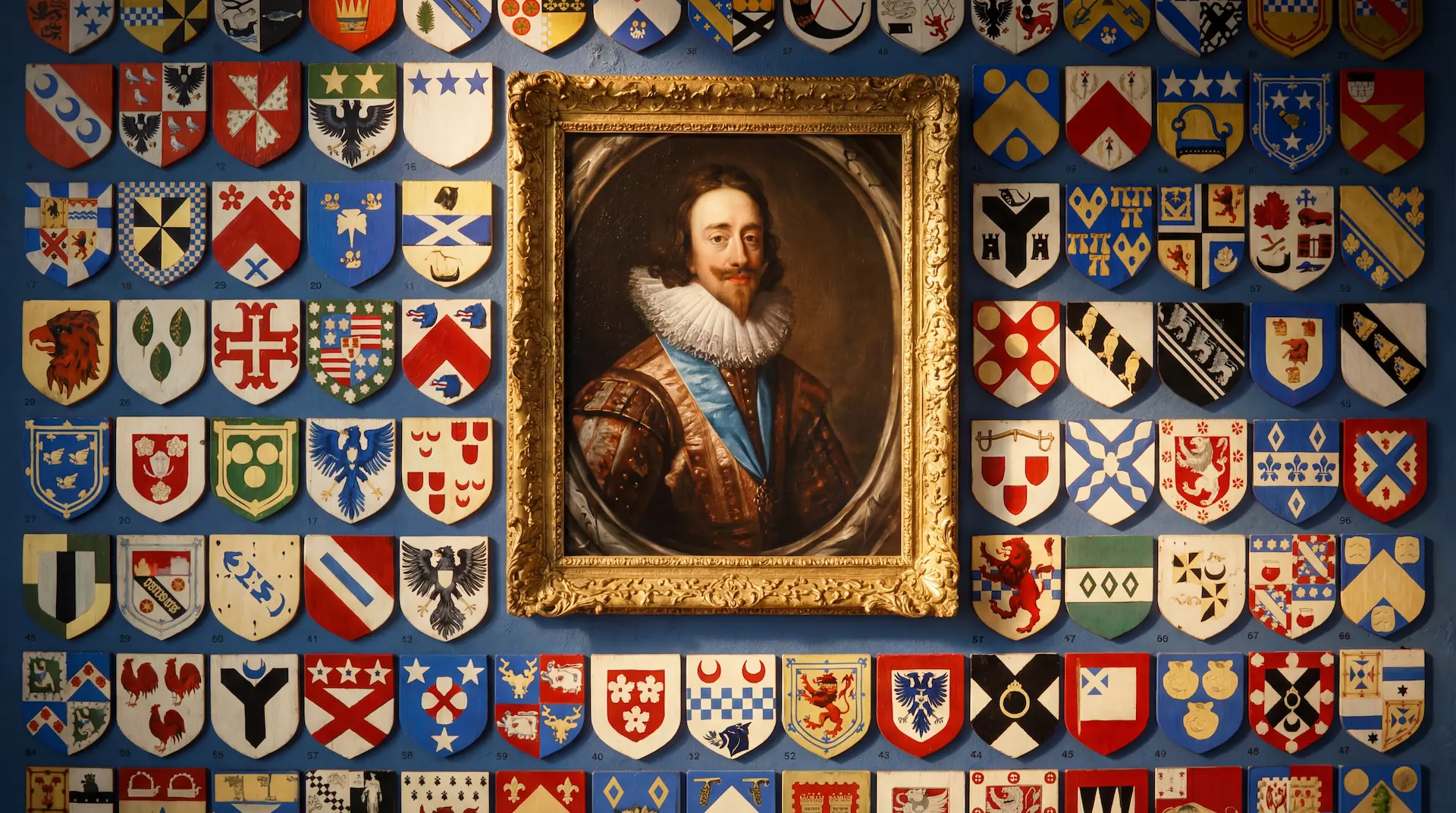 The Knights Baronet of Nova Scotia→
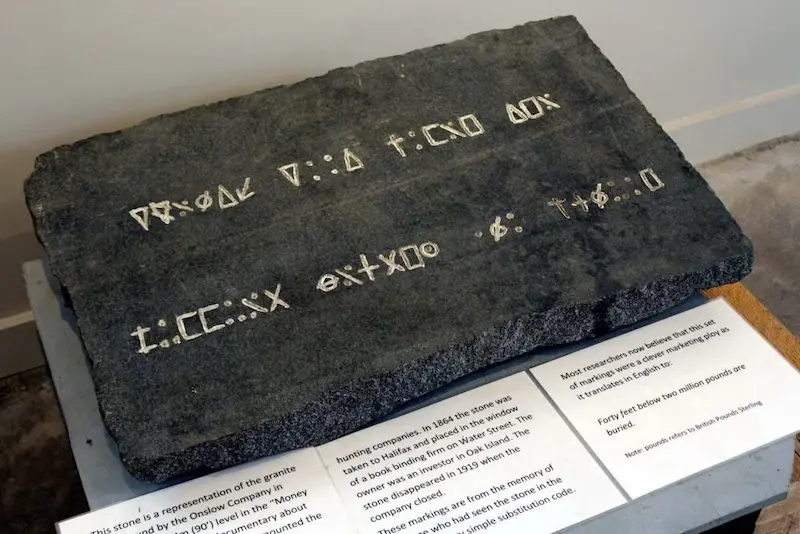 Inscribed stone (90-foot stone)→
The Morris Map and Its Symbols
2 min
In Season 11 of The Curse of Oak Island, 32nd degree Scottish Rite Mason and researcher Scott Clarke presented evidence he had found in the Canadian Archives: the original 1762 map of Mahone Bay created by Charles Morris. Clarke, a librarian, archivist, and records analyst from Toronto who has researched the Oak Island mystery for over two decades, had been examining the map's details with a Freemason's trained eye.
What Clarke found was striking. The first letter A in "Mahone Bay" on the map was written with a distinctive v-shaped crossbar, a form that differs from the other A's on the document, which are written normally. This v-bar A is a symbol found repeatedly in Templar and early Masonic stonework, appearing in churches across Portugal and Italy. It is commonly associated with the Holy Grail in Masonic tradition.
Clarke found the symbol used in three other places on the map. When these four instances were plotted on a compass circle, the lines intersected at Oak Island. Clarke's conclusion was direct: Freemasons within the colonial Nova Scotia establishment knew, as early as 1762, that something of significance was on the island.
Clarke also identified what he believes is a separate Masonic cipher on the same map. The abbreviation of "Saint" uses a capital S and T followed by two periods, rather than the standard single period. After examining hundreds of maps and old logos from the 1600s to the 1800s, Clarke found that over 90 percent consistently used a single period. The only other example of the capital S, capital T, and two periods that he located appears on the original seal of Saint Andrew's Royal Arch Chapter in Boston, whose most important symbol is the Triple Tau. Morris was a lodge brother of Isaac DeCoster, the first master of the Lodge of Saint Andrew, who became a Freemason in 1738 at the same lodge as Morris, at Annapolis Royal. Clarke argues the notation is a cipher recognisable only to a select group of early Royal Arch Masons.
The Secret Vault
2 min
The parallels between the Oak Island legend and the rituals of Freemasonry are so numerous that they have been noted independently by Masons and non-Masons alike. The resemblances centre on the allegorical story of the Secret Vault, a narrative used in the Royal Arch and Scottish Rite degrees that describes the discovery of a hidden underground temple built by the biblical patriarch Enoch.
In the Scottish Rite's 13th degree, known as the Royal Arch of Solomon (or the Royal Arch of Enoch, or Master of the Ninth Arch, depending on jurisdiction), candidates are taught that God appeared to Enoch in a vision at Mount Moriah, later identified as the Temple Mount in Jerusalem, and showed him a plate of gold engraved with the true name of God. Enoch then constructed nine underground vaults, one beneath the other, and sealed the golden plate in the lowest chamber. Centuries later, when King Solomon had the Temple built, three of his grand master architects discovered the vaults beneath the foundations, descended through all nine levels, and recovered the sacred treasure. The York Rite tells a similar story in its Select Master degree, with King Solomon, Hiram of Tyre, and Hiram Abiff creating a secret vault of nine levels beneath the sanctum sanctorum.
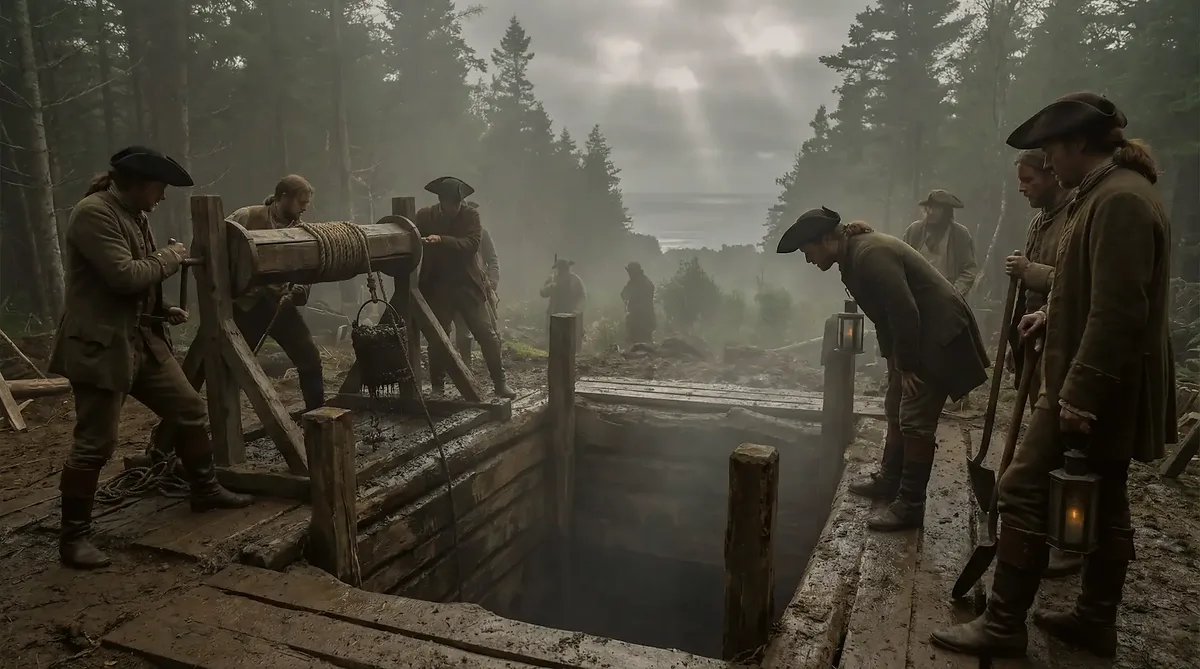
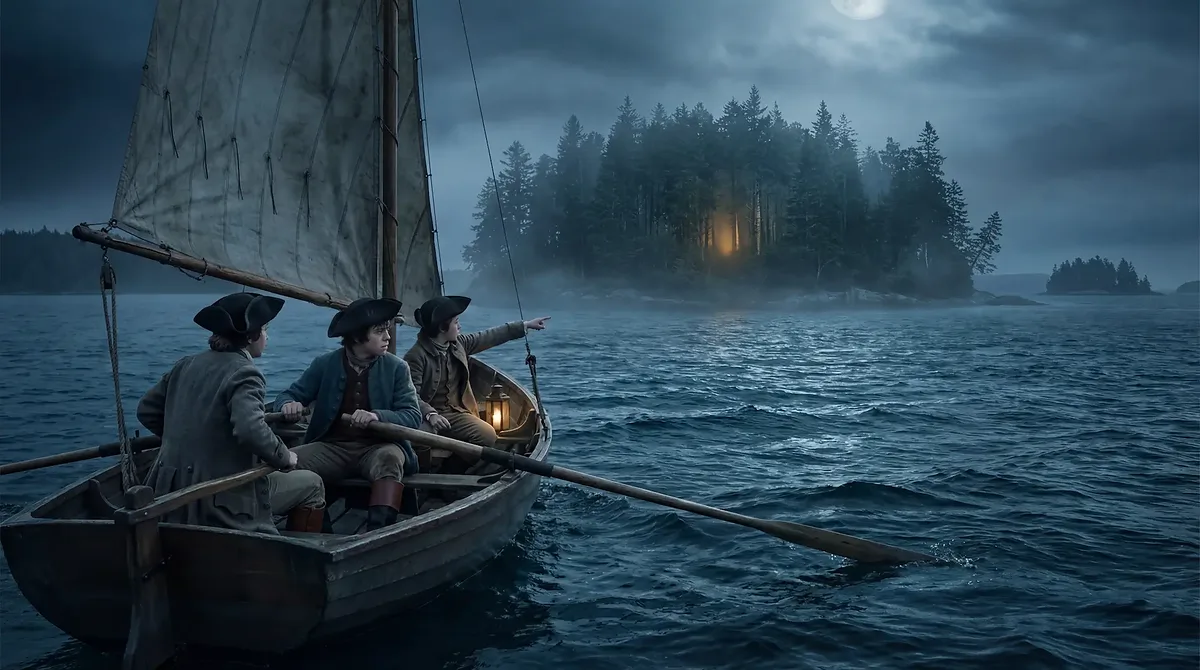
The parallels to the Oak Island story as traditionally told are difficult to set aside. Three young men discovered a depression in the ground. They found nine distinct levels marked by oak platforms every ten feet. A stone with a cipher inscription was found at depth. Workers probed the bottom with a crowbar and struck what they believed to be a chest. The tools used by the diggers (spade, pickaxe, crowbar) correspond to the three Working Tools of the Royal Arch Mason. A stone with an iron ring was found in a pit near the main shaft, echoing the iron ring set in stone at the first level of Enoch's temple. Three gold chain links were recovered during excavation, and three oak trees reportedly formed a triangle around the pit, both motifs with direct Masonic significance.
As Clarke writes, this similarity is "the overriding reason why so many prominent Freemasons have been drawn to the mystery of Oak Island." Whether the Money Pit was built to replicate a Masonic ritual or the Masonic rituals shaped how the pit was later described remains an open question.
McCully and the Masonic Lens
2 min
The most detailed early account of the Money Pit's features comes from an 1862 article written by Jotham Blanchard McCully, an engineer involved in the treasure search since 1849. McCully managed the Truro Company's operations, served as secretary of the Oak Island Association, and participated in at least three separate treasure-hunting syndicates over nearly two decades. Although not present in official lodge records, McCully was almost certainly a Freemason: a letter from 1874 sent to a Masonic lodge in Nova Scotia asks someone with his name to take the letter for safekeeping after it was read.
McCully's account, published in the Nova Scotia Colonist, introduced most of the Masonic-sounding elements into the public record: the nine platforms, the inscribed stone, the systematic layers of oak logs. An earlier 1861 account by a writer identified as Patrick contained fewer of these elements. Researcher Dennis King, himself a Freemason, demonstrated in his 2010 paper "The Oak Island Legend: The Masonic Angle" that changes in the legend over time track closely with changes in Masonic ritual. The inscribed stone, for example, was not described as porphyry until the 20th century, after porphyry was introduced into the Masonic allegory of Enoch's temple.
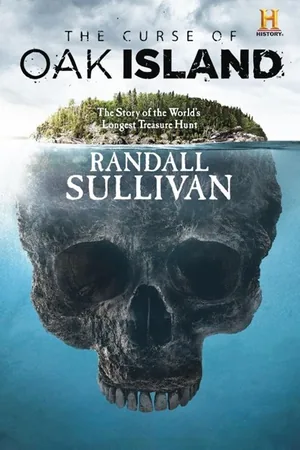
Randall Sullivan, researching his book The Curse of Oak Island, examined King's findings in detail and added a further layer. King had traced the story of the three gold chain links reportedly brought to the surface by the auger boring of 1849. McCully's Colonist articles made no mention of chain links. They had appeared eleven months earlier in the Yarmouth Herald as "three links of a chain, of a copper colour, which, however, upon being tested proved to be gold." The same newspaper later referred to "gold wire" rather than chain links. James McNutt's 1867 diary described three pieces of copper wire. Two 1866 articles in the New York Herald and the Scotsman, otherwise fairly complete accounts of the treasure hunt, made no mention of chain links, wire, or any such finds at all. The details were not stable. They shifted between accounts in ways that suggest oral tradition shaped by the teller rather than a fixed historical record.
King proposed that McCully, knowing Masonic ritual intimately, had embellished the Money Pit narrative with symbolism from the Royal Arch and Enochean degrees. He noted that Masonic pranks of this kind are "not as farfetched or as uncommon as non-Masons might suppose," citing the Legends of the Moving Coffins of Barbados, Swift's Lost Silver Mine in Kentucky, and the Beale Treasure as examples of apparent Masonic hoaxes that entered the canon of unsolved mysteries. King pointed out that author and Freemason Arthur Conan Doyle was known for inserting Masonic allusions into his Sherlock Holmes stories, confident that fellow Masons would recognise the references while other readers would not.
The Symbols on the Island
1 min
Physical evidence of Masonic symbolism has been reported across Oak Island for over a century, though much of it was documented in circumstances that make independent verification difficult.
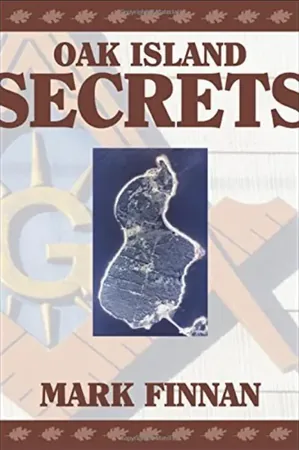
In 1936, treasure hunter Gilbert Hedden led an expedition that turned up several stones near Joudrey's Cove on the north side of the island. Hedden, himself among the most prominent Freemasons in New Jersey, reported that the stones bore Masonic markings. On one, he found a carving of a point within a circle, a symbol representing the individual Mason within the boundaries of duty and moral law. He also found a three-sided square (which appears in the Masonic pigpen cipher) and the letter H, a Masonic emblem for God. Author Mark Finnan described the discovery of a handworked heart-shaped stone that he connects to the sword pointing to a naked heart in the Entered Apprentice degree.
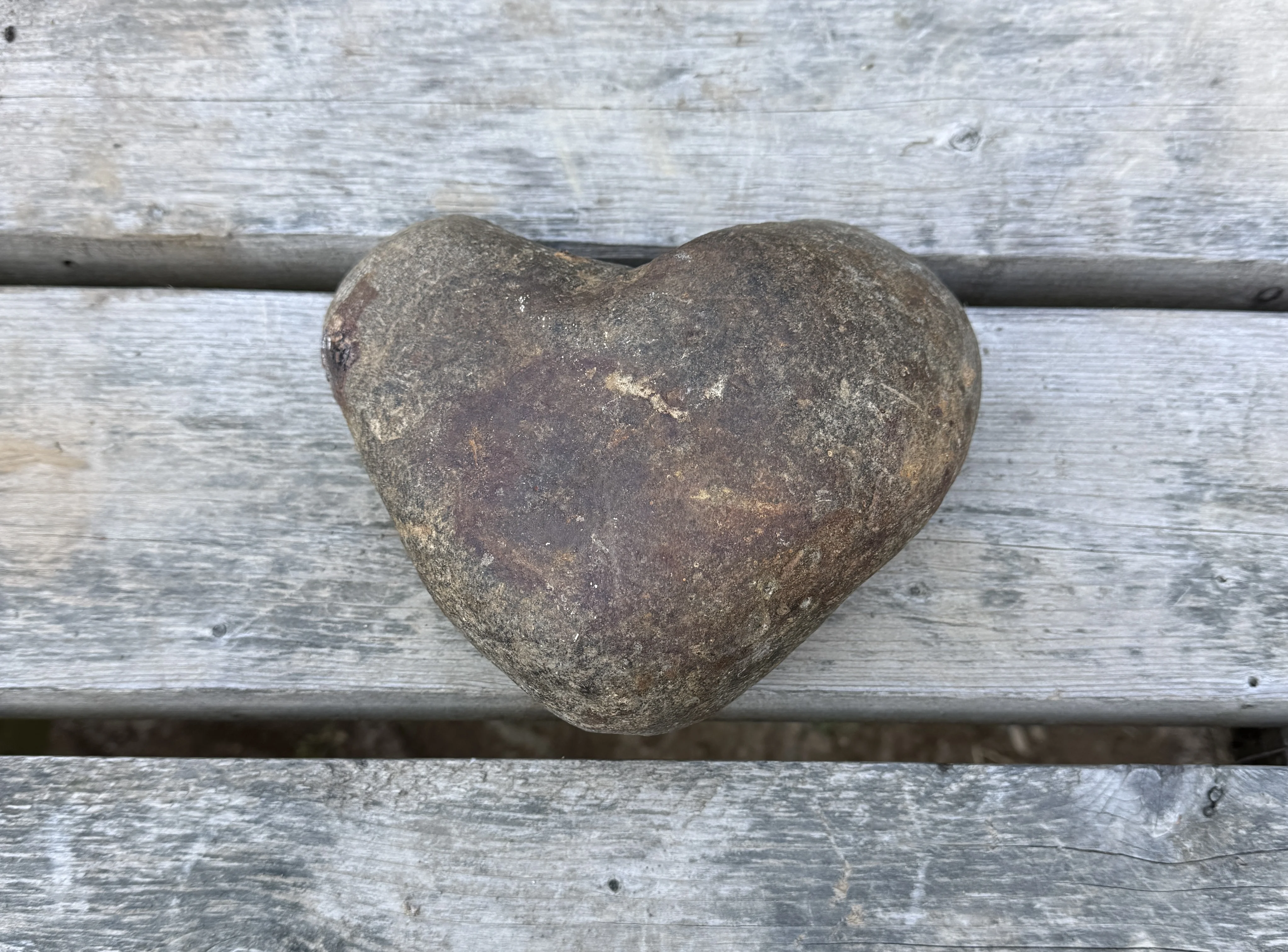 Heart-Shaped Stone (Smith's Cove)→
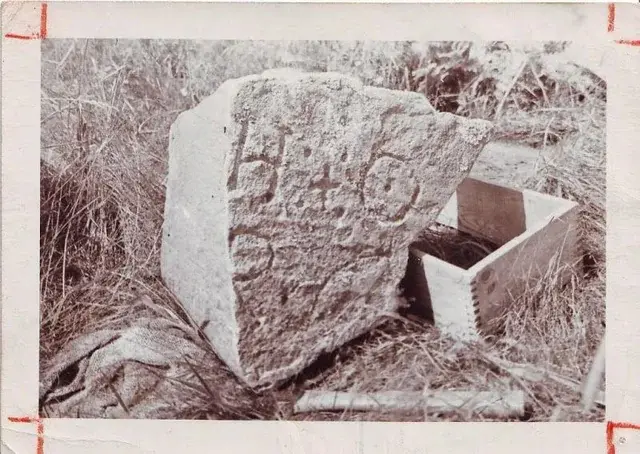 H+O stone→
In 1967, a granite boulder was overturned by a bulldozer on the east side of the island, revealing on its underside a carved letter "G" inside a rectangle. In Masonic teaching, "G" denotes the Grand Geometer of the Universe, and the east is considered the source of light. The combination of symbol, orientation, and placement carries specific meaning for any Freemason who encounters it. A metal set square recovered beneath the finger drains at Smith's Cove carries similar weight. The square, united with a pair of compasses, forms the universal emblem of Freemasonry.
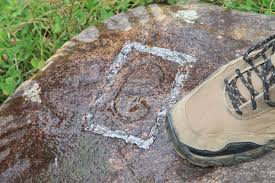 Masonic 'G' stone→
The Masonic Network
3 min
Whatever may have existed on Oak Island before 1795, the treasure hunt that followed was shaped at every stage by Freemasons. Sullivan described the realisation that searcher Frederick Blair was a high-ranking Mason; Blair's attorney R.V. Harris had risen to provincial grand master of Nova Scotia; Melbourne Chappell, who later held the same title, controlled access to the island for decades; Gilbert Hedden was among the most prominent Freemasons in New Jersey; and Edwin Hamilton had served as grand master of the Grand Lodge of Massachusetts. Treasure hunter Frederick Lewis, attempting to gain access to the island, discovered he was being stymied by what Sullivan called "an old boys' network, all of them Freemasons and most of whom belonged to the Grand Lodge of Nova Scotia."
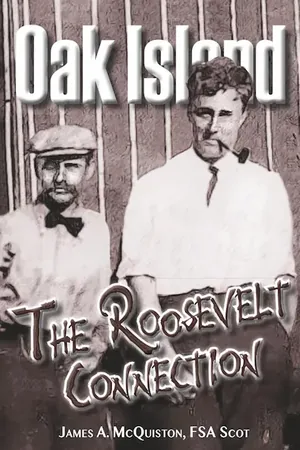
Franklin D. Roosevelt, a Freemason initiated in 1911, followed the Oak Island mystery from a boyhood visit around 1896 to correspondence about the treasure in the final year of his presidency. Actor John Wayne, also a Mason, was reportedly associated with one of the treasure syndicates. Admiral Richard Byrd, the Antarctic explorer, contributed to Oak Island efforts as well. Within a week of arriving in Nova Scotia to work on the History Channel series, Sullivan learned from cast members Charles Barkhouse and Tony Sampson that both were Masons and that membership remained widespread among men on the south shore. Barkhouse, the show's historian, readily acknowledged that "what could be regarded as Masonic symbols had cropped up again and again as the Oak Island story unfolded, and that this was probably significant." Christopher Morford, who regularly features on the show and who co-authored The Jerusalem Files with Corjan Mol, is a 32nd degree Scottish Rite Mason.
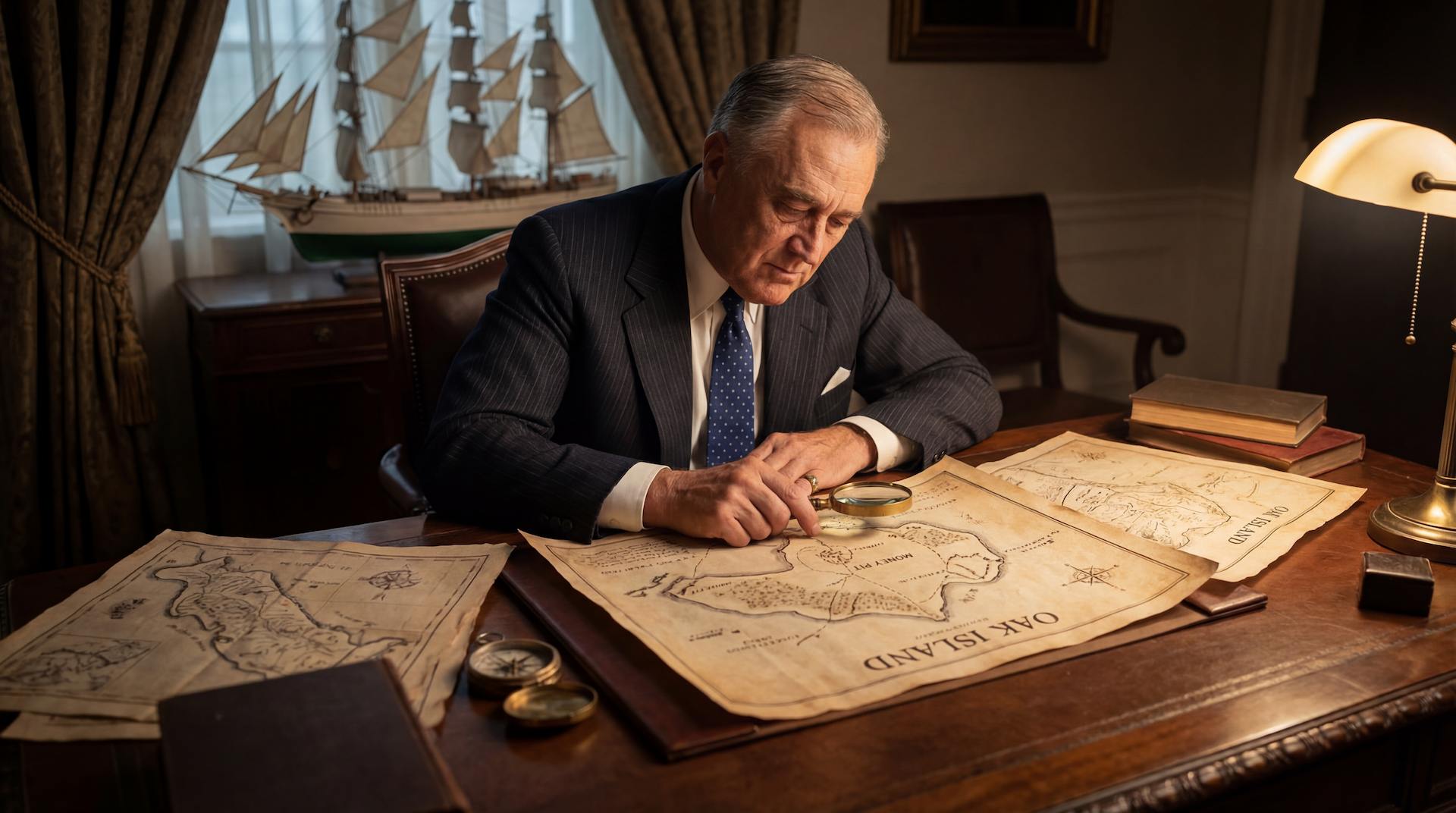 The Roosevelt Connection→
Mark Finnan, whose 1995 book Oak Island Secrets was among the first to draw explicit attention to Masonic connections, gained access to the Order's extensive library at the Grand Lodge on Barrington Street in Halifax and to rarely seen Masonic files in the Public Archives, through the assistance of past grand master Frank Milne and General Secretary Gerry Vickers. Finnan concluded that "the combined use of secrecy and religious symbolism in the creation of the Oak Island enigma, the extensive and intricate nature of the project, the time-frame scientifically established for its origin and the direct involvement of many high-ranking Freemasons in attempts to solve it makes a credible case for the theory that there is a Masonic/Rosicrucian connection to the mystery."
A physical artifact recovered during Season 13 added a further figure to that thread. Metal detection work near the cobblestone pathway in the swamp produced a small encrusted copper-alloy disc that Laird Niven and metallurgist Emma Culligan identified as a Washington Funeral Medal, dated 1800. The piece was designed by Jacob Perkins of Newburyport, Massachusetts, himself a Freemason and inventor known for his anti-counterfeiting work on early U.S. currency. It bears the likeness of George Washington on one face and a funerary urn on the reverse, with a deliberate hole for wearing at the official national memorial service held on February 22, 1800. Washington was one of the most prominent Masons in American history, initiated in 1752 and serving as Worshipful Master of Alexandria Lodge No. 22. The medal was recovered from the bog just five years after the Money Pit's first recorded discovery, raising the question of who was present on the island at that moment and why they carried it.
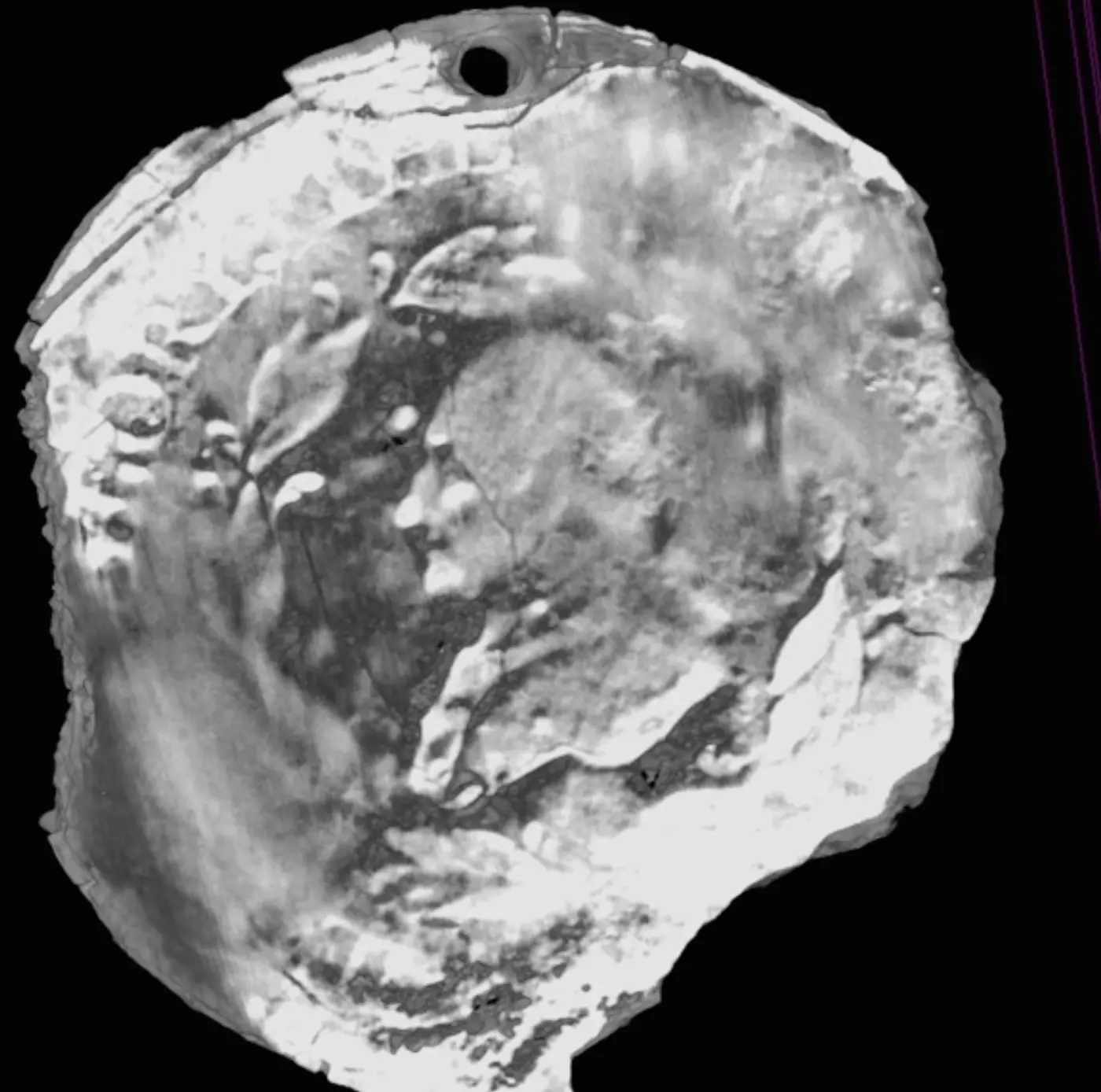 George Washington funeral urn medal, 1800 (swamp)→
Builders or Believers
3 min
The Masonic theory of Oak Island is really two theories that operate on different levels and are not mutually exclusive.
In the first, Freemasons (or their precursors) constructed the underground workings on Oak Island as a physical enactment of sacred ritual, a vault of nine arches made real. The pre-1795 lot ownership documented by Clarke, the land grants timed to Masonic feast days, the lodge connections running through multiple generations from the Belchers to Seccombe to Fife, and the physical symbols on the island all point in this direction. Clarke himself believes the vault was used for Masonic ritual purposes and was sealed off around 1785, with flood tunnels activated and the shaft backfilled with material at ten-foot intervals.
In the second, Freemasonry became layered onto the Oak Island legend as the story was told and retold by men who were themselves Masons, shaping the narrative to fit the allegories and symbols they knew from their lodge rituals. McCully's 1862 article remains the earliest published source for most of the details that parallel degree rituals. The shifting accounts of the chain links, the gold wire, and the copper wire suggest a narrative in flux rather than a stable historical record. Under this reading, Freemasons were not the builders but the believers, drawn to the island because a fellow Mason had decorated the story with symbols that spoke to their deepest teachings.
McQuiston's research complicates both interpretations by pushing the timeline further back, into the 1600s, before the formal establishment of Freemasonry as an organised body. If the connections he traces between the Knights Templar, the Knights of St. John, Mary Queen of Scots, the Knights Baronet of Nova Scotia, and the first recorded Freemasons in Edinburgh hold, then the activity on Oak Island may predate Freemasonry itself, belonging instead to the traditions and networks from which the fraternity later emerged.
That geometry received independent scientific support in Season 13, when archaeoastronomy expert Professor Adriano Gaspani of Italy applied the same stellar alignment methodology he had used in his peer-reviewed 2022 study of Nolan's Cross to the eight-sided wooden survey stakes found in the swamp. His analysis, conducted on surveyor Steve Guptil's GPS data, found that the stakes divide into two groups sharing historical alignments with Deneb in the Cygnus constellation, the same alignment that underpinned his conclusion that Nolan's Cross was constructed around 1200 AD. Both features, he concluded, were created by Europeans with Templar cultural knowledge, working to a single coordinated plan.
 The Geometry of Nolan's Cross→
The evidence cannot resolve the question on its own. What it does establish is that Freemasons have been present on and around Oak Island since before the official discovery of the Money Pit; that the physical structure of the pit, as reported, corresponds in specific and documented ways to the vault described in higher-degree Masonic ritual; that the narrative took on its most Masonic character through the pen of a single probable Freemason in 1862; and that the fraternity's involvement in the treasure hunt, from Roosevelt to the Laginas' visitors in 2014, has been continuous for more than two centuries.
Freemasonry is a society built on the principle that truth is concealed within layers that reveal themselves only to those who have been properly prepared. If that principle was applied to Oak Island, the island itself becomes what a Mason would recognise as a degree: a stage on which a story unfolds, level by level, to those willing to descend.