About This Artifact
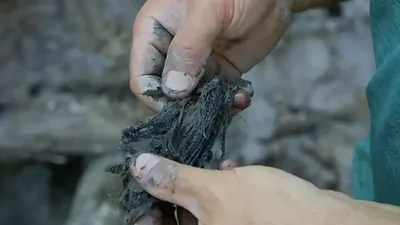
A round stone projectile recovered by Derek Couch from the Peacock-1 spoils at the wash plant. The material originated from approximately 100 feet deep in the Money Pit area. Charles Barkhouse identified it on site as a possible Portuguese stone shot, noting its resemblance to two earlier examples found on Lot 15 and in the Money Pit, both of which were traced to the Azores and Madeira Islands, former Portuguese colonies.
Archaeometallurgist Emma Culligan performed a CT scan of the artifact and identified two divots consistent with wear marks or working marks. Archaeologist Laird Niven confirmed the peck marks as characteristic of stonemasonry, noting that stone shot of this type were produced primarily during the 14th and 15th centuries. Jack Begley observed that the dating aligns with the Pitblado coin, a Portuguese tornas from the reign of Ferdinand I (1367-1383) reportedly recovered from the Money Pit in 1849.
The stone was subsequently cut in half and sent to Dr. Robert Raeside, a professor of geology and earth science at Acadia University in Wolfville, Nova Scotia. Raeside reported that the geological composition was unlike anything he had previously encountered. He confirmed his belief that this specimen, along with the two stoneshots found earlier on the island, may have originated in the Portuguese Azores. Marty Lagina stated he was 90 percent certain the artifact is a projectile dating to the 1300s or early 1400s. Historian Doug Crowell noted that the stone material could also have been sourced from Labrador, a region named after Portuguese explorer João Fernandes Lavrador and among the first areas explored by the Portuguese in North America. Alex Lagina observed that with three nearly identical spherical stones now recovered, two from deep within the Money Pit, the likelihood of a natural explanation was diminishing.
Historical Context
Emma Culligan, archaeometallurgist; Laird Niven, archaeologist; Charles Barkhouse; Derek Couch; History Channel S13E21
Where It Was Found
Found at Money Pit spoils from below 100 feet. Location: the original 1795 excavation shaft on Oak Island, Nova Scotia.