Introduction
1 min
The man who first mapped Mahone Bay and divided Oak Island into thirty-two lots was no passing surveyor. Charles Morris held the office of Surveyor General of Nova Scotia for thirty-two years, from 1749 until his death in 1781. He laid out the street grids of Halifax, Lunenburg, Liverpool, and Charlottetown. He fought at the Battle of Grand Pré, helped plan the expulsion of the Acadians, served as Chief Justice of the Nova Scotia Supreme Court, and sat on the Governor's Council under Charles Lawrence. His 1762 map of Mahone Bay is the earliest known survey of Oak Island, produced thirty-three years before the Money Pit was reportedly discovered. No understanding of the island's pre-1795 history is complete without understanding this man.
Boston Origins
1 min
Charles Morris was born on 8 June 1711 in Boston, Massachusetts. He was the eldest son of Charles Morris, a prosperous sailmaker who had emigrated from Bristol, England, and Esther Rainsthorpe. His mother was buried at the Granary Burying Ground in Boston, one of the most prominent colonial burial sites in New England, where her gravestone records her death on 12 September 1755 at the age of seventy-nine. His father was already dead by 1734, when the younger Charles was living on the family farm at Hopkinton, Massachusetts, and teaching at the local grammar school.
Around 1731, Morris married Mary Read, daughter of John Read, the Attorney General of Massachusetts. Read was a Harvard graduate (class of 1697) who had originally trained for the ministry before turning to law. The Colonial Society of Massachusetts describes him as the leading lawyer in the colony during the first half of the eighteenth century. He was appointed Attorney General in 1723, elected warden of King's Chapel in 1735, and named to the Massachusetts Council in 1742. Through this marriage, Morris entered the highest circle of Massachusetts legal and political society.
Annapolis Royal and the Battle of Grand Pré (1746–1748)
1 min
In 1746, Governor William Shirley of Massachusetts commissioned Morris as captain to raise a company of one hundred men for the defence of Annapolis Royal, Nova Scotia. This was Morris's first exposure to the colony and it would define his career. On 5 December 1746, Morris and his men were ordered to march from Annapolis Royal to the Minas region as the advance guard of Colonel Arthur Noble's detachment.
On 31 January 1747, a French and Indigenous force under Nicolas-Antoine Coulon de Villiers attacked Noble's garrison at Grand Pré in a midnight assault. The New England troops were overwhelmed. Colonel Noble was killed. Morris survived. Nicolas-Antoine Coulon de Villiers was a brother of Louis Coulon de Villiers and Joseph Coulon de Villiers de Jumonville, names that recur across the colonial conflicts of this period.
 De Villiers: The Treasure Bloodline→
The experience at Grand Pré left a permanent mark. The battle nourished a grudge against the neutral French population that Morris retained until the end of his days. He remained in service through the winter, recruiting for the Annapolis garrison, and in the spring of 1748 Governor Shirley sent him back to Nova Scotia to survey the Minas and Chignecto regions. With fifty men, Morris traversed the Chignecto Isthmus and surveyed the Bay of Fundy, at that time, in his own words, "utterly unknown to the English."
The result was a 107-page manuscript entitled "A Breif Survey of Nova Scotia" (Morris's spelling), containing a geographical description of the province, its natural resources, climate, and the settlements and population of the Acadians. Historian Andrew Hill Clark identified this document as the work of Nova Scotia's first practical field geographer. The manuscript is held at the Royal Artillery Institution in Woolwich, England, with a copy at Library and Archives Canada. Morris's published report to Shirley, detailing specific sites for Protestant settlement at Annapolis Royal, Minas, and Chignecto, was later included in the 1912 Report of the Canadian Archives Branch.
The Founding of Halifax and Rise to Power (1749–1755)
1 min
When Edward Cornwallis founded the town of Halifax in the summer of 1749, Morris was among the first settlers. Working with military engineer John Brewse, he laid out the town's street grid. On 25 September 1749, Cornwallis appointed him Chief Surveyor of Lands within the Province, on the recommendation of the Earl of Halifax. Morris went on to survey the Atlantic coast north and south of the capital, selecting sites for new townships including Lawrencetown and Lunenburg. He laid out the town grid at Lunenburg in 1753 and 1754, supervising the settlement of German and Swiss immigrants there.
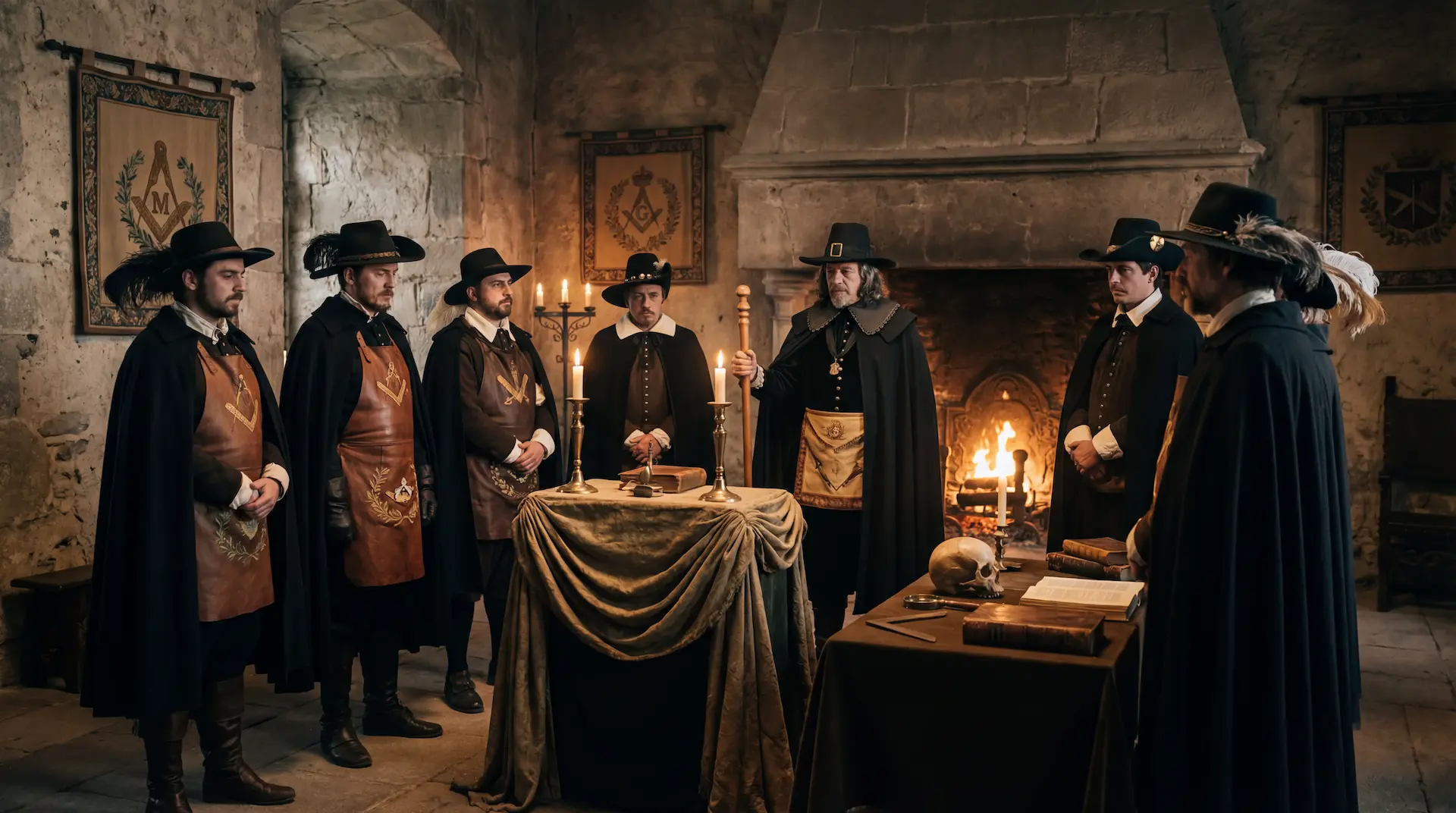
According to Reginald V. Harris, the foremost historian of Freemasonry in Nova Scotia, Morris became a Freemason at the lodge in Annapolis Royal prior to 1755. This was the first constituted Masonic lodge in Canada, founded in 1738 by Erasmus James Philipps. Morris was a close associate of Jonathan Belcher Jr., the Grand Master of the Provincial Grand Lodge of Nova Scotia, and the two sat together on Lieutenant-Governor Charles Lawrence's council. Morris eventually became one of Belcher's principal assistants when Belcher became Lieutenant-Governor.
A figure of particular interest among Morris's Masonic associates was Isaac DeCoster, who according to Masonic records also became a Freemason at the Annapolis Royal lodge around 1738. DeCoster later became the first master of the Lodge of Saint Andrew in Boston (warranted 1756), and almost certainly received the Royal Arch degree, which at that time was conferred on past masters within the Antient system. DeCoster fought at the second siege of Louisbourg in 1758 and spent time in Halifax, providing ample opportunity for contact with Morris. He would later play a founding role in establishing the Scottish Rite of Freemasonry, being made a deputy inspector general in 1781 and establishing the Sublime Grand Lodge of Perfection in Charleston, South Carolina, in 1783.
 Freemasons on Oak Island→
The 1762 Mahone Bay Survey and Oak Island
1 min
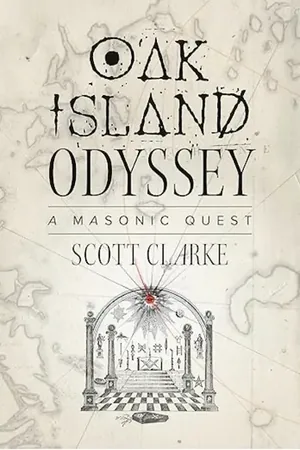
Jonathan Belcher Jr., in his capacity as Lieutenant-Governor, ordered Charles Morris to survey Mahone Bay. Morris was the first person known to have done so. The resulting map, titled "A Draught of Mahone Bay on the Sea Coast of Nova Scotia with All the Islands, Shoals, Ledges of Rocks and Soundings Done by Charles Morris Chief Surveyor," is dated 1762. The original is held at the Ministry of Defence of the United Kingdom (Hydrographic Office). Scott Clarke, a Freemason and author of Oak Island Odyssey, tracked down and purchased a copy from Library and Archives Canada in Ottawa.
Morris's earlier writings contain no mention of Mahone Bay or the south shore of Nova Scotia. His 1749 report to Shirley covers Annapolis Royal, Minas, and Chignecto in detail, but when he reaches the boundaries of his knowledge, he writes: "as I am not personally acquainted with that part of the Country I leave it." His 107-page "Breif Survey of Nova Scotia," held at the Royal Artillery Institution in Woolwich and Library and Archives Canada, has never been fully published and appears to remain largely unexamined by Oak Island researchers. The Mahone Bay survey came fourteen years after the Shirley report, on Belcher's specific orders. Whatever Morris knew or did not know about the area before 1762 is not recorded in his surviving published writings.
On this map, Oak Island appears under the name Smith's Island. Morris divided it into thirty-two lots of approximately four acres each, with the first twenty lots ranging along the northern edge and the remaining twelve along the southern shore. The survey was conducted thirty-three years before the reported discovery of the Money Pit in 1795.
The Numbers in the Survey
1 min
Two features of Morris's Oak Island survey carry significance when looked at through a masonic lens. The first is the number of lots: thirty-two. In the Scottish Rite system that would be formalized later in the century, partly through the work of Morris's lodge brother Isaac DeCoster, the thirty-second degree is the highest degree that can be earned by a member (the thirty-third is honorary and conferred by the Supreme Council).
The second is the angle of the centre road. The main road across Oak Island, as laid out in Morris's survey, does not run due east-west. It runs at approximately eighteen degrees north of due east, or 108 degrees from true north. The number 108 is the interior angle of a regular pentagon, a shape with deep significance in both classical geometry and Masonic-Rosicrucian symbolism. In the Scottish Rite degree system, the eighteenth degree is the Knight of the Rose Croix, the Rosicrucian degree.
Whether these numbers are coincidental or intentional cannot be determined from the survey documents alone. They are recorded here as documented features of a survey conducted by a documented Freemason.
 The Geometry of Nolan's Cross→
Clarke's Cipher Theory
1 min
Scott Clarke identifies what he interprets as three Masonic ciphers embedded in the 1762 Mahone Bay map. The first involves the abbreviation "st." in "st. margarets bay," where the capital T and two periods beneath it resemble the Masonic Triple Tau, the most important symbol in Royal Arch Freemasonry. Clarke found that the only other known example of this specific abbreviation style (capital S and T with two periods) appears on the original seal of Saint Andrew's Royal Arch Chapter in Boston, the chapter that grew out of DeCoster's Lodge of Saint Andrew.
The second cipher involves what Clarke identifies as Masonic-script letter A's in the name "st. margarets bay." When a circle is drawn using the arc created by these three A's, it passes through the compass rose at the centre of the map and directly over the eastern end of Oak Island.
A line drawn through the stem of the T and two dots in "st. margarets," when extended, also points directly to Oak Island. Clarke presents these three ciphers as converging on the same location: the eastern end of Oak Island, where the Money Pit would later be reported.
Christopher Morford, co-author of The Jerusalem Files, independently discovered a third pointer within the map by utilizing the arc created by the three Masonic-script A's, which, when extended into a circle, passed through the compass rose and directly over the eastern end of Oak Island.
The Morris Family and the Surveyor General Dynasty
1 min
Charles Morris and Mary Read had eleven children. Their eldest son, Charles Morris II (1731–1802), came to Nova Scotia around 1760 and assisted his father in the surveyor's office. By 1776, the younger Morris was performing the duties of the office alone, though he did not receive the formal appointment until after his father's death. He married Elizabeth Bond Leggett. Charles Morris III (1759–1831), the grandson, succeeded his father as Surveyor General in 1802. John Spry Morris, the great-grandson, succeeded his father in 1831 and served until the office was merged with the commissioner of crown lands in 1851. Four generations of the Morris family thus held the position of Surveyor General of Nova Scotia for its entire 102-year existence, from 1749 to 1851. A continuity of service only rivalled by the Wright family of Prince Edward Island.
In 1813, Richard John Uniacke, the Attorney General of Nova Scotia, purchased a 400-acre property and several additional parcels totalling 2,540 acres from the estate of Charles Morris. One of these parcels became the site of the grand house at what is now the Uniacke Estate Museum Park at Mount Uniacke, one of the most recognized heritage properties in the province.
 Richard Uniacke, Oak Island Gatekeeper→
Later Career and Death
1 min
Morris's last major surveying assignment appears to have been in 1769–1770, when he was ordered to help settle the boundaries between New York and New Jersey. He continued to attend Council meetings in Halifax and served as an assistant judge on the Nova Scotia Supreme Court, briefly holding the position of Chief Justice from 1776 to 1778. In that role, he presided over the trials of those involved in the Eddy Rebellion and the sedition trial of Malachy Salter.
Like many members of the Halifax elite, Morris owned farmland at Windsor, Nova Scotia, in the former Acadian district of Pisiquid. According to Arthur Wentworth Hamilton Eaton, Morris may have died while visiting this rural property in late 1781. On 11 November 1781, he set his hand to a codicil to his last will and testament at Windsor. Legal documents indicate he was dead two days later. He was buried at the Old Parish Burying Ground in Windsor.
The Franklin Connection
1 min
Morris's position as Surveyor General placed him at the centre of all land grant activity in Nova Scotia. In 1765, Colonel Alexander McNutt applied for 100,000 acres at Port Roseway, between Barrington and Liverpool townships, on behalf of several prominent men in Philadelphia, including Benjamin Franklin. McNutt described this land as the foundation for a new city to be called New Jerusalem. Morris's office processed these grants. Benjamin Bridge, a Freemason and cousin of Jonathan Belcher Jr. through the Belcher family, served as an assistant surveyor to Morris during the 1762 Mahone Bay survey and later settled in Chester as a neighbour of Dr. Jonathan Prescott, who owned two lots on Oak Island.
The intersection of Franklin's interest in Nova Scotia lands, Morris's authority over all survey and grant information in the province, and the Masonic networks connecting Boston, Halifax, and Philadelphia placed Morris at a nexus of colonial knowledge and influence that extended well beyond his official title.
 Benjamin Franklin's Nova Scotia Connection→
Assessment
1 min
Charles Morris mapped Nova Scotia from the Bay of Fundy to Charlottetown. He surveyed Mahone Bay and Oak Island decades before anyone reportedly discovered anything there. He was a documented Freemason in a colony where Freemasons controlled the government, the military, and the land grants. His 1762 map, if Scott Clarke's reading is correct, may contain encoded Masonic symbolism pointing to the eastern end of Oak Island. His survey divided the island into thirty-two lots with a centre road running at 108 degrees from true north.
Whether Morris knew of pre-existing activity on Oak Island, whether his survey embedded intentional symbolism, or whether these features are the product of practical decisions by a busy colonial official, cannot be established from the available record. What can be established is that no single figure had more knowledge of, or authority over, the geography of Nova Scotia than Charles Morris. He held that authority for thirty-two years, and his family held it for a century after him.
He died at Windsor in November 1781 and was buried in the Old Parish Burying Ground. His 1762 map of Mahone Bay remains the earliest known survey of Oak Island.
Sources
2 min
Primary documents by Charles Morris:
- "Report by Captain Morris to Governor Shirley Upon His Survey of Lands in Nova Scotia Available for Protestant Settlers, 1749." Report of the Work of the Archives Branch for the Year 1912, Appendix H, pp. 79–83. Available at archive.org/details/1913v47i23p29b_0960.
- "A Breif Survey of Nova Scotia" (c.1748). Unpublished 107-page manuscript. Royal Artillery Institution, Woolwich, England, and Library and Archives Canada (MG 18, F.4–F.10).
- "Judge Morris' remarks concerning the removal of the Acadians" (1755). Collections of the Nova Scotia Historical Society, Vol. II, pp. 158–160.
- Last will and testament and codicil, 11 November 1781. Halifax County Estate Papers, RG 48, Vol. 414, No. M154, Nova Scotia Archives.
Morris maps:
- "A Draught of Mahone Bay on the Sea Coast of Nova Scotia" (1762). Original at UK Ministry of Defence, Hydrographic Office. Copy at Library and Archives Canada. First known survey of Oak Island.
- "A Chart of the Sea Coasts of the Peninsula of Nova Scotia" (1755). Leventhal Map Center, Boston Public Library.
- "A chart of the peninsula of Nova Scotia" (1761). Library of Congress. Available at loc.gov/item/74691224.
Biographical and genealogical sources:
- Phyllis R. Blakeley, "Charles Morris," Dictionary of Canadian Biography, Vol. 4, pp. 559–563 (1979). Available at biographi.ca. Principal academic biography.
- Donald F. Chard, "Morris, Charles (1731–1802)" and "Morris, Charles (1759–1831)," DCB Vols. 5 and 6 (1983, 1987).
- Arthur Wentworth Hamilton Eaton, "Eminent Nova Scotians of New England Birth, Number One: Capt. the Hon. Charles Morris, M.C.," NEHGR, Vol. LXVII (1913), pp. 287–290.
- Ethel Crathorne, "The Morris family – surveyors-general," Nova Scotia Historical Quarterly, Vol. 6 (1976), pp. 207–216.
- Find A Grave, memorial for Esther Rainsthorpe Morris (1676–1755), Granary Burying Ground, Boston. Memorial ID 21029421.
- Geni.com, profile for John Read, Attorney General of Massachusetts (1680–1749). Father of Mary (Read) Morris.
The Morris House:
- Jonathan Fowler, Andre Robichaud, and Colin P. Laroque, "Dating the Morris House: A Study of Heritage Value in Halifax, Nova Scotia," Northeast Historical Archaeology, Vol. 47 (2018). Dendrochronological analysis yielding probable construction date of 1757.
- Historic Nova Scotia, "The Morris Family of Surveyors" (2020). Available at historicnovascotia.ca/items/show/186.
Oak Island and Masonic sources:
- Scott Clarke, Oak Island Odyssey (Nimbus Publishing, 2023). Primary source for the Triple Tau and Masonic-script A cipher theories, the Morris-DeCoster-Belcher connections, Benjamin Bridge, James Monk, and pre-1795 Masonic lot ownership. Clarke sourced Morris's Masonic membership from R.V. Harris.
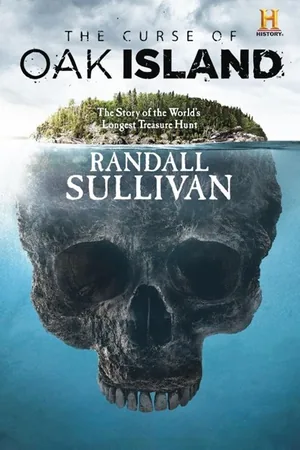
- Randall Sullivan, The Curse of Oak Island: The Story of the World's Longest Treasure Hunt (Atlantic Monthly Press, 2018). Morris's survey of Island No. 28 and division into 32 four-acre lots.
- Mark Finnan, Oak Island Secrets (Formac Publishing, 1995). Morris's 1762 survey and possible Stone Triangle connection.
- "History of Freemasonry in Nova Scotia," Chapters 1–2 (King Solomon Lodge No. 54). First Canadian lodge at Annapolis Royal, 1738. Available at kingsolomonlodge54.com.
Other sources:
- Andrew Hill Clark, Acadia: The Geography of Early Nova Scotia to 1760 (University of Wisconsin Press, 1968). Credits Morris as Nova Scotia's first practical field geographer.
- John Mack Faragher, A Great and Noble Scheme (W.W. Norton, 2005). Morris's role in planning the Acadian expulsion from 1754.
- Uniacke Estate Museum Park, "The Estate." Records the 1813 purchase of 2,940 acres from the Morris estate. Available at uniacke.novascotia.ca.
- Corjan Mol, own research