In the War Room, Rick and Marty Lagina and members of the team meet via video with Vanessa Lucido, CEO of ROC Equipment, to plan a major new dig in the Money Pit area. After recent groundwater tests identified a region where a large concentration of gold and precious metals lies buried below 100 feet, and drilling produced evidence that may include part of the fabled Chappell Vault, a massive wooden chest first reported by Frederick Blair and William Chappell at 153 feet in 1897, the team wants to install large-diameter steel caissons capable of reaching 220 feet. Vanessa recommends a seven-to-eight-foot diameter as the sweet spot for speed and recovery, which aligns with the team's internal modeling. She confirms her crews and equipment are available within weeks. Rick says he wants to make strident moves toward understanding the who, what, when, where, why, and how of Oak Island, and Marty tells Vanessa to saddle up and start heading their way.
In the northern region of the triangle-shaped swamp, Alex Lagina, metal detection expert Katya Drayton, and Billy Gerhardt continue following a cobblestone pathway discovered in recent weeks near a vault-like feature composed of brick and slate. As Billy scrapes the surface, axe-cut wood chips appear, an indicator of deliberate woodworking in the area. Rick arrives and the team uncovers a board with a stake driven through it, followed by additional boards arranged in layers. The find recalls the work of the late treasure hunter Fred Nolan, who in 1969 drained the swamp and discovered uniform lines of wooden stakes that were carbon-dated to as early as the 16th century. Nolan, a professional surveyor, believed the stakes were placed by whoever created the swamp to hide multiple caches of treasure.
On Lot 5, Craig Tester joins archaeologists Fiona Steele and Moya MacDonald at a large stone foundation near the shoreline. Over the past two years, excavations have revealed man-made mortar matching clay-like soils from more than 100 feet deep in the Money Pit area, along with multiple construction phases predating the Money Pit's discovery. The site has produced 18th-century pottery, a 17th-century coin, Venetian trade beads, and a 14th-century lead barter token that, like the lead cross found at Smith's Cove in 2017, may be connected to the Knights Templar. The team now investigates a gap between rocks that could be an entranceway into the semicircular feature.
In the War Room, Rick presents research conducted by Doug Crowell, Judi Rudebusch, and historian Terry Deveau at the Connecticut Museum of Culture and History. They recovered what they identify as the Blair treasure map, a document connected to previous searcher Frederick Blair that indicates three separate treasure caches on Oak Island. Armed with the map, Rick and Gary Drayton travel to the western side of the island near Lot 18 or Lot 25, an area rarely investigated and on the opposite side of the island from the Money Pit. Gary identifies a stone matching a marker on the map, observes an X carved into it, and his metal detector returns a loud, clear signal. He calls it a top-pocket find and notes that the discovery transforms the map from a theoretical document into evidence of human activity at the site, possibly dating back as much as six centuries.
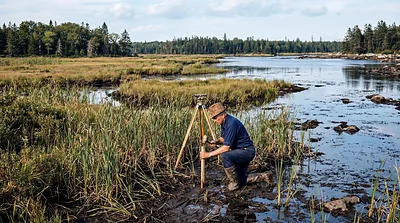
Geoscientist Dr. Ian Spooner and surveyor Steve Guptill visit the northern swamp to examine the newly uncovered wooden platform and stakes. Spooner notes that the stakes are reminiscent of those found along the stone path near the stone road in the southeast corner of the swamp, which he previously carbon-dated to the 17th century. Guptill measures the elevation and finds it matches the cobblestone path, leading the team to theorize that the platform represents the transition point where the path meets dry land. Spooner collects samples from the center of a stake for carbon-dating, hoping to determine whether the feature was built at the same time as the stone road and what its relationship might be to the vault-like structure discovered nearby.