At the Research Center, Rick Lagina, Marty Lagina, and Craig Tester review the drilling program with Steve Guptill and Scott. Steve shows the list of boreholes completed this year: four remain in the Baby Blob and Pie area, after which the team will move into the Golden Circle, where testing has revealed high levels of copper, lead, zinc, and tin. Marty renames it the Golden Egg. Rick suggests a grid pattern while maintaining the monitoring wells, and the first new borehole, EN13, is placed at the southern edge of the Golden Egg where it overlaps the Baby Blob. Alex Lagina, Terry, and Charles supervise the drilling. The next day, Adam brings over a core from 89 feet. Terry says the material is solid but hopes the next sample will be better. It arrives softer at the bottom, a sign they could be near a target. Mike tells Rick he thinks they have hit wood because the drill stiffened, though the core from 99 feet contains no wood; the material is soft, which could still indicate proximity to a feature. Rick asks Dr. Ian Spooner to collect a water sample and then start the next borehole five feet away. Later, Dr. Spooner tells Rick that while sampling EN13 he heard a sound like thunder lasting about 30 seconds, which he attributes to a collapsing void. A water sample he collected is darker in color, possibly indicating the presence of nearby wood.
On Lot 5, Jack Begley and Laird Niven search for metal targets that Gary Drayton flagged earlier. Jack sifts through the soil Laird removes and finds what appears to be an old coin with heavily worn edges. Both agree numismatist Sandy Campbell should examine it. Nearby, Alex, Laird, and Fiona continue investigating the rounded stone feature. As Alex digs, he hits rocks that could be another section of the structure. The next day, Fiona finds a pattern of rocks that look deliberately placed, and Laird identifies a possible hollow area within the foundation.
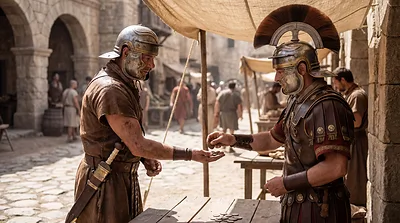
In the lab, Sandy Campbell examines the coin. He notes the irregular shape indicates it was hammered rather than struck, dating it before 1650. Sandy identifies what he believes is a horse in the design and suggests the coin could be Roman. Emma Culligan's scan shows 70 percent copper and 16 percent lead, with high levels of arsenic and sulfur. Gary texts Rick to come to the lab. When Rick arrives, Craig calls Marty so he can hear Sandy's findings. Sandy tells them everything points to the coin being late Roman, likely from 200 to 300 AD. He adds that copper coins circulated for extended periods and the Vikings were known to repurpose coins they found.
At the Research Center, Rick and Marty meet with Doug Crowell and Emiliano Cataldi to discuss Norse activity in North America. Doug explains that by 875 AD the Norse had reached Iceland and by 985 Greenland. The only known Viking settlement on the continent is L'Anse aux Meadows in Newfoundland, 625 miles northeast of Oak Island, which was active in 1021 AD. The Viking Sagas suggest the Norse and their descendants may have traveled further south. The team decides to visit L'Anse aux Meadows and will bring artifacts found on Oak Island for comparison, including an arrowhead supposedly recovered by Robert Dunfield and a Scandinavian whistle found near Smith's Cove in 1885. Mary B. Steward, a New York financier of the 1932 expedition, had the whistle examined by museums including the American Museum of Natural History, where it was identified as most likely Scandinavian and made from walrus tusk ivory, the material Vikings were trading in Greenland around the 1200s. Emiliano suggests there could be more Viking camps in Canada, possibly including one on Oak Island. Other Oak Island artifacts traced to Scandinavia include a pickaxe and a decorative lead piece.