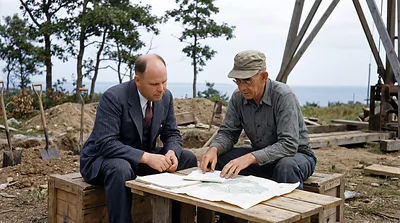
The team begins borehole HN15.5 based on data from Jan Francke, who indicated a possible void or structure at 127 feet the previous week. No historical record of activity in this area exists. Rick Lagina arrives as a core spanning 119 to 129 feet is brought over. Terry examines it and says the material is in situ with no evidence of a void. Separately, drilling continues in borehole D.5-7.4, several feet northeast of F4. At 98 feet, Mike reports hitting wood. Terry says the wood sits below undisturbed soil. The core from 108 feet brings more wood, and the group suspects a large tunnel. Rick and Scott arrive, hear the report of a possible nine-foot-tall tunnel, and instruct the team to take the borehole to bedrock.
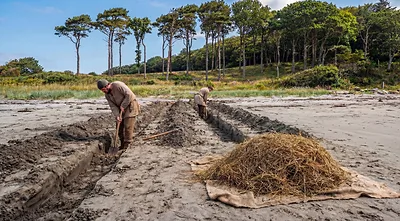
At Smith's Cove, Rick and Craig Tester observe the ongoing excavation in the search for the flood tunnel that feeds seawater to the Money Pit. Billy Gerhardt reports hitting rocks and clay at the bottom of the trench, and Rick asks to deepen it. The next day, Rick spots a board. After he removes it, Gary Drayton scans the area and finds a large bolt that is probably modern, followed by modern nails and then a broken spike of uncertain age that will be sent for testing. The team feels they are close to the tunnel, and Rick says to keep digging. Along the shoreline, 50 yards from Smith's Cove, Gary and Alex Lagina metal-detect an area where spikes predating the Money Pit and a 14th-century lead cross have previously been found. Gary picks up a signal, and Alex begins digging. After draining water from the hole, Alex and Peter Fornetti continue until Alex strikes a large, heavily encrusted object. The team hopes scanning will reveal additional artifacts trapped in the concretion.
In the War Room, the team hears a new report from Dr. Ian Spooner, Dr. Lukeman, and Dr. Fred Michel on groundwater testing. Dr. Spooner presents a chart showing water movement and wells with high metal values, noting that every well tested to the north shows no anomalous results; the team does not believe any metal lies north of the Baby Blob. Marty asks why tin has not appeared in this year's testing, and Dr. Spooner explains that each new borehole dilutes the sample. Dr. Michel tells the group there is something in the water that is not natural. Dr. Spooner adds that when they were digging near the Hedden and Chappell shafts, elevated metals appeared to the north, suggesting the Baby Blob was receiving metal-rich water. Steve Guptill identifies an area on the map where borehole F4 tested consistently for gold and silver and suggests placing a new borehole there. This area is also where the team collected soil samples from 100 feet deep that matched a mortar-like substance found on Lot 5. On Lot 5, Fiona tells Peter and Ethan that the number of artifacts already recovered demands investigation of certain areas first. Peter and Ethan move a rock so Fiona can search the soil beneath. She uncovers shards, pieces of brick, bone, and a large pocket of charcoal, all pointing to a date around the 1780s.
In the lab, Rick and Gary meet with Laird Niven and Emma Culligan to hear the analysis of the encrusted object from the shore. The item was too large for the CT scanner, so the team used a hammer and chisel to remove the concretion, revealing a cast-iron stove door. Gary notes the starburst design reminds him of the button found on Lot 5 with a similar pattern. They plan to research the design's origin. Emma reports a few items were embedded in the concretion that she scanned with the XRF. The door is cast iron, and its manganese content places it in the 1800s.