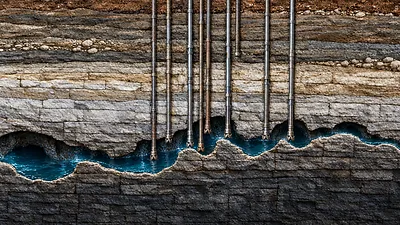
With TOT1 (The One Thing) reaching 195 feet and the caisson unable to advance further, the team shifts to airlifting material from the solution channel, blasting air at 300 pounds per square inch down the shaft. Marc Chaisson and Cherity Nauss handle hydro evacuation using an industrial-grade water jet and suction pump, feeding material into a 3,500-gallon tank for transport to Smith's Cove, where Gary Drayton scans the spoils. Rick Lagina spots a wooden dowel among the material, and Gary quickly picks up a hit. Marty Lagina pulls out what appears to be the working end of a pick, sized for tunneling and possibly the matching piece of a tool recovered the previous week. A second target yields a hand-forged pick or chisel.
On Lot 5, archaeologist Laird Niven shows Rick and Marty a hollow space containing a nail. Gary picks up a nonferrous signal nearby, and Fiona excavates hand-painted pottery dating to as early as the 1770s, followed by what appears to be a coin or token.
At the final meeting of the year, Laird reports that eight pre-1760 items were recovered from Lot 5 this season alongside artifacts dating from 1760 to 1820, confirming activity on the site earlier than previously documented. A button initially mistaken for a coin proves to have a silver gilt body with very high arsenic content in its copper. Emma explains that arsenical copper points to medieval-era production by a skilled metalworker who refined and recycled the material, while the copper-iron alloy composition places it in the 1600s to 1700s. Alex adds that a Malta-based button expert identified the starburst button as possibly Spanish, dating it to 1650 to 1675, with carvings resembling the button found at the Cittadella.
The team reviews the season's swamp findings: multiple sections of cobblestone path bordered by wooden survey stakes dating to the 17th century, a line of stacked boulders believed to be an artificial seawall, and a vault-like structure of brick and slate also from the 17th century. Steve places the major construction period between 1630 and 1750, while Dr. Spooner compares the swamp to a highway running across the island; Rick estimates the team has explored only 30 percent so far. Emma reports that the chisel and pick recovered from TOT1 are clean iron with consistent potassium content, indicating a charcoal-based manufacturing process dating to the early to mid-1700s and possibly as far back as the 1650s. Scott notes the pipe stem from RP1 dates to 1680 to 1710. Steve then presents a map of the Money Pit area: over 500 boreholes and 27 caissons have been placed, yet only 20 to 25 boreholes reached the bottom of the solution channel and just four caissons hit bedrock, leaving more than 80 square feet unexplored. The season closes with the team weighing a deep drilling program against a full-scale big dig to finally reach the Money Pit.