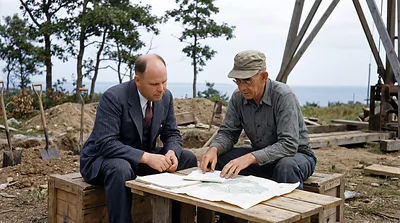
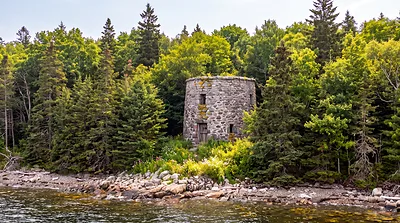
In the swamp, Craig Tester, Alex Lagina, Billy Gerhardt, and Dr. Ian Spooner investigate one of the features recently found in the northern section. Dr. Spooner observes that the rocks in the path are uniform in size with no gravel, a distribution he says would not occur naturally. Craig asks Gary Drayton to scan for metal. On the way over, Gary finds a piece of pottery that Laird Niven identifies as refined earthenware from the 1860s to 1870s. The group discusses whether these features could be connected to Anthony Graves. Gary begins scanning the cellar-like vault and recovers a large piece of iron pipe, which Laird takes to the lab. Rick Lagina and Tom Nolan arrive to see the vault for the first time. Tom says he has never encountered anything like it. Rick pulls a piece of glass from the bottom that Laird identifies as machine-made and from the late 1800s. Tom notes that two wells found on the Graves property were both round, making this slate-and-brick structure different. Katya Drayton scans the vault and gets a hit. Rick pulls out bricks and then what appears to be a handle, and asks Laird to plan a full excavation. The following day, the feature is partially drained. Katya scans again and picks up a couple of signals. After further draining, Rick recovers what looks like a wrought iron hook. Tom suggests the hook was used to lower or remove items from the structure.
In the War Room, Rick meets with the team by video conference with Dr. Michael Pisaric, an earth sciences professor at Brock University in St. Catharines, Ontario. Dr. Pisaric has been analyzing wood samples from Shaft 2 using dendrochronology. He presents sample 0021 and says he is very confident about the dating: 1784. The team debates whether the wood was placed by depositors or reused from an earlier structure when Shaft 2 was built. Since Shaft 2 sits 14 feet from the Money Pit, Steve Guptill uses the information to place the Money Pit over the corner of the Hedden Shaft and suggests drilling to the southeast. Dr. Spooner adds that new water testing indicates precious metals in that area.
Steve, Terry, and Charles supervise the drilling of borehole H.5-10.5 at the southern edge of the Hedden Shaft, constructed in 1937 by Gilbert Hedden. A core from 146 feet contains pieces of wood, placing the drill 22 feet below the bottom of the Hedden Shaft. In the 1940s, Erwin Hamilton also hit wood below the shaft. Hamilton had built a six-by-six-foot extension onto the bottom and, while drilling from it, struck a wooden structure at 153 feet. Terry describes the current core as loose, which could indicate proximity to a structure. The next sample, from 173 feet, is in situ, with over 10 feet of solid material. Terry calls the hole complete, and the team moves to the next target.
On Lot 5, Fiona, Ethan, and Jack Begley continue work at the rounded stone feature. Ethan digs out a Robert Young peg numbered 5-025. Between 1996 and 2020, Robert Young marked any finds with these pegs, which included iron tools and medieval coins. Jack calls Laird to check the database, and Laird reports that peg 5-025 corresponds to a silver 1781 Spanish half Real. In the lab, Rick, Craig, and Katya meet with Emma Culligan and Laird to hear results on the vault artifacts. Emma's CT scan reveals the handle is wrought iron, and Laird notes the square shape indicates it functioned as a crank, used to move something. Emma dates the hook to the early to mid-1800s based on its manganese content. The pipe and the crank, however, date to the late 1700s, leading the team to conclude the vault was constructed before the discovery of the Money Pit.