Alex Lagina arrives at the Money Pit to check on RP3, positioned just north of RP1 and RP2 and slightly outside Shaft 6. Adam explains that this hole differs from the previous two because the team is coming off it at an angle. The shaft sits at 67 feet, with the target zone expected the following day. By the next session, John reports a depth of roughly 110 feet, and pressures are climbing in a way that suggests wood. The hammer grab confirms it, producing numerous pieces that could be from Shaft 6. Adam updates the depth to 116 feet. The next grab, however, returns nothing but clay and soil. Marty tells Rick Lagina he suspects the material they are looking for went into the solution channel. At 120 feet, Marty calls RP3 complete and says the team has time for either two shallow or one deep caisson before the season ends.
In the northern swamp, Rick, Jack Begley, Gary Drayton, and Alan Kostrzewa continue searching for features. Alan excavates and Jack identifies a layer of organic material beneath the C-horizon, suggesting the ground has been disturbed before. Gary scans the area and gets a hit. Jack uncovers wood with a large iron pin driven through it, and a second pin follows shortly after. Gary notes the weight and striations of the pins suggest they date to the 1700s or earlier and speculates they could be from a wharf or gate, or possibly from the wall Fred Nolan found in this area more than 50 years ago. Alan then unearths a piece of wood roughly 10 to 12 inches long, close to the size of the timbers Fred described. The next scoop reveals three boulders in a line along with more wood. The following day, Rick and Tom Nolan continue clearing around the boulders and discover a cut log pinned against the rock. Gary observes from the top of the spoil pile that the line of boulders is clearly visible. Steve Guptill arrives to record the orientation and elevation, and tells Rick he believes it is a seawall that may have been used to create the swamp.
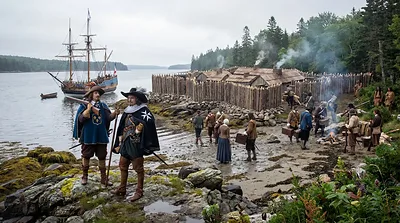
At the Oak Island Museum, Judi Rudebusch presents research drawn from the books John Edwards acquired, connecting the Knights of Malta to Oak Island. Judi explains that the Knights of Malta traveled and fought alongside the Templars, beginning as the Hospitallers in Jerusalem before becoming the Knights of Rhodes and ultimately the Knights of Malta. After the Templar dissolution in 1312, all Templar assets passed to the Hospitallers, who moved to Cyprus, then Rhodes, and by the 1550s to Malta, where they began digging tunnels and constructing works similar to what has been found in the Money Pit. Judi then discusses Isaac de Razilly, a descendant of the de Villiers family, who were grand masters of Malta, and himself a Knight of Malta. Doug Crowell adds that de Razilly arrived in Nova Scotia in 1632 or 1633 and settled his capital on the LaHave River near Oak Island. Judi draws further connections to Lot 5, pointing out similarities between the sunburst button found there and buttons from Knights of Malta uniforms, and noting that the Venetian beads recovered on Lot 5 originated near where the Knights were based. Marty suggests the team should travel to Malta.
On Lot 5, Ethan recovers pieces of blue bottle glass, matching earlier finds from test pit 28. While digging, Moya MacDonald discovers another Venetian trade bead that closely resembles one she found several weeks earlier.