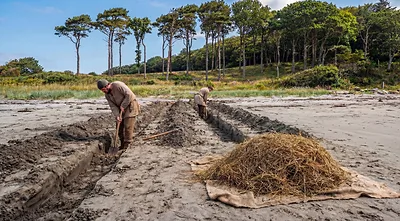
Billy Gerhardt continues searching for the flood tunnel at Smith's Cove while Peter Fornetti and Gary Drayton check the spoils. Craig Tester arrives, and Gary reports no artifacts yet. Rick Lagina notices a board just above water level, and Craig calls Steve Guptill to mark the exact position. Steve confirms the board sits on the projected line of the flood tunnel. As Billy continues, three boards are exposed before a section of the trench begins to collapse. Rick spots a board in the trench wall, and when Billy pulls it free it turns out to be a piece of concrete. Billy then extracts a large beam that the group agrees was not machine-cut and would have been too large for the Restalls to position. The concrete will go to Emma Culligan for testing. The next day, Billy resumes digging and exposes another beam at more than 30 feet deep. Craig wants it recovered for dendrochronology. Further digging reveals rocks and cobbles that Billy believes could be significant, possibly part of the vertical shaft. Rick arrives after Craig reports evidence of a possible flood tunnel, and Craig tells him the find appears manmade.
In the War Room, Rick and the team meet with Dr. Jan Francke, a geophysicist who designed technology used to scan the pyramids of Giza and the subsurface of the moon. Craig has invited Francke to help locate targets using a 100-megahertz Helix borehole radar antenna, which sends electromagnetic pulses through the earth to identify anomalies such as structures, voids, and metal objects. The technology can determine the depth and approximate distance from the borehole of any target. Jan will be looking for air- or water-filled voids, which produce strong reflections.
Jan and Craig begin scanning borehole HN16, located in the Golden Egg just 18 feet north of the Garden Shaft. In the War Room, Emma presents her analysis of the concrete from Smith's Cove. The XRD detected a trace of portlandite, placing the sample in the Portland cement category, the most common type used in modern construction. Emma narrows the source to one of only two locations in Canada that have portlandite: Quebec or British Columbia. She says Quebec is more likely because the aggregates and sand appear to be Nova Scotia-based. The Quebec facility began using hydraulic mining in the 1920s, and the sample was hydraulically mined cement. She rules out anything post-1980s because modern concrete additives are absent. The sample was also not mixed thoroughly, a characteristic consistent with concrete poured to fill a floodgate. Rick concludes they need to find the vertical shaft.
On Lot 5, Moya MacDonald and Ethan continue digging at the stone feature. Moya finds what appears to be the top of a wine bottle, followed by a piece of metal strapping. Jack Begley wonders if the strapping is from a chest. Helen arrives and suggests the wine bottle piece is French based on its pale olive color. She wants the strapping scanned to determine whether the bend is damage or intentional. In a second War Room session, Jan Francke presents the GPR results. He reports that 12 feet appears to be the maximum range from a borehole. He identifies a void three to four feet from the borehole at a depth of 127 feet in the Golden Egg, filled with water that does not appear to be saltwater. The team decides to drill another borehole once Dr. Ian Spooner finishes collecting water samples.