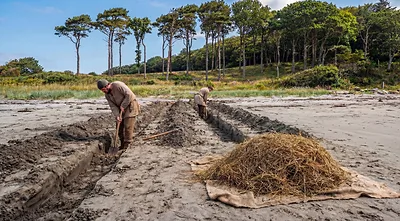
Terry, Charles Barkhouse, and Steve Guptill monitor the progress of borehole FN15.5, located in the southern part of the Golden Egg where Dr. Fred Michel believes the metals detected in the water are originating. The borehole sits just 5 to 10 feet from the Garden Shaft, where the previous year the team hit a possible flood tunnel while probe-drilling the bottom, sending saltwater pouring in at 700 gallons per minute. Rick Lagina arrives as a core from 89 to 99 feet comes over. Terry says the material is slightly soft but they will wait for the next sample, which proves about the same. The team selects a location for the next borehole. Drilling of GN16 begins 13 feet from the Garden Shaft in the Golden Egg. Cores from 109 feet are firm, and the following sample is similarly solid with little sand and silt.
At the Research Center, Rick, Marty Lagina, Steve, and Scott discuss a possible dig at Smith's Cove. Scott explains that the Restalls believed they had found the flood tunnel and shows where they placed the convergence point of the finger drains. Because the convergence sits at tidal level, a special permit would be needed. Scott proposes digging on the inland side of the road to locate the tunnel and follow it toward the Money Pit, close to where the Restalls found a stone-lined vertical shaft and pumped concrete into it in an attempt to seal the flood tunnel. Most of the concrete never set properly. Using Bobby Restall's 1963 survey map, the team begins searching. At depth, roughly 7 feet from the target and 30 to 40 feet down, Billy Gerhardt starts pulling out cobbles of similar size. Rick notes the flood tunnel was historically described as three feet by four feet and packed with head-sized stones. Billy and Rick examine the area and decide to look for more cobbles. Several timbers also appear, and the group debates whether the Restalls reused them. Rick then finds a piece of concrete in the material and sends it to Emma Culligan for analysis.
On Lot 4, Craig Tester and Gary Drayton search 10 tons of spoils removed from the round feature on Lot 5. Gary picks up a hit and finds a button he estimates at mid-1600s to mid-1700s, probably from a tunic. He then detects a piece of lead that he calls a coin weight, possibly used for payroll or by a merchant. In the lab, Rick and Gary meet with Laird Niven and Emma for the scan results. Emma reports the button is a copper-iron alloy with high lead content and no aluminum, which she believes makes it English and from the 1700s to early 1800s. Laird notes the lead piece weighs 26.2 grams; if it is a coin weight, it would correspond to a large coin such as a gold coin. Emma, however, finds the phosphorus content unusually high, a characteristic not seen in lead alloys until the mid-20th century. Laird adds that after 1066, coin weights transitioned from lead to brass. Emma recommends laser ablation to determine the origin and age of the lead. Rick also wants an expert to examine the piece.
In the War Room, the team discusses the water testing program. Dr. Ian Spooner warns that continued drilling in the Golden Egg is dispersing the metal particles, creating a dilution plume that could make it difficult to pinpoint the source. He wants to pause drilling and recheck the data.