Repairs to the Money Pit pad continue as more than 50 tons of gravel are laid down to stabilize the area for another seven-foot shaft intended to reach the solution channel. In the lab, Marty, Charles, and Jack meet with Laird Niven and Emma Culligan to review scans of a button recovered from Lot 5. Laird draws attention to the button's robust, nearly rectangular eye, a feature that would place it earlier than the mid-1700s. The scan reveals an ornate design on the face. Emma reports that the back is mostly leaded brass while the body is zinc and copper, a less refined manufacturing method that could indicate an older technique, and she dates the piece to the mid-1600s through the 1700s.
On Lot 1, Marty, Craig Tester, Steve Guptill, Gary Drayton, and Jack search for valuables using the Blair treasure map that Terry Deveau, Doug Crowell, and Judi Rudebusch presented to the team earlier in the season. The map depicted three boulders that Blair believed were placed centuries earlier to mark treasure deposits. Marty removes the first boulder and Gary immediately picks up a signal. Jack unearths a hand-forged fastener, and when Marty pulls out the timber beneath the boulder, a wedge appears alongside it. Further digging reveals a ring of boulders. The team clears a five-foot radius, and Gary picks up another hit, this time producing a wrought iron pin. A third target yields yet another piece of hand-forged iron before the team moves on to the next boulder.
On Lot 21, the team locates the second boulder from the Blair map. Steve identifies it as the anchor stone from which every measurement on the map was calculated. Gary scans before the boulder is moved and finds an ox shoe. Once Marty lifts the stone and digs beneath it, angular rocks appear that resemble those found in the paved area of the swamp. Gary's follow-up scan produces no further hits, and Marty digs until he reaches the C-horizon. He concludes the boulder was deliberately placed as a reference point rather than a marker for a deposit.
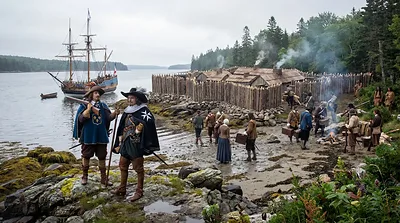
In Malta, the team visits the Old Prison in the Cittadella in Gozo, reconstructed in 1599 and believed by some to have been used to conceal Templar-related treasures. Corjan Mol tells the group that prisoners held here carved symbols into the walls, and the team begins searching for markings that might connect to Oak Island. Emiliano Cataldi identifies a four-dot cross carved into the stone, which Doug notes was used to represent the presence of holy relics. Alex spots a six-petal symbol, and Rick finds one that matches a symbol on the 90-foot stone. At the Palazzo Falson in Mdina, a museum housing the collection of Captain Olof Frederick Gollcher OBE, Corjan presents research tracing a single family bloodline across every major Hospitaller and Templar stronghold and connecting it to Oak Island. In 1187, Guillaume de Villiers served as second in command of the Knights Hospitaller in Jerusalem. By 1307, Gérard de Villiers held the title of Master of France, the most powerful Templar in the country, and historical records place him leading 50 horses out of Paris and sailing with 18 galleys, believed to be carrying the Templar treasure. Some of the fleeing knights are thought to have reached Scotland or Portugal. The de Villiers name resurfaced in Rhodes in 1522, where Philippe de Villiers served as Grand Master of the Knights Hospitaller before the order took possession of Malta and Gozo in 1530. The line continued through Catherine de Villiers, mother of Isaac de Razilly, a Knight of Malta who landed at LaHave in 1632 and established the French colony of Acadia, now known as Nova Scotia.
Back at the Oak Island Museum, the two groups reconvene. Marty reports that the Blair map search turned up hand-forged iron but no treasure. Dr. Spooner notes the anchor boulder appears to have been moved at some point, as has the other stone. Marty shares the Lot 5 button results, and Alex observes that its scan resembles the six-petal carving found at the Cittadella. Rick describes the pick marks visible in Malta's underground tunnels, and Alex recounts how Corjan traced the de Villiers bloodline from Jerusalem to Nova Scotia.