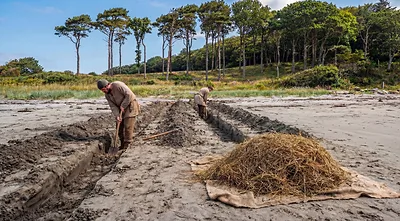
At the Research Center, Rick Lagina meets with Scott, Doug Crowell, and Steve Guptill to plan the next borehole. The previous week, the team found what appeared to be a collapsed tunnel at about 98 feet while drilling borehole D.5-7.4. Meanwhile, Dr. Ian Spooner's groundwater testing has stopped detecting precious metals in the Baby Blob, with the source now appearing more than 40 feet to the southwest. Rick reviews the 3D model and the team selects E.75-5.6 as the next target. Gary Drayton arrives with his daughter Katya, who will join the team as a metal detectorist. Rick assigns her to Smith's Cove, where the search for flood tunnels continues. Craig Tester, Billy Gerhardt, Jack Begley, and Katya begin work at Smith's Cove. They quickly get a hit and Jack unearths a large piece for lab scanning. As Billy digs, Craig notices a beam, and Billy exposes three vertical beams running up one side that Craig thinks could be a shaft. Billy pulls out a notched piece of wood, and more timber appears. The next day, Rick and Scott check on progress but learn nothing further has emerged. The trench has reached about 40 feet, the excavator's maximum depth. Rick calls Smith's Cove done for now.
On Lot 5, Laird Niven works in an area he calls an "annex" to the main foundation, attempting to expose the north wall after removing large stones the previous year. Helen, Moya MacDonald, and Jillian Parsons work nearby, where Helen finds part of a TD pipe stem. TD stands for Thomas Dormer, an English pipemaker from the mid-1700s. On Lot 4, Jack and Gary metal-detect spoils from the Lot 5 stone foundation. Gary finds a button, then a small lead ball, and finally a small piece of silver that appears hammered. Jack texts Helen, who arrives and agrees it looks like a possible cut coin.
Work continues on borehole E.75-5.6, positioned 11 feet southwest of where the team found evidence of a nine-foot-high tunnel the previous week. Leighton brings over a core from 109 feet. Terry and Charles examine it; Terry says the material appears in situ, but Charles spots pieces of wood. The next core contains blackened wood. To the team's knowledge, there are no recorded tunnels in this area. A core from 123 feet holds more wood, and another from 149 feet produces a substantial amount, including what Terry describes as a sequence of plank, beam, and plank that appears collapsed. He then notices what looks like concrete, though he notes that limestone could be mistaken for it. Peter Fornetti points out the significance: the findings match the description of the Chappell Vault, discovered in 1897 by Fredrick Blair and William Chappell at a depth of 153 feet. Rick arrives shortly after being notified.
In the lab, Rick, Scott, and Gary meet with Laird and Emma Culligan. Emma's XRF scans show the hammered silver contains high aluminum, indicating it is modern. The lead ball, however, proves more interesting: it is pitted, composed of pure lead with no alloying elements, which would indicate it is not modern. Emma estimates it predates the 1700s. Other artifacts recovered from the same area and dated to before the 1700s include the scalloped disc and the starburst button.