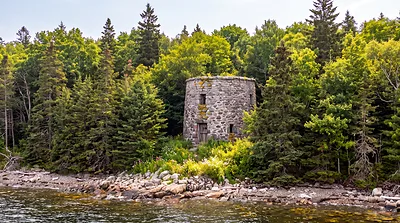
About This Structure
The concrete wall was discovered at Smith's Cove during the Lagina team's Season 6 excavation, buried approximately three feet below the ocean floor near the slipway and the U-shaped structure. It measured five inches thick and three feet tall, entirely unrecorded in any searcher documentation from 1850 onward. Embedded in the bottom of the wall were two connected rubber tubes. Archaeologist Laird Niven noted he had found rubber artefacts dating to the 1850s at other sites, and the team considered the possibility that the rubber tubes were a later addition drilled through an existing structure.
Dan Blankenship, who had worked at Smith's Cove for decades, had no record of the wall and suggested it predated Robert Restall's operations, noting that earlier searchers were often too focused on treasure to keep proper records. Rick Lagina observed that the Romans had developed hydraulic concrete capable of setting underwater as early as the third century BC, mixing volcanic ash with minerals to create a compound that hardens in seawater. Marty Lagina raised the possibility that the concrete was far older than the rubber tubes and that a later searcher had drilled through the pre-existing wall.
In Season 12, geochemist Emma Culligan analysed a concrete sample recovered from the Smith's Cove area. Her X-ray diffraction results detected a trace of portlandite, placing the sample in the Portland cement category. She narrowed the source to one of only two locations in Canada with portlandite deposits: Quebec or British Columbia, with Quebec more likely because the aggregates and sand appeared to be Nova Scotia-based. The Quebec facility began using hydraulic mining in the 1920s, and the sample was consistent with hydraulically mined cement. Culligan ruled out anything post-1980s because modern concrete additives were absent, and noted the concrete was not mixed thoroughly, a characteristic consistent with cement poured to fill a floodgate. The analysis narrowed the wall's construction to the early-to-mid twentieth century, though its purpose and the identity of its builders remain unresolved.
Historical Context
Lagina team
Where It Was Found
Found at Smith's Cove. Location: the cove at the east end of Oak Island where the flood system's box drains were found in 1850.