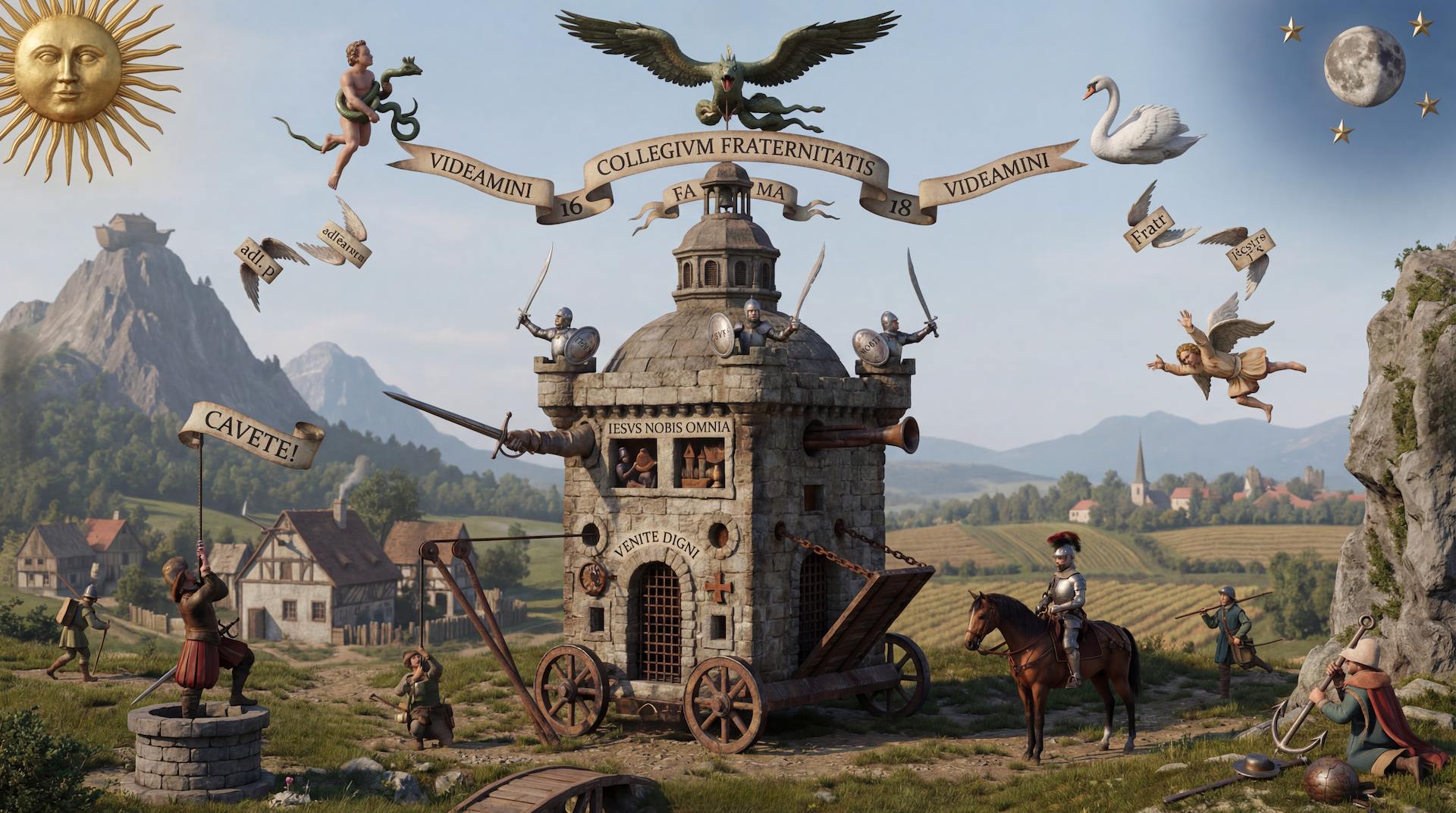
In 1614, an anonymous document appeared in the German city of Cassel. It described a secret underground vault, seven-sided and five feet broad on each wall, sealed behind a hidden door for 120 years. Inside were preserved books, scientific instruments, looking-glasses of diverse virtues, burning lamps that had never gone out, and a body lying uncorrupted beneath a brass altar plate inscribed in Latin. The door had been concealed behind plaster in a wall, discovered only when a nail was pulled and a stone came loose, revealing a passage that had been invisible for over a century. The document was the Fama Fraternitatis, the founding text of the Rosicrucian movement. It was not describing Oak Island. But the parallels are difficult to ignore.
The Fama told the story of a man identified only as Brother C.R., later understood to be Christian Rosenkreuz, a German monk born in 1378 who travelled to the Holy Land as a young man. In Damascus he studied with Arab scholars who, the text claims, had been expecting him. He learned medicine, mathematics, and what the Fama calls the secrets of nature. After further study in Fez, Morocco, where he was taught by practitioners of magic and Kabbalah, Rosenkreuz returned to Europe with a library of translated texts and a burning conviction that the arts and sciences of the continent were corrupt and in need of reform. The learned men of Spain and elsewhere laughed at him. He retreated to Germany, built a small house he called the Sancti Spiritus, and gathered three, then four, then eight followers around him. Together they created a secret language, compiled a great book of knowledge designated only as "Book M," and established the Fraternity of the Rosy Cross. Their six rules were precise: they would cure the sick for free, wear no distinctive clothing, meet once a year at the house of the Sancti Spiritus, each recruit a successor before death, use the letters C.R. as their seal, and keep the fraternity secret for one hundred years.
The Vault
The centrepiece of the Fama is the rediscovery of Rosenkreuz's burial vault, 120 years after his death. A later brother, renovating the building, pulled a brass nail from a wall and accidentally dislodged a stone, revealing a hidden door. Inscribed upon it in large letters were the words "Post 120 annos patebo," meaning "After 120 years I shall be opened." Behind the door lay a chamber of seven sides and seven corners, each wall five feet wide and eight feet tall. Though the sun had never shone inside, the vault was lit by an artificial sun mounted in the ceiling, which "had learned this from the Sun." In the centre stood a round brass altar bearing the inscription: "A.C.R.C. Hoc universi compendium unius mihi sepulchrum feci," which translates roughly as "I made this tomb a compendium of the whole universe." Each wall was divided into ten squares containing figures and sentences. Each wall also contained a door leading to a chest, and in those chests were "all our books," along with looking-glasses, small bells, burning lamps, and "wonderful artificial songs," all placed there so that if the fraternity should ever come to nothing, the vault alone could restore it. Beneath the altar lay the uncorrupted body of Rosenkreuz himself, holding a parchment book described as the fraternity's greatest treasure after the Bible.
The parallels to Oak Island are structural, not superficial. A concealed underground chamber, engineered to survive centuries. Preserved documents and artifacts placed inside as a time capsule for future generations. A sophisticated construction designed to be rediscovered only when the time was right. The Money Pit, with its oak platforms at ten-foot intervals, its parchment fragment recovered from 153 feet, and its elaborate flood tunnel system designed to protect whatever lies below, fits the Rosicrucian template with striking precision.
The Confessio and the Signs in the Sky
A second manifesto, the Confessio Fraternitatis, appeared in 1616. Where the Fama told a story, the Confessio issued a declaration: the fraternity was real, its treasures were available to the worthy, and the signs of its emergence had been written in the heavens. The Confessio specifically referenced new stars that had appeared in the constellations Serpentarius (now Ophiuchus) and Cygnus as divine signals that the age of revelation was at hand. "The Lord God hath already sent before certain messengers," the text reads, "which should testify his will, to wit, some new stars, which do appear and are seen in the firmament in Serpentario and Cygno."
The reference to Cygnus is significant in the context of Oak Island. The constellation Cygnus, also known as the Northern Cross, has been identified by multiple researchers as the celestial pattern mirrored by Nolan's Cross on Oak Island. The five megalithic boulders that form Nolan's Cross, arranged across the island's surface, correspond to the principal stars of Cygnus when projected downward from the sky. The Fama itself closes with the Latin phrase "sub umbra alarum tuarum Jehova," meaning "under the shadow of thy wings, Jehovah." Cygnus is the swan, a creature defined by its wings. If the Rosicrucians chose Oak Island as the site for their vault, Nolan's Cross may have been placed as a marker, a terrestrial reflection of the constellation their own manifesto declared sacred.
Francis Bacon and the New Atlantis
The question of who actually wrote the Rosicrucian manifestos has never been definitively settled. The Lutheran theologian Johann Valentin Andreae is often credited, and he did acknowledge authoring the Chemical Wedding of Christian Rosenkreutz, a third text published in 1616 that is commonly grouped with the Fama and Confessio. But many scholars have argued that the manifestos were the product of a circle rather than an individual, and that circle almost certainly included Francis Bacon.
Bacon's connections to Rosicrucian thought are extensive. His unfinished utopian novel The New Atlantis, published posthumously in 1627, describes a secret society of scholars called Salomon's House, operating from a remote island, dedicated to the preservation and advancement of knowledge. The society conducts its work in underground chambers, maintains vast libraries, and sends agents into the world in disguise. Its members are sworn to secrecy. The resemblance to the Fraternity of the Rosy Cross as described in the Fama is not coincidental. Bacon was, at minimum, deeply influenced by Rosicrucian ideals; at maximum, he was a driving force behind the movement itself. The broader case for Bacon's involvement with Oak Island, including the cipher research of Petter Amundsen, Jake Roberts, and John Edwards, is explored in the Baconians article on this site.
One figure in Bacon's circle deserves particular attention in this context. Thomas Bushell, born around 1593, entered Bacon's service at the age of fifteen and served as his seal-bearer and secretary until Bacon's fall from power in 1621. After Bacon's death in 1626, Bushell became a mining engineer of considerable skill. He recovered flooded mines in Wales and operated a Royal Mint at Aberystwyth Castle. He constructed elaborate underground waterworks at Enstone in Oxfordshire. He defended Lundy Island for the Royalist cause during the English Civil War, surrendering it in February 1647, after which he went into hiding and did not resurface until 1652. That five-year disappearance falls within the period that Amundsen's cipher research and dendrochronological dating from the show place activity on Oak Island. A man trained by Bacon in the sciences, skilled in mining, experienced in engineering underground chambers and managing water, and unaccounted for during the critical mid-1600s window: Bushell fits the profile of someone who could have overseen the construction of the Money Pit.
The Rosicrucian Timeline and Oak Island
The dating evidence from Oak Island increasingly supports a 1600s construction period for at least some of the island's features. In the Season 7 finale, Craig Tester summarized the team's findings by noting that "there's a lot converging on the late 1600s," a period he explicitly linked to "the Rosicrucians and the Francis Bacon theories." The Eye of the Swamp has been dated to the late 1600s. The slipway at Smith's Cove was dated by dendrochronology to 1769, but a larger structure beneath it returned a date of 1741, indicating pre-searcher activity. Artifacts dated to the 1400s and 1500s suggest even earlier visits to the island, but the 1600s cluster aligns most closely with the peak of Rosicrucian activity in Europe.
The Rosicrucian theory also provides a framework for understanding why so many apparently different groups may have been involved with Oak Island across centuries. The Fama describes how the original eight brothers dispersed to separate countries after establishing their fraternity, each tasked with recruiting a successor. The Confessio promises that the brotherhood will expand its membership "when the wall is removed" and the door to Europe is opened. If the Rosicrucians operated as the Fama describes, through a network of initiated members embedded in different countries and organizations, then the Templar artifacts, the Masonic connections, and the Baconian ciphers all found on one small island in Mahone Bay may not represent competing theories at all. They may represent successive layers of the same tradition. The documented links between Rosicrucianism and early Freemasonry in Nova Scotia, detailed elsewhere on this site, strengthen this reading.
A Vault Built to Be Found
The Fama makes one promise above all others. The vault of Christian Rosenkreuz was not built to remain hidden forever. It was built to be rediscovered at the appointed time. "Post 120 annos patebo." After 120 years, I shall be opened. The fraternity placed inside it everything needed to reconstitute their knowledge from nothing: books, instruments, songs, and the body of their founder holding a parchment that contained their greatest secrets. The entire structure was designed as a resurrection device for an idea.
The Money Pit, if it is a Rosicrucian vault, was built on the same principle. Its oak platforms, its parchment, its flood tunnels designed to protect the contents from unworthy intruders, all suggest a construction meant to preserve something until the right people, at the right time, with the right knowledge, came to open it. The Fama warned that the building "shall for ever remain untouched, undestroyed, and hidden to the wicked world." For over 230 years, the Money Pit has fulfilled that promise. Whatever is buried beneath Oak Island has remained untouched, despite the efforts of every treasure hunter who has tried.
The Rosicrucians may not have built the Money Pit. But whoever did build it appears to have read the same book.