Most Oak Island theories begin and end with a single event. The Villiers Bloodline theory spans seven centuries. It traces a documented genealogical chain from the man who carried the Knights Templar treasury out of Paris in 1307 to a Knight of Malta who established his capital twenty miles from Oak Island in 1632. Every link in that chain held a position of extraordinary trust within the military orders, and at every crisis where treasure or sacred relics needed saving, a member of this family was the one who carried them out.
Origins
1 min
The Villiers name enters the historical record around 1013 with Godefroy de Villiers, rooted in Norman soil barely a century after Rollo's Norse settlers accepted land from the French crown. At nearly the same moment, in 1014, a lord named Adam received a fortress on the River Oise, becoming the first Seigneur de L'Isle Adam. These two families, Villiers and L'Isle Adam, occupied the same frontier north of Paris and would later merge by marriage, producing the dynasty at the centre of this theory. The family's Norman roots are worth noting: the Norse world from which the Normans descended was one in which Atlantic seafaring was a living capability, as the settlement at L'Anse aux Meadows in Newfoundland, dated to 1021, attests. Whether that maritime heritage persisted through generations of Francophone feudal life is a different question, but the cultural context is relevant.
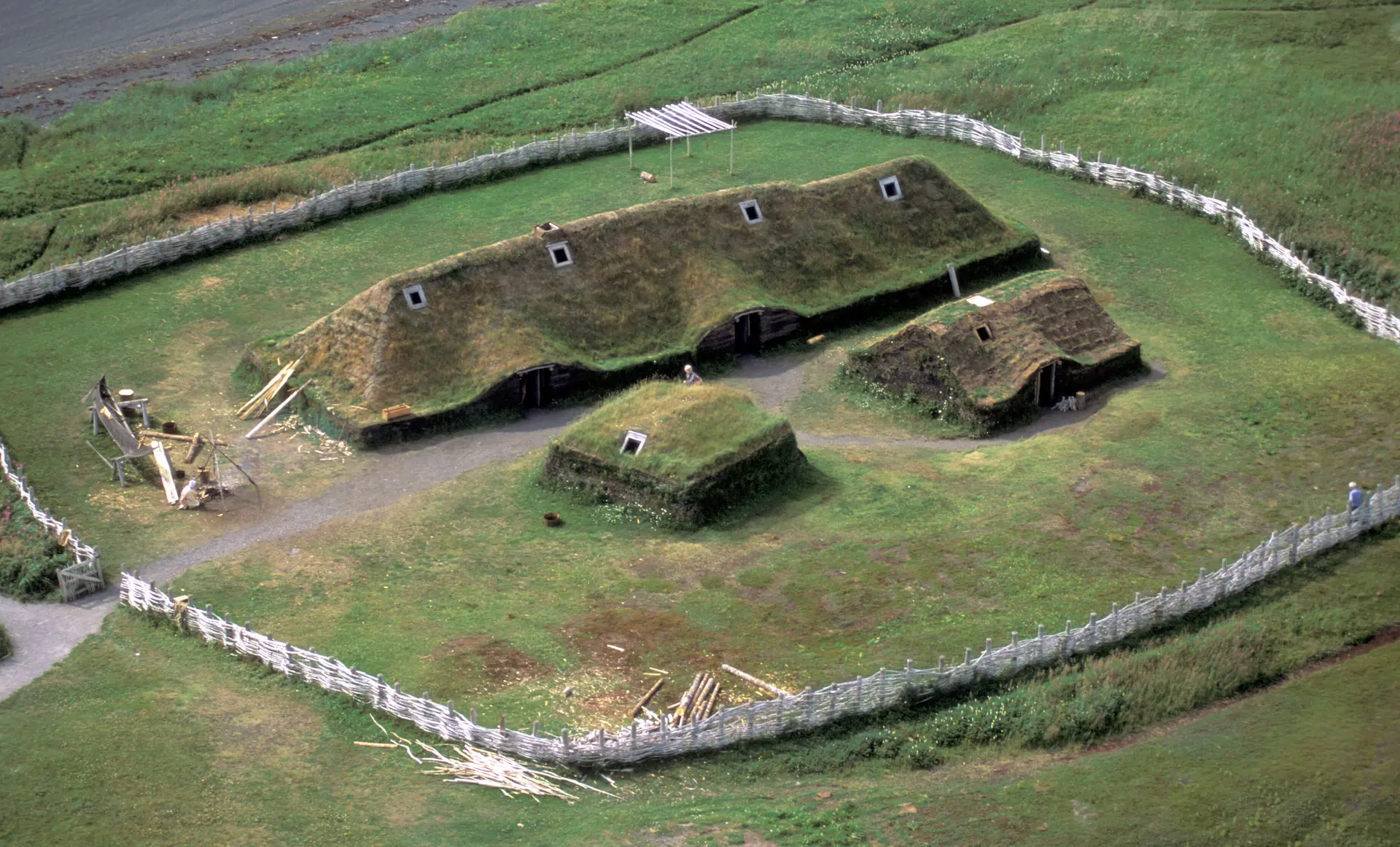 L'Anse aux Meadows→
By the mid-twelfth century, the family was placing sons in both the Knights Templar and the Knights Hospitaller simultaneously. By 1193, Guillaume de Villiers held the title of Grand-Commandeur deca Mer, the supreme Hospitaller command over all European operations, the officer who controlled the flow of men and money to the Holy Land. On the Templar side, members of the family held commanderies across France. Both orders. Both command structures. For generations.
A Pattern of Rescue
3 min
Guillaume de Villiers was already a senior Hospitaller officer when the catastrophe struck. On July 4, 1187, the army of the Kingdom of Jerusalem marched from Saffuriya toward Tiberias across waterless terrain in the heat of a Palestinian summer. King Guy de Lusignan had been persuaded, against the counsel of Raymond III of Tripoli, to advance. Saladin had positioned his forces between the Crusaders and the nearest water. At the Horns of Hattin, surrounded and dying of thirst, the Crusader army disintegrated. The king was captured. Saladin then singled out every captured Templar and Hospitaller knight and had them executed, reportedly two hundred men, while ransoming secular prisoners. The military orders were not merely defeated. They were targeted for destruction.
Within six years of Hattin, Guillaume held the title of Grand-Commandeur deça Mer, confirmed in Joseph Delaville Le Roulx's Cartulaire général de l'Ordre des Hospitaliers (n° 945, 30 April 1193) and independently in Zsolt Hunyadi's The Hospitallers in the Medieval Kingdom of Hungary (p. 90), where Guillaume is named as magister ultramarinus in a circular letter announcing the death of Saladin. A man does not rise to the supreme European command without decades of service. He was almost certainly active in the order's senior hierarchy during the crisis of 1187.
After Hattin, Saladin moved swiftly. Acre fell. Then Jaffa, Sidon, Beirut, and Ascalon. When Jerusalem surrendered on October 2, 1187, the military orders used their own treasury funds to ransom thousands of civilians who could not afford the price. It was the first recorded instance of the orders deploying their financial reserves in a crisis evacuation, using the treasury not for war but for rescue. The pattern that the De Villiers family would later repeat at Montségur, at Acre, and at Rhodes begins here.
The pattern appears even earlier, in a different context. In March 1244, the Cathar fortress of Montségur in the Pyrenees fell after a ten-month siege. On the night over two hundred Cathars burned at the stake, the garrison commander Pierre Roger de Mirepoix hid two men inside the walls. The interrogation record of the inquisition, recorded in the Languedoc DOAT, leave no doubt that one of them was Hugh de Villiers. The Inquisition record of Arnaud Roger de Mirepoix states the reason explicitly: "so that the Church of the heretics would not lose its treasure, which was hidden in the woods." Hugh de Villiers and his companion Amiel Aicard were lowered by rope down the precipice beneath the castle. Witnesses traced their route through Caussou, Prades, and the Castle of Usson. The Inquisition never found them, and never found the treasure.
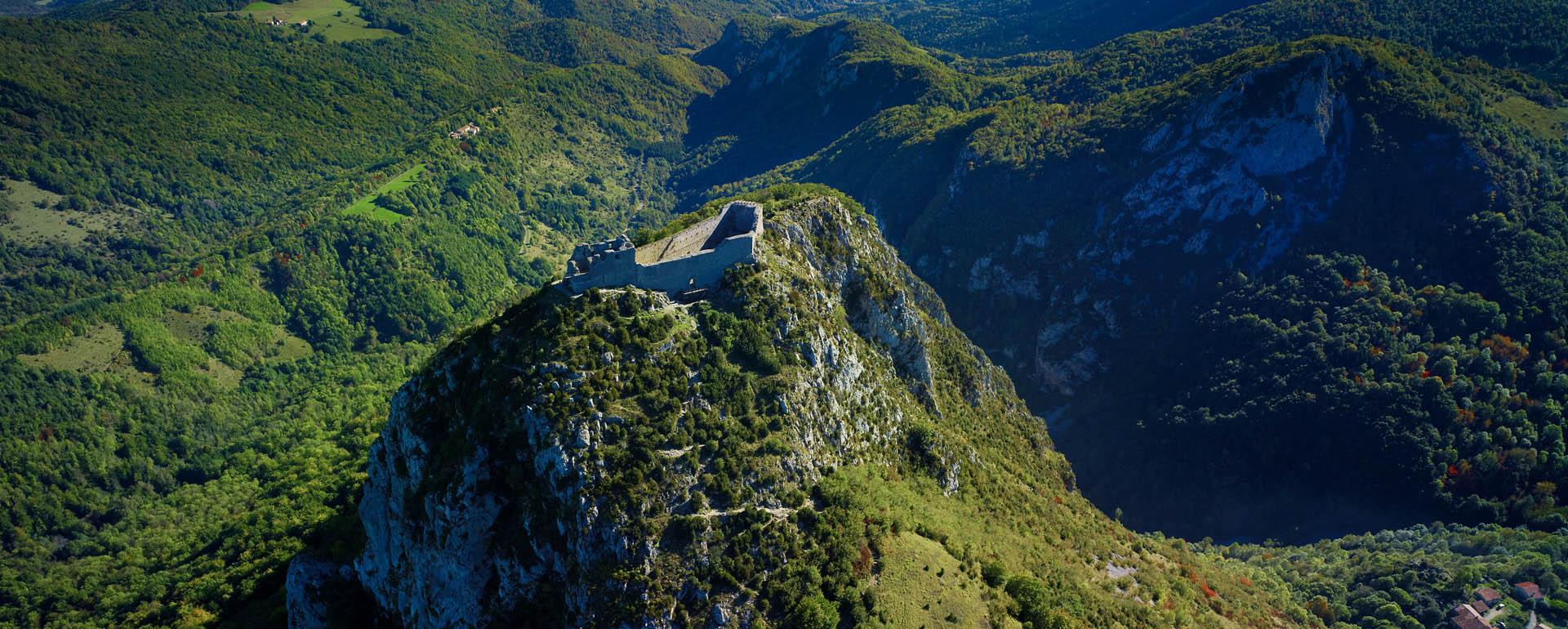 Château de Montségur→
A century after Hattin, Jean de Villiers served as Grand Master of the Hospitallers when Acre, the last Crusader city, fell to the Mamluks in 1291. In the spring of that year, Sultan al-Ashraf Khalil assembled a force of over one hundred thousand men, supported by massive siege engines and catapults capable of shattering walls. The Christian garrison numbered perhaps fifteen to twenty thousand, including the full fighting strength of both military orders. They were outnumbered five or six to one. The siege began in April. The Mamluks pounded the walls day and night. On May 18, the Templar Grand Master Guillaume de Beaujeu was struck by a javelin and died that night. Jean de Villiers was severely wounded leading the defence of his sector. His knights carried him from the walls to the harbour and put him on a ship. He reached Cyprus carrying the order's most sacred relics: the Right Hand of John the Baptist and the icon of Our Lady of Philermos. The same family had been in command when Jerusalem was lost and when Acre was evacuated. A century apart, the pattern was identical: a De Villiers ensuring the most precious objects survived.
Ruad, 1302
1 min
After the fall of Acre, the military orders regrouped on Cyprus and waited. Ruad was a tiny island fortress off the Syrian coast, barely a kilometre from Tortosa, the last physical toehold of the Crusader presence in the Levant. By 1300, roughly one hundred and twenty Templars and several hundred supporting troops garrisoned the island, waiting for a Mongol alliance that never came.
Gérard de Villiers was there. He had risen through the order's hierarchy in the years after Acre, part of the generation tasked with planning a return to the Holy Land. When the Mamluks besieged Ruad, the Templars were starved out. A free passage was negotiated, then betrayed. The men were attacked as they emerged. The garrison was massacred or enslaved.
But not Gérard. During the Papal inquisition trials in Paris in November 1309, Templar knight Ponsard de Gizy testified (Procès des Templiers, ed. Jules Michelet, vol. I) that Gérard de Villiers had "left a day earlier, taking his friends with him." A day earlier. Before the siege concluded. Before the betrayal. Before the massacre. This was the same Gérard de Villiers who, five years later, would flee Paris with fifty horses on the eve of the Templar arrests. Twice in a fortress about to fall. Twice out before the door closed. This was not luck. This was a man with intelligence networks and the authority to act on them.
Paris, 1307
2 min
Five years after Ruad, the last hammer fell. On October 13, 1307, King Philip IV ordered the arrest of every Templar in France. The leadership already knew. In testimony before the Papal Inquisition at Poitiers in June 1308, the knight Jean de Châlons described what happened: Gérard de Villiers, Master of France, fled with fifty horses and put to sea with eighteen galleys. A second man, Hugues de Châlons, escaped carrying what the testimony calls "the whole treasure" of Hugues de Pairaud, the Visitor General who controlled every Templar treasury across Europe.
The historian E.-G. Léonard identified Hugues de Châlons, preceptor of Épailly, as "probably identical" with Hugh of Villiers, who held the same office from roughly 1293 to 1301. If correct, then both men who carried the Templar treasury out of Paris were De Villiers.
The Inquisition testimony further describes Hugues de Châlons as the nephew of Pairaud, the Visitor, meaning Pairaud was family too. Pairaud's father Humbert had served as Master of England and Aquitaine from 1266 to 1271 (documented in Alain Demurger, Les Templiers: Une chevalerie chrétienne au Moyen Âge, and the Procès des Templiers), a jurisdiction that extended across Scotland and Ireland. Every preceptory, every harbour, every contact from London to Edinburgh was known to Humbert. Hugues de Pairaud himself testified under interrogation that he was received into the order by his own father at the age of eighteen. The knowledge of the entire Templar network across the British Isles passed directly from father to son.
As it appears, three generations coordinated a single operation: Pairaud controlling the Templar treasury from within, his nephew Hugh carrying the money, and Hugh's nephew Gérard running the military escort. The succession of the office of Master of France tells its own story. Hugues de Pairaud held it from 1291 to 1294. Within five years, Gérard de Villiers held the same chair, from 1299 to 1307. Uncle and nephew, occupying the same seat of power within a single decade.
When the eighteen galleys sailed from France in October 1307, someone on board knew exactly where every Templar safe haven was located across Britain. That knowledge was a Pairaud family asset, inherited from father to son. The treasure did not leave an institution. It left a family's hands to enter other hands of the same family. The ships sailed and none of them were ever seen again.
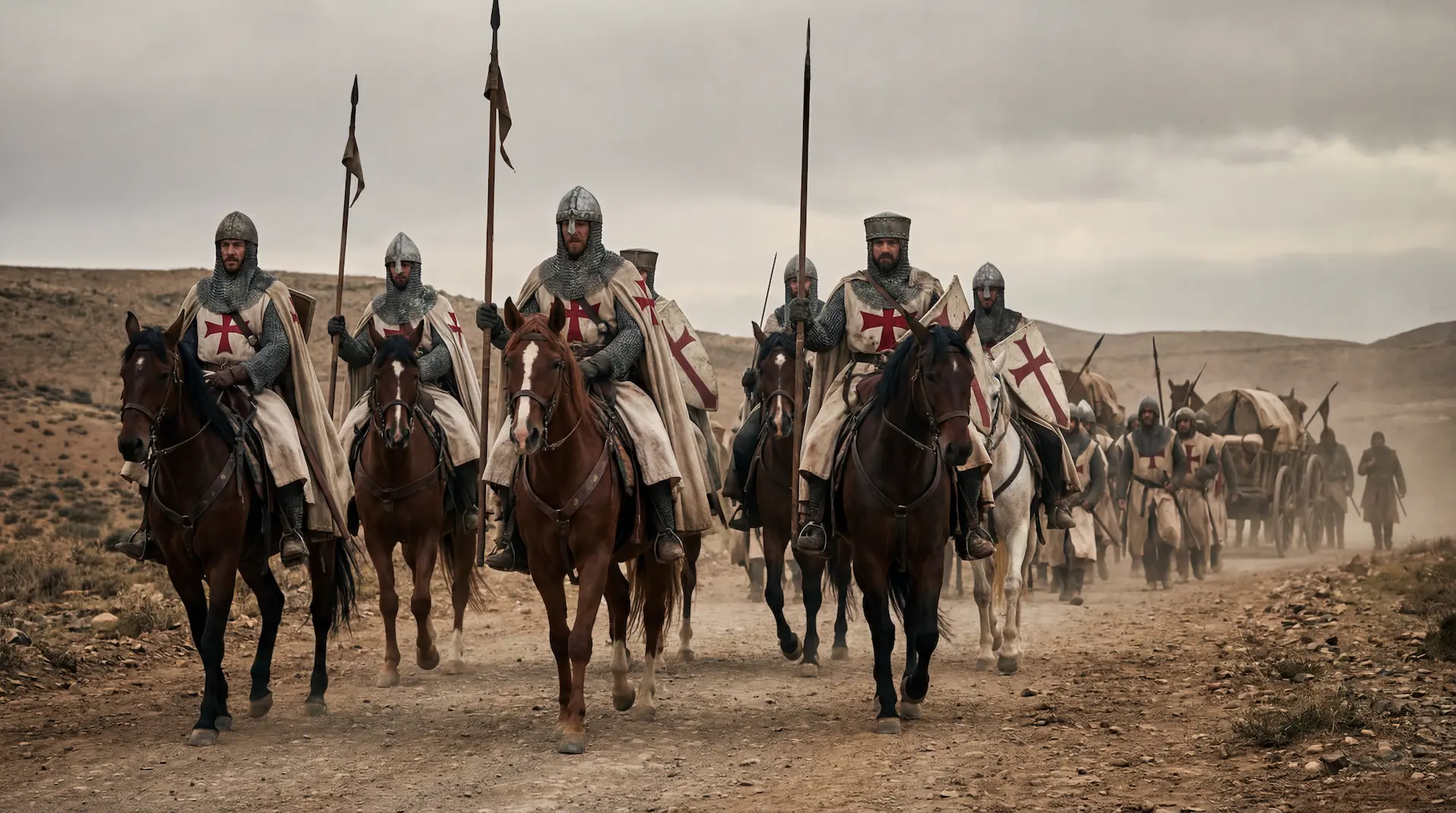 The Knights Templar on Oak Island→
The Other Side of the House
3 min
When the Templars were dissolved in 1312, their assets passed to the Knights Hospitaller. The De Villiers name transferred with them. The families of De Villiers and L'Isle Adam had merged through marriage in the 1290s, and the documented genealogy traces six generations from Gérard de Villiers to Philippe de Villiers de L'Isle Adam, born in 1464. Gérard's nephew Adam married into the L'Isle Adam house. Their descendants held positions as Knight of the Star, Knight Hospitaller, Chamberlain of France, holder of the Golden Fleece, Marshall of France, and Governor of Paris. One hundred and eighty-nine years. Six generations. The family's power base shifted seamlessly from the destroyed order to the surviving one.
Philippe became Grand Master in 1521. Within a year, Sultan Suleiman besieged Rhodes with 100,000 men against fewer than 7,000 defenders. Only Sir John Rawson, Prior of the order's Irish house, came alone to help. Philippe would defend the island with six hundred knights drawn from the order's eight langues, perhaps four thousand mercenaries and local militia, and the civilian population of Rhodes itself. The siege lasted six months. The Ottomans pounded the walls day and night with heavy cannon. They dug mining tunnels beneath the bastions, packing them with gunpowder. The defenders used listening devices to detect the vibrations of Turkish sappers underground and destroyed over fifty tunnels before they could be detonated. On September 4, two massive mines exploded beneath the Bastion of England, collapsing twelve yards of wall into the moat. Philippe personally led the counterattack, driving the Turks back out of the gap in close-quarters fighting. By December, both sides were exhausted. Suleiman offered terms: surrender, and the knights could leave with their lives, their weapons, and their sacred objects. On January 1, 1523, Philippe led the surviving knights out of the city. They carried with them the order's most sacred possessions: the Right Hand of John the Baptist and the icon of Our Lady of Philermos. The same relics Jean de Villiers had evacuated from Acre 232 years earlier.
What followed was seven years of exile. Philippe led the order from one temporary refuge to the next: Crete, then Messina, then Viterbo, then Nice. An order that had held territory continuously since the twelfth century was homeless for the first time in its history. At Nice, Philippe commissioned the construction of the Santa Anna. She was a carrack unlike anything the Mediterranean had seen: six decks, a hull sheathed below the waterline in lead plates fastened with bronze nails, making her, by some accounts, the first armoured warship in history. She mounted fifty heavy guns and could carry five hundred marines in addition to her crew. Below decks she housed a forge staffed by three armourers, a mill and ovens for baking fresh bread at sea, and officers' quarters with a garden growing in boxes of earth in the stern galleries. The Hospitaller chronicler Giacomo Bosio (Dell'Istoria della Sacra Religione, 1594-1602) called her the finest floating fortress in the Mediterranean. In 1531, the Santa Anna single-handedly routed an Ottoman squadron of twenty-five ships.
The Santa Anna was not a coastal vessel. She was an ocean-going warship, built to project power across open water, capable of carrying men, supplies, and cargo across any sea in the known world. Philippe de Villiers de L'Isle Adam, descendant of the family that had been moving sacred cargo since 1187, had built the most formidable transport vessel of its age. In 1530, Philippe secured the islands of Malta and Gozo from Emperor Charles V. He arrived aboard the Santa Anna on October 26 and established the order's new headquarters at the Palazzo Falson in Mdina.
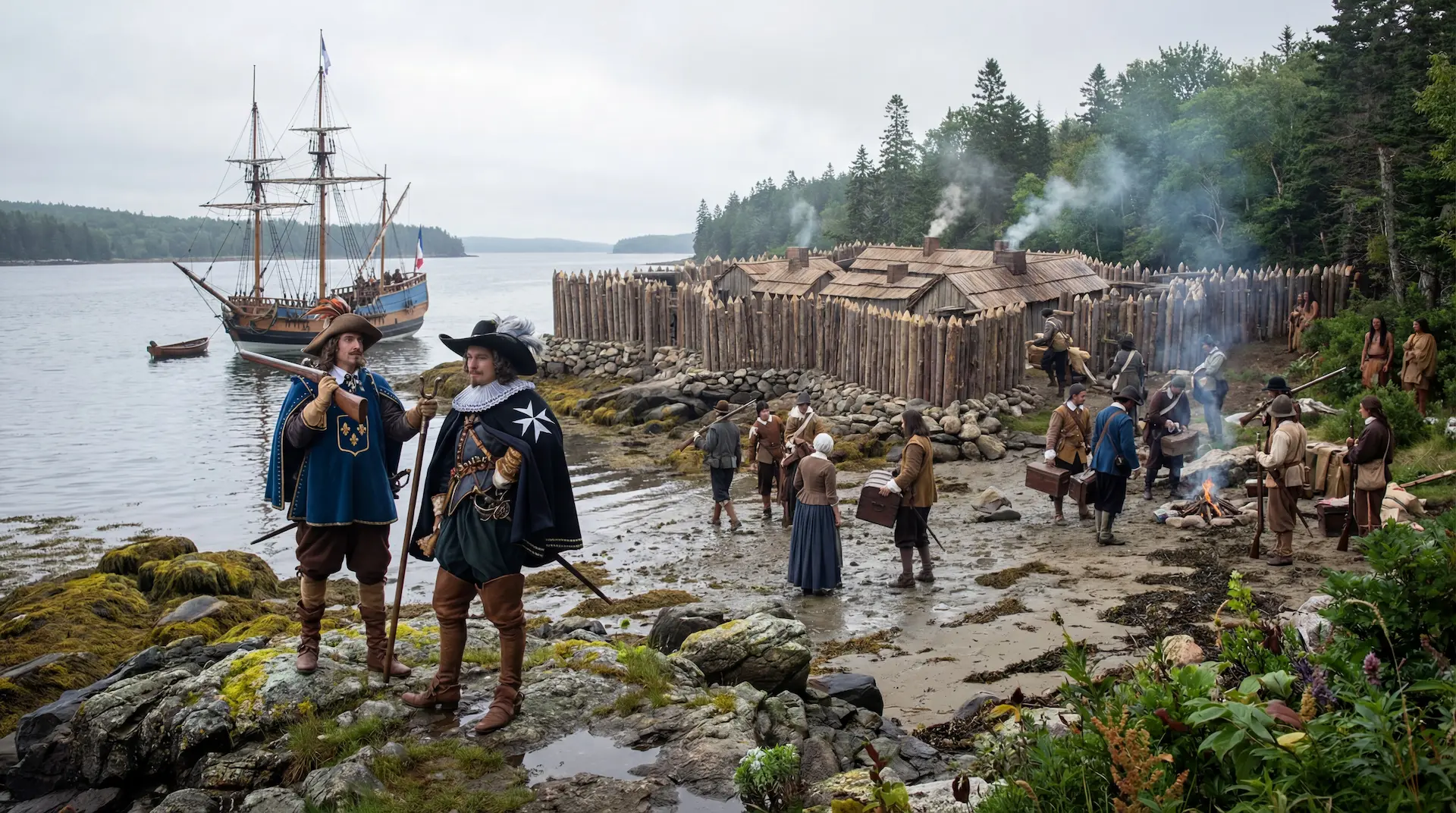 The Knights of Malta→
Twenty Miles from Oak Island
4 min
Philippe's grandfather had a brother, Jacques de Villiers de L'Isle Adam, Marshall of France and Provost of Paris. From Jacques the line descended through Robert II, Jacques II (Knight of the Order of Saint Michel), and Catherine de Villiers, who married François de Razilly. Their son Isaac, born in 1587, was the tenth generation from Gérard.
Isaac de Razilly was a Knight of Malta, Commander of Isles Bouchard, and an Atlantic navigator whose career reads like a catalogue of every contested coastline in the Atlantic world. By the age of twenty-five he was exploring the coast of Brazil, part of the expedition to establish France Équinoxiale near the island of Marajó. By 1619, Louis XIII sent him to Morocco to reconnoitre the Atlantic coast as far south as Mogador, the fortified harbour that the Portuguese had used and the Phoenicians before them had known as Migdol. Razilly surveyed it as a potential French colonial base, assessing its harbour, its defences, and its strategic position on the African Atlantic seaboard.
In 1624, the king dispatched him to the pirate harbour of Salé, the corsair stronghold on the Moroccan coast, to negotiate the release of French captives. The mission went wrong. Razilly was seized, thrown in chains, and imprisoned. He was eventually released but was forced to leave many of the Christian captives behind. He returned to France and was given command of the blockade fleet during the siege of La Rochelle, the great Huguenot stronghold on the Atlantic coast. During the fighting, a vessel exploded near his ship and Razilly lost an eye. He kept fighting. The siege lasted fourteen months and ended with the city's surrender in October 1628.
In 1626, between these campaigns, Razilly had submitted a memorandum to Cardinal Richelieu: his "Articles pour persuader un chacun de risquer sur mer et trouver fonds pour la navigation," a manifesto arguing for French sea power and colonial expansion overseas, in Africa, Asia, or America (documented in Robert Le Blant, Revue d'histoire de l'Amérique française, vol. 11, 1957, and Édouard de Barthélemy, Revue des questions historiques, vol. 15, 1874). Richelieu listened. In July 1629, Razilly sailed for Morocco with seven warships, bombarded Salé, destroyed three corsair vessels, and briefly occupied the island of Mogador. In 1630 he negotiated the release of French slaves. In 1632 he helped negotiate the Franco-Moroccan Treaty that gave France preferential trading rights along the coast.
His uncle was Cardinal Richelieu, the most powerful man in France and architect of the country's colonial expansion. Richelieu could have sent his nephew anywhere in the New World. He sent him to the Atlantic coast of Nova Scotia. On September 8, 1632, three hundred and twenty-five years after Gérard de Villiers fled Paris with the Templar treasury, Isaac de Razilly landed at La Hève (LaHave) with three hundred men and three Capuchin monks. The date was the Feast of the Nativity of the Blessed Virgin Mary, the patronal feast of the Knights Hospitaller and the date the Great Siege of Malta was lifted in 1565, as confirmed by the Sacra Militia Foundation of Malta, the academic arm of the Maltese Association of the Sovereign Military Order of Malta. Razilly named his fort Sainte-Marie-de-Grâce, in honour of the Virgin, because he had arrived on her feast day. He took possession of roughly a third of what is now the province. His companion Nicolas Denys (Description géographique et historique des costes de l'Amérique septentrionale, Paris, 1672; English translation by William Francis Ganong, The Champlain Society, 1908) explored the inner reaches of Mahone Bay and gave the first known written description of the area, including an island covered with a forest of mature oak trees.
La Hève sits twenty miles from Oak Island.
Before his death, Razilly wrote to Grand Master Antoine de Paule proposing a Priory of the Order of Malta on the Nova Scotian coast, overseeing several new Commanderies. He died in late 1635 before the answer reached Acadia. It was not favorable. The Order had just committed 200,000 écus to restoring the defenses on Malta.
Over a century later, in 1746, the man commanding French forces in Acadia was still a De Villiers. Nicolas Antoine II Coulon-de-Villiers patrolled the coast between La Hève and Halifax. According to Abbé Casgrain's biography of de Gaspé, whose maternal grandmother was a Coulon, the family claimed alliance with the Grand Master of the Order of Malta, Philippe de Villiers de L'Isle Adam. The authors of Coulon de Villiers: An Elite Military Family of New France noted that this statement could not be verified. What can be verified is the maternal line: Coulon-de-Villiers' maternal grandfather was Antoine de la Fosse, Lord of Valpendant, the old Templar commandery overlooking L'Isle Adam, the ancestral seat of the Villiers family. Four centuries after Gérard de Villiers vanished from history, a man whose family claimed descent from the same bloodline was patrolling the same stretch of Nova Scotian shore.
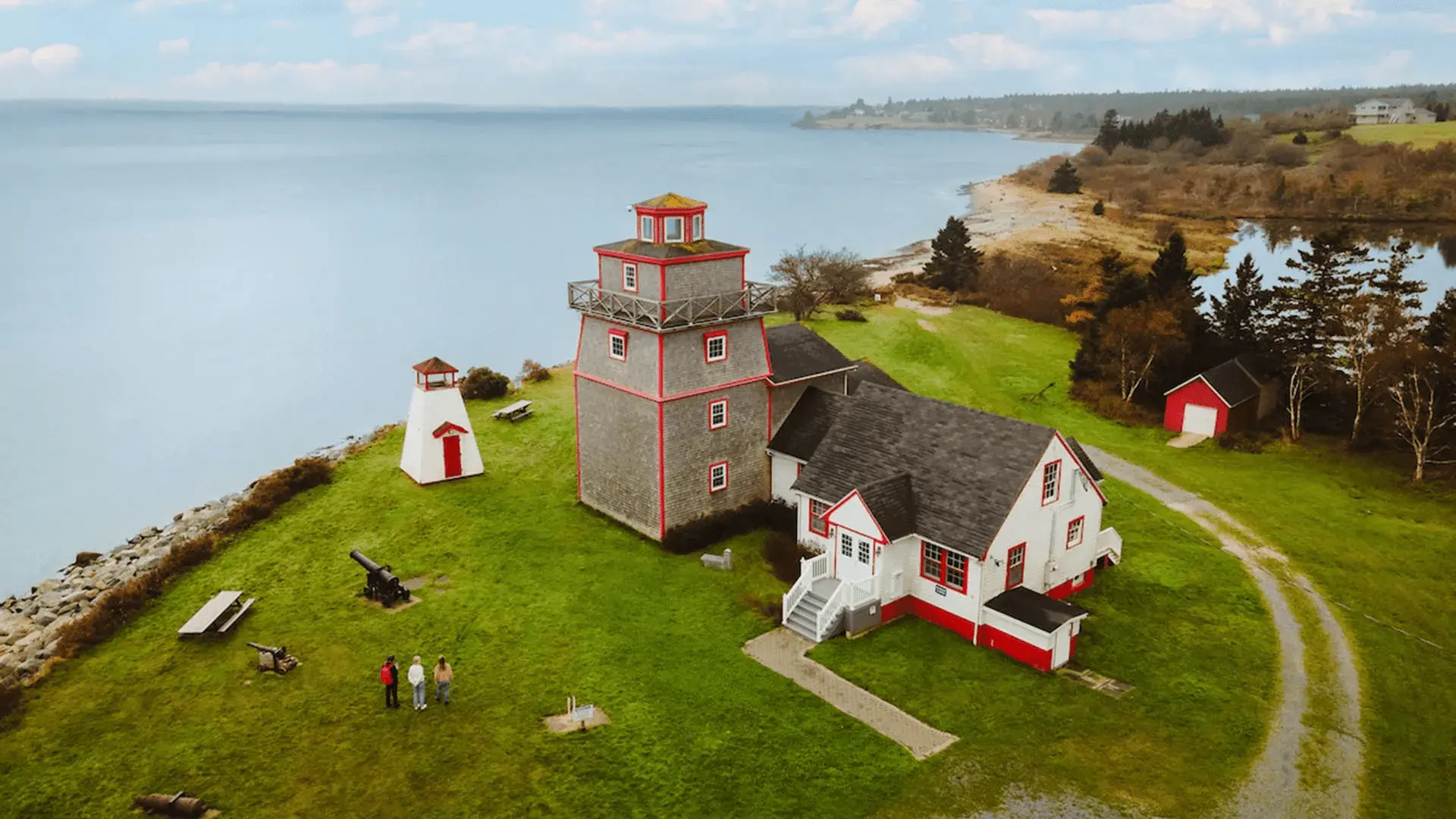 Fort Point Museum→
Presented at the Palazzo Falson
1 min
This research was presented by Corjan Mol in Season 12, Episode 23 ("Family Ties") of The Curse of Oak Island, at the Palazzo Falson in Mdina, the same residence Philippe de Villiers de L'Isle Adam chose when he arrived on Malta in 1530. The bloodline is documented. The positions are documented. The proximity to Oak Island is documented. From Gérard's escape with the Templar treasury through Philippe's evacuation of Rhodes to Razilly's landing twenty miles from Oak Island, spans seven centuries and approximately twenty-five generations. What the documents do not record is what any of them carried with them.
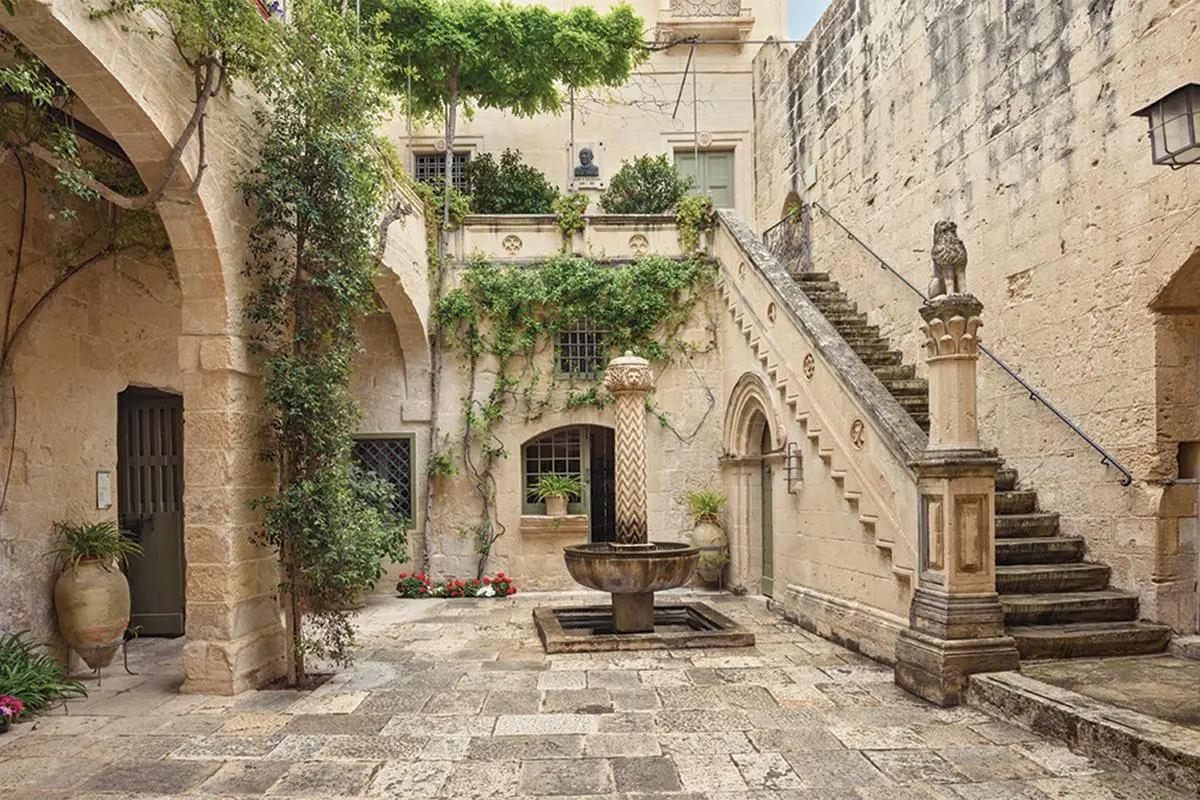 Palazzo Falson→
Sources
7 min
This article traces the documented De Villiers bloodline across seven centuries, from Guillaume de Villiers at the fall of Jerusalem in 1187 to the death of Victor de Villiers de L'Isle Adam in Paris in 1901. The genealogical chain from Gérard de Villiers (1307) to Philippe de Villiers de L'Isle Adam (1464) is mapped across six generations. From Gérard to Isaac de Razilly (1632) spans ten documented generations. The full arc from the Crusades to the extinction of the line covers approximately twenty-five generations.
Original Research
- Corjan Mol, original genealogical research presented in Season 12, Episode 23 ("Family Ties") of The Curse of Oak Island, at the Palazzo Falson in Mdina, Malta. Traces the six-generation chain from Gérard de Villiers to Philippe de Villiers de L'Isle Adam through documented marriages into the House of L'Isle Adam, and the ten-generation chain from Gérard to Isaac de Razilly.
- Corjan Mol and Christopher Morford, The Jerusalem Files (London: Watkins / Penguin Random House, 2024).
Primary Source Collections and Prosopographies
- Joseph Delaville Le Roulx, Cartulaire général de l'Ordre des Hospitaliers de St-Jean de Jérusalem (1100–1310), 4 vols. (Paris, 1894–1906). Guillaume de Villiers as Grand-Commandeur deça Mer: n° 945 (30 April 1193). Prior of England 1199–1202: n° 1056. Prior of France 1207–1209: n° 1243 and 1331. See also Delaville Le Roulx, Les Hospitaliers en Terre Sainte et à Chypre (1100–1310) (Paris: E. Leroux, 1904).
- Zsolt Hunyadi, The Hospitallers in the Medieval Kingdom of Hungary, c. 1150–1387 (Budapest: Central European University, 2010), p. 90. Confirms Guillaume de Villiers as magister ultramarinus in a circular letter announcing the death of Saladin (4 March 1193). The original document is held in Paris.
- Procès des Templiers, ed. Jules Michelet, 2 vols. (Paris: Imprimerie Royale, 1841–1851), vol. I. Contains the testimony of Jean de Châlons (Poitiers, June 1308) and of Ponsard de Gizy (Paris, November 1309). Jean de Châlons describes Gérard de Villiers fleeing with fifty horses and eighteen galleys, and Hugues de Châlons escaping with "the whole treasure" of Hugues de Pairaud. Ponsard de Gizy states that Gérard left Ruad "a day earlier, taking his friends with him."
- Single-page document, August 1308, Bibliothèque nationale de France, inserted into a letter by Pope Clement V, entitled "these are the names of the brothers that have fled." Names "Gérard de Villiers and Hugh de Châlons who had armed 40 brothers." Also referenced by Heinrich Finke.
Montségur, 1244: The Cathar Treasure
- DOAT (Collection Doat), Bibliothèque nationale de France, Volume XXII, p. 108. Interrogation of Arnaud Roger de Mirepoix: Pierre Roger de Mirepoix retained Amiel Aicard and his companion Hugh [de Villiers] in the castle; after the perfects had been burned en masse, Pierre Roger hid them and they escaped. "And this was done so that the Church of the heretics would not lose its treasure, which was hidden in the woods."
- DOAT, Volume XXIV, p. 172. Interrogation of Imbert de Salles: the perfect Mathieu and his brother Pierre Bonnet carried away "gold, silver, and an infinite quantity of money" (aurum, argentum et pecuniam infinitam) from the castle, depositing it in caves in the Sabarthès on lands held by Pons Arnaud de Châteauverdun.
- DOAT, Volume XXIV, p. 62. Interrogation of Bérenger de Lavelanet: the perfects came to Caussou, then Prades, then the Castle of Usson, where they met the perfect Mathieu.
- DOAT, Volume XXIV, p. 81. Bernard Guilhem and Bernard d'Auvezines confirmed that Amiel Aicard and Hugh [de Villiers] were lowered by rope down the precipice beneath the castle, on the night the castle was delivered to the King and Church.
- Michel Roquebert, L'Épopée cathare, 5 vols. (Toulouse: Privat, 1970–1998). Standard academic history of the Cathar movement, the siege of Montségur, and the Avignonet raid of 1242.
- Guillaume de Puylaurens, Chronica, ed. Jean Duvernoy (Paris: CNRS, 1976). Names Jourdain de Villiers among the participants in the Avignonet raid (28 May 1242).
The Escape of 1307
- E.-G. Léonard, Introduction au Cartulaire manuscrit du Temple (1150–1317) (Paris: Champion, 1930). Identifies Hugues de Châlons, preceptor of Épailly, as "probably identical" with Hugh de Villiers, who held the same office from roughly 1293 to 1301. No subsequent scholar has challenged this attribution.
- Alain Demurger, Les Templiers: Une chevalerie chrétienne au Moyen Âge (Paris: Seuil, 2005). Prosopographical data on Hugues de Pairaud and his father Humbert, Master of England and Aquitaine (1266–1271).
- Alain Demurger, Jacques de Molay (Paris: Payot, 2002). Context for the 1307 arrests and the Poitiers hearings.
- Barbara Frale, L'ultima battaglia dei Templari (Rome: Viella, 2001). Additional analysis of the escape testimonies.
Philippe de Villiers de L'Isle Adam, the Siege of Rhodes, and the Santa Anna
- Eric Brockman, The Two Sieges of Rhodes, 1480–1522 (London: John Murray, 1969). The siege lasted from June to December 1522. Philippe negotiated surrender on December 22 and departed January 1, 1523.
- Giacomo Bosio, Dell'Istoria della Sacra Religione di San Giovanni Gierosolimitano (Rome, 1594–1602), Book XXI. Source for the Santa Anna: six decks, lead-sheathed hull, fifty guns, capacity for five hundred marines, forge, mill, ovens, and stern gardens. Bosio called her the finest floating fortress in the Mediterranean.
- H. J. A. Sire, The Knights of Malta (New Haven: Yale University Press, 1994).
- Sovereign Military Order of Malta, official history and account of the icon of Our Lady of Philermos (orderofmalta.int).
Isaac de Razilly and the Knights of Malta in Nova Scotia
- Nicolas Denys, Description géographique et historique des costes de l'Amérique septentrionale: avec l'histoire naturelle du païs, 2 vols. (Paris: Chez Claude Barbin, 1672). English translation by William Francis Ganong: The Description and Natural History of the Coasts of North America (Acadia) (Toronto: The Champlain Society, 1908). First known written description of the inner reaches of Mahone Bay, including an island covered with oak trees. Available at: archive.org
- The Sacra Militia Foundation of Malta (founded 1998), the academic arm of the Maltese Association of the Sovereign Military Order of Malta. Research confirming Isaac de Razilly's arrival at La Hève on September 8, 1632, the Feast of the Nativity of the Blessed Virgin Mary, the patronal feast of the Knights Hospitaller and the date the Great Siege of Malta was lifted in 1565.
- Robert Le Blant, Revue d'histoire de l'Amérique française, vol. 11 (1957). Source for Razilly's memorandum to Richelieu and his proposal for a Priory of the Order of Malta in Acadia.
- Édouard de Barthélemy, Revue des questions historiques, vol. 15 (1874). Additional documentation on Razilly's colonial proposal and the Order's wider Atlantic ambitions.
- Order of Malta Canadian Association. Records that Razilly formally offered his Acadian lands to Grand Master Fra Antoine de Paule with the proposal that they be erected into a Priory.
- Mark Finnan, Oak Island Secrets (Formac Publishing, Halifax, 1995; revised edition 2002). Notes Denys's account as "the first known description of the area."
- Randall Sullivan, The Curse of Oak Island: The Story of the World's Longest Treasure Hunt (New York: Atlantic Monthly Press, 2018). Confirms Nicolas Denys as the first to describe Oak Island in print.
Coulon-de-Villiers in Acadia, 1746
- Abbé Henri-Raymond Casgrain, biography of Philippe Aubert de Gaspé (whose maternal grandmother was a Coulon). Reports that the Coulon family claimed alliance with the Grand Master of the Order of Malta, Philippe de Villiers de L'Isle Adam.
- Coulon de Villiers: An Elite Military Family of New France, Featuring the Translated Works of Amédée Edmond Gosselin, Pierre-Georges Roy, and Aegidius Fauteux. Notes that Casgrain's statement "could not be verified." Confirms the verifiable maternal line: Nicolas Antoine II Coulon-de-Villiers' maternal grandfather was Antoine de la Fosse, Lord of Valpendant, the old Templar commandery overlooking L'Isle Adam.
Auguste de Villiers de L'Isle Adam and Axël
- A.W. Raitt, The Life of Villiers de l'Isle-Adam (Oxford: Clarendon Press, 1981). Principal biography. Source for Léon Bloy anecdote, deathbed marriage (August 14, 1889), legitimisation of Victor, the unfinished manuscript of Axël, and Auguste's self-description as belonging to "a lineage of navigators and extravagant warriors."
- Axël (Paris, published posthumously 1890). A play about a noble family guarding an immense underground treasure across generations. Family crest inscription: Altius resurgere spero gemmatus. Auguste's own illustrations include Ursa Minor, the navigator's star.
Academic Reference Works
- Arnaud Baudin, Ghislain Brunel, and Nicolas Dohrmann (eds.), Acta Templarorium, ou la prosopographie des Templiers (Paris, 2002). Prosopographical database of 4,730 identified Templars compiled from primary charter and trial sources across France. Contains entries for members of the De Villiers family holding Templar offices across multiple generations. Available at: academia.edu
- Malcolm Barber and Keith Bate (trans. and eds.), The Templars: Selected Sources (Manchester: Manchester University Press, 2002). Translated primary sources including the trial depositions containing the Jean de Châlons testimony. Available at: archive.org
- Jochen Schenk, Templar Families: Landowning Families and the Order of the Temple in France, c. 1120–1307, Cambridge Studies in Medieval Life and Thought, Fourth Series, no. 79 (Cambridge: Cambridge University Press, 2012). ISBN 978-1-107-00447-4. Academic study of the relationship between the Order of the Temple and the noble landowning families that supported it, focusing on Burgundy, Champagne, and Languedoc.
- Karl Borchardt, Karoline Döring, Philippe Josserand, and Helen J. Nicholson (eds.), The Templars and Their Sources, Crusades: Subsidia, no. 10 (London: Routledge, 2017). ISBN 978-1-138-20190-3. Contains Alan Forey's chapter "The Office of Master Deça Mer in Military Orders," directly relevant to Guillaume de Villiers' title of magister ultramarinus in 1193.
Television
- The Curse of Oak Island, Season 12, Episode 23, "Family Ties." Corjan Mol presents the De Villiers Bloodline research at the Palazzo Falson in Mdina, Malta.