About This Carved Stone
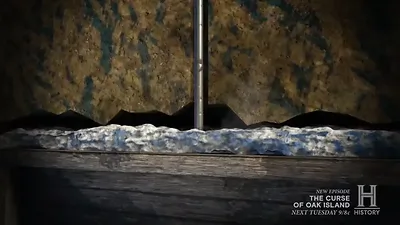
A flat stone bearing an inscription in unknown characters was reportedly found at a depth of approximately ninety feet in the Money Pit during the Onslow Company excavation of 1803-1804. The Onslow crew encountered the stone resting on top of an oak platform, marking the deepest point reached before the shaft flooded with seawater. The inscription was unlike any alphabet the workers could identify. The stone was removed from the pit and kept on the island for some years before entering the possession of John Smith, who owned the land containing the Money Pit and used it as a fireback in his chimney.
The stone later passed to the bookbindery of A.O. Creighton and Marshall on Upper Water Street in Halifax, where it served two purposes: displayed in the shop window to attract investors for treasure operations, and used as a beating stone to flatten leather during bookbinding. J.B. McCully, a Freemason and member of the Truro Company, described the stone in an 1862 letter. By the time Captain Henry Bowdoin visited the bookstore in 1909, accompanied by future U.S. President Franklin Roosevelt, the inscription had been nearly obliterated through decades of use. Bowdoin reported finding only the carved initials L and N still visible on its surface. The bookstore closed in 1919 and the stone vanished. No photographs, rubbings, or tracings of the original inscription survive.
The most widely known translation was offered by Reverend A.T. Kempton in 1949 and appeared in Edward Rowe Snow's book that same year. Using a substitution cipher, Kempton rendered the message as: forty feet below, two million pounds are buried. However, the cipher on which this translation was based cannot be traced back beyond the early twentieth century, and modern researchers have raised serious questions about its authenticity. In 1971, former U.S. military cryptographer Dr. Ross Wilhelm applied a sixteenth-century cryptography manual to the symbols and identified a second hidden message. Swedish researcher Daniel Ronnstam later built on Wilhelm's work, producing a French decipherment that referenced a shaft measurement of 522 feet, almost exactly the distance from Smith's Cove to the Money Pit.
Researcher Zena Halpern provided a separate cipher she called La Formule, whose symbols matched those attributed to the ninety-foot stone. Working with a cryptography professor, Doug Crowell produced a partial French decipherment that yielded fragments including references to digging at forty feet with an angle and the word chambre, meaning chamber. The professor identified La Formule as one of seven pieces of a larger document, with the remaining six fragments still missing. J. Hutton Pulitzer proposed that the markings were not a cipher at all but characters from tifinagh, an ancient alphabet associated with the Punic language of Carthage.
In Season 6, Doug Crowell, Jack Begley, and Charles Barkhouse searched the basement of the former Creighton and Marshall building, now the Halifax Seed Company, with Dr. Allan Marble of the Royal Nova Scotia Historical Society. They located a large stone matching the documented description: approximately two feet long, fifteen inches wide, ten inches thick, close to two hundred pounds, flat on two sides with rounded corners, and bearing the carved initials L and N that Bowdoin had reported in 1909. The stone was transported to Oak Island for examination and lidar scanning by Azimuth Consulting, though its identity as the original ninety-foot stone has not been confirmed beyond doubt.
Graham Harris and Les MacPhie, the geotechnical engineers who wrote Oak Island and its Lost Treasure, add several details and a skeptical reading. The early accounts give the stone as thirty-six by fifteen inches and ten inches thick, which would weigh about five hundred pounds, although smaller figures, including a weight of about 175 pounds, were also reported. One description calls it freestone with unsquared corners, resembling dark Swedish granite or porphyry, very hard, with an olive tinge. In 1864 it was placed in the window of A. and H. Creighton, bookbinders, at 64 Upper Water Street in Halifax. Harris and MacPhie note that Creighton was treasurer of the Oak Island Association, which was then selling shares to fund further digging, and that the deciphered message is first heard of at that time. They list five difficulties: John Smith built the stone into his fireplace, which suggests he did not think it important; the translation surfaced during a share sale; signs of treasure were later found ten to fifteen and sixty-three to seventy feet below the stone, not forty; the markings were on the underside; and anyone hiding great wealth would have little reason to leave a clue. Their conclusion is that the stone existed and came from the Money Pit, but that its markings, to whatever extent they existed, cannot be treated as a clue. Drawing on the local geology, they suggest it may be a glacial erratic of basalt carried from North Mountain on the Bay of Fundy, a dark rock that weathers to a dun color, which the original diggers met in the shaft, levered aside onto a platform, and which a workman may have scratched before rolling it over.
Historical Context
J.B. McCully letter 1862; Bowdoin found no symbols on stone he examined 1909 Graham Harris and Les MacPhie, Oak Island and its Lost Treasure, third edition (Formac Publishing, Halifax, 2013), chapter 1.
Where It Was Found
Found at Money Pit, approximately 80–90 ft depth. Location: the original 1795 excavation shaft on Oak Island, Nova Scotia.