A Man with a Patch Over One Eye
1 min
In early September 1632, the Mi'kmaq living along the Pijinuiskaq, the river now called the LaHave, watched two ships sail through the narrows between Kraut Point and the western shore. The vessels anchored and roughly 300 men came ashore, led by a figure with a patch over one eye. Isaac de Razilly may have looked like a pirate, but he was a French naval officer, a Knight of Malta, and the newly appointed Lieutenant-General of New France. He had lost the eye five years earlier at the siege of La Rochelle. Before that he had spent four years in Brazil, served as chief of squadron in Brittany, captured thirty merchant vessels off the coast of La Rochelle in 1621, and conducted three separate naval expeditions to the coast of Morocco, where he negotiated treaties with both the rebel city of Sale and the Emperor, freed Christian slaves, and established French consulates at Sale, Maroc, and Azaffy. He had, as he put it in his own words, "voyaged in the four parts of the world." He was somewhere around fifty-two years old, and Cardinal Richelieu, the most powerful man in France and his blood relative, had sent him to take possession of Acadia.
Port Royal, established in 1604, was the obvious destination. It had thirty years of French settlement, existing buildings, and a sheltered harbour on the Annapolis Basin. Razilly sailed past it. He chose instead a point of land where the LaHave River narrows, on the exposed South Shore of Nova Scotia, roughly fifteen miles from a small island in Mahone Bay that would one day become the site of the longest-running treasure hunt in history.
 Mi'kmaq, the First Nation on Oak Island→
From Rhodes to Malta
1 min
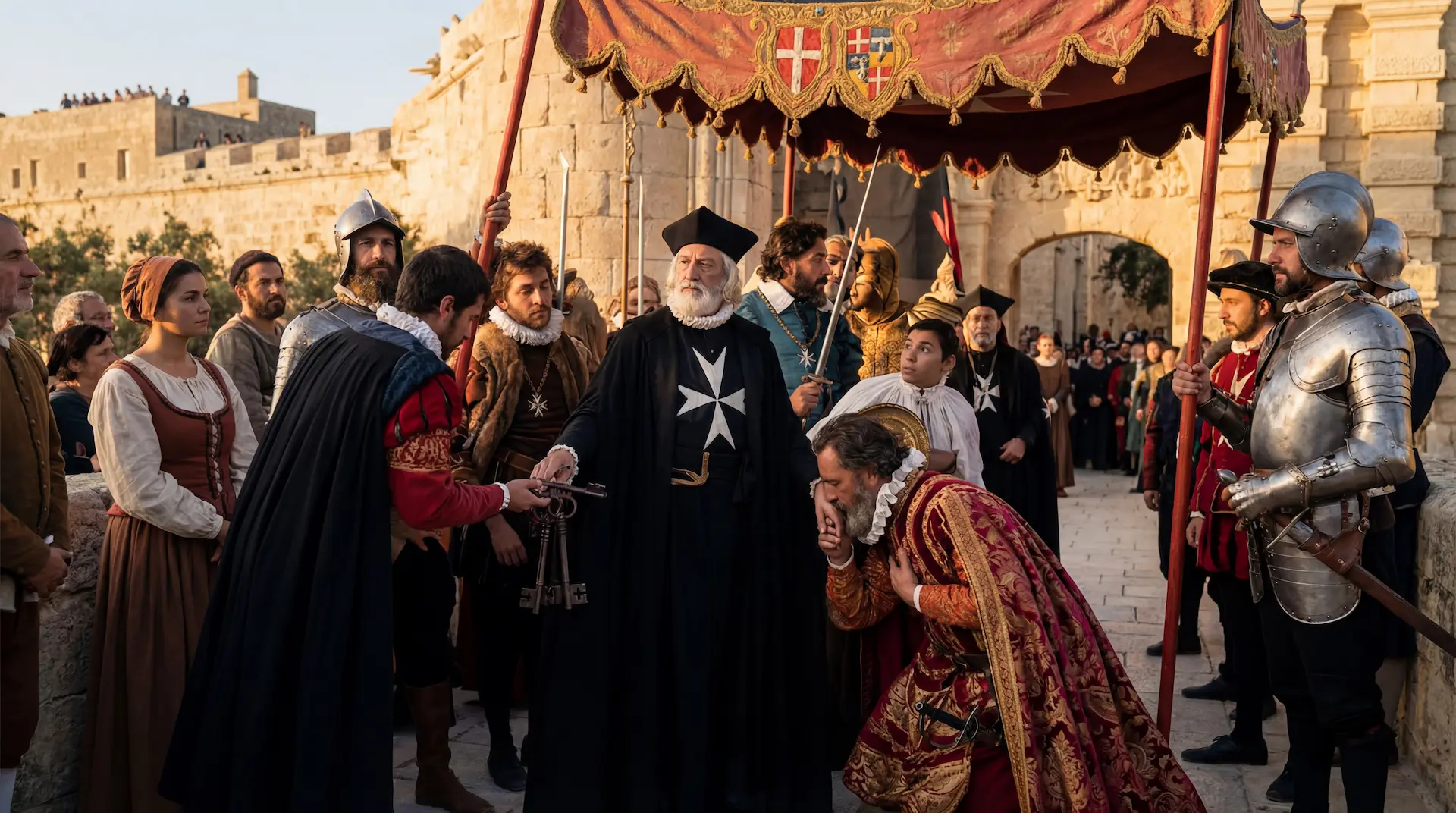
Razilly's title as Knight of Malta connected him to an institution that had shaped the Mediterranean for five centuries. When the Knights Hospitaller lost Rhodes to Sultan Suleiman in 1522, it was Grand Master Philippe de Villiers de L'Isle Adam who commanded the defence with fewer than 7,000 men against an Ottoman force that the historian Edgar Erskine Hume estimated at 200,000. After six months of siege Philippe negotiated an honourable withdrawal, and on January 1, 1523, the surviving knights sailed from Rhodes carrying their archives, their treasury, and their most sacred relics: the right hand of Saint John the Baptist, a fragment of the True Cross, and the icon of Our Lady of Philermos.
For seven years the homeless order wandered the Mediterranean, from Crete to Messina to Viterbo, carrying their relics at every stage. In 1530, Emperor Charles V granted the knights the islands of Malta and Gozo, a gift that received the approval of Pope Clement VII. Philippe established his headquarters in the fortified city of Mdina, choosing the medieval Palazzo Falson as his residence, and from that point the Hospitallers became popularly known as the Order of Malta. In 1565, under Grand Master Jean de la Valette, the order withstood the Great Siege against an Ottoman force of over 30,000. The fortified capital of Valletta was built in its aftermath, and the Knights of Malta became one of Europe's foremost military and naval powers, with ambassadors in every court in Europe, the right to coin currency, and over five thousand feudal holdings across the continent. Admission required proof that all sixteen of an applicant's great-great-grandparents were noble, the fees were large, and the vows binding. Isaac de Razilly met the standard. His brother Gabriel had been a knight since 1591, and Isaac rose to the rank of Commander of Ile Bouchard by 1631.
 De Villiers: The Treasure Bloodline→
The Memorandum
2 min
The Razilly and Du Plessis families had been intermarried since at least 1409, when the succession of Jean de Razilly was disputed between Pierre du Plessis and Louis de Razilly. The Du Plessis line produced Cardinal Richelieu. This was not a distant connection: Richelieu was Razilly's uncle, and the two families held neighbouring estates in the Touraine, where the Razillys had been vassals of the lords of Chinon since the twelfth century. The biographer Leon Deschamps, writing in 1887, noted that this family relationship explains both Richelieu's influence over the Razilly brothers and their devotion to his service.
On November 26, 1626, Razilly presented Richelieu with a document written at Pontoise, titled "Articles pour persuader ung chascun de risquer sur mer et trouver fonds pour la navigation" (Articles to persuade everyone to take risks at sea and find funds for navigation). The 74-page manuscript, preserved at the Bibliotheque Sainte-Genevieve in Paris, laid out a complete programme for French overseas expansion in Africa, Asia, and America. Razilly argued that France was a kingdom with every natural advantage for naval power: 360 leagues of Atlantic coastline, deep forests for shipbuilding, abundant hemp for rope and sails, and iron for fittings, yet it had allowed its merchants to become, in his words, like "flying fish, which serve as prey to all the others, for being pursued in the water they are forced to fly into the air, where an infinite number of birds devour them." He proposed a royal fleet of thirty warships, trading companies for each region of the world, colonies in the Americas, and the liberation of the eight thousand French sailors held as slaves in North Africa.
Deschamps called the memorandum "a first-rate document for the colonial question" and noted that both Richelieu and Colbert followed its recommendations almost to the letter. Richelieu acknowledged receipt on December 10, 1626, writing: "For the enterprise you propose to me, when he [Claude, Isaac's brother] is here, we will speak of it particularly together." The plan received its first application the following year in the charter of the Compagnie des Cent Associes. Isaac and his brother Claude were not merely advisers. They equipped twelve ships for Richelieu at Le Havre in 1626, advancing their own money against uncertain repayment. Richelieu promised only "to employ the little credit he had to have them both paid."
Fort Sainte-Marie-de-Grace
3 min
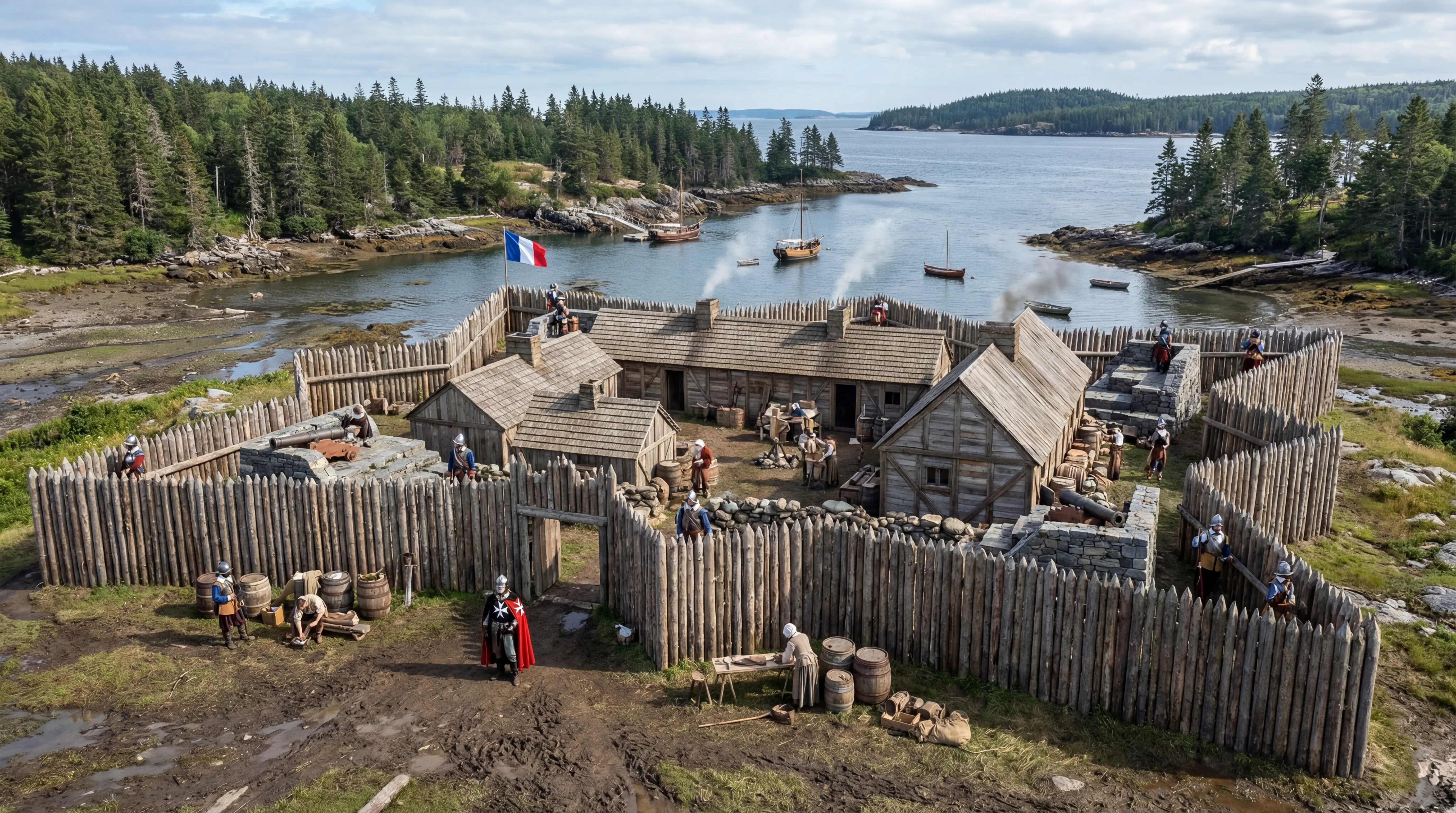
A royal commission dated May 10, 1632, appointed Razilly lieutenant-general in New France and authorized him to found a colony in Acadia. Nine days later, the Compagnie des Cent Associes granted him the river and bay of Sainte-Croix, including islands and adjacent lands extending twelve leagues wide and twenty leagues deep, to be held in perpetuity as a seigneurie. The expedition landed on September 8, 1632: the Feast of the Nativity of the Blessed Virgin Mary. For any Catholic, this was a principal Marian holy day. For a Knight of Malta, it carried a deeper meaning. September 8 was the date of the Order's greatest victory: the day in 1565 when the Ottoman besiegers withdrew from Malta after three months of siege, a deliverance the Knights attributed to the intercession of the Virgin. The date is still celebrated as Victory Day in Malta. Razilly named his settlement Fort Sainte-Marie-de-Grace, Saint Mary of Grace, in her honour. The choice of date and name was not administrative. It was a consecration, binding his colony on the coast of Nova Scotia to the Order's holiest day and its most sacred patron. The ships had brought bricks, lime, plaster, and planks, and with these the men began building on the point of land overlooking the river narrows.
The first winter was hard. Some men died from inadequate shelter. By the second winter they were better prepared and no one was lost. The Mi'kmaq, who had lived along the Pijinuiskaq for thousands of years, helped the settlers adapt, shared their knowledge of medicinal plants, and taught survival skills that the French, for all their naval expertise, would not have had. The settlement grew into a compound: a fort armed with 25 cannons in battery, living quarters, storehouses, a mill, and a chapel where three Capuchin monks held services. Gardens were planted with peas, beans, cauliflower, lettuce, melons, and cucumbers. Apple trees went into the ground near the fort. Native fruit and wild berries were plentiful, and Razilly wrote that they had celebrated Mass with wine made from wild grapes. He reported to Richelieu that the fort was capable of withstanding a six-month siege. At its peak, the settlement served as a port of call for as many as five hundred transient fishermen working the offshore banks, and for a brief period La Heve replaced Port Royal as the capital of Acadia and, by extension, of all New France.
In a letter to Richelieu dated July 25, 1634, written from the fort, Razilly described both the cost and his commitment: "We have already advanced 50,000 ecus for the commencement of this work, without having drawn any profit from it, save for buildings and fortresses, armed with 25 cannons in battery, in good order to defend the cross and the lilies, and I will employ to this end the last drop of my blood."
On September 8, 1635, exactly three years to the day after landing at La Heve, and once again on the Feast of the Nativity of the Blessed Virgin Mary, the anniversary of the Order's deliverance at Malta, Razilly wrote to the Grand Master proposing the establishment of a Priory in Acadia. The site was to serve as a naval station for the Order, for the building of ships and the general operation of maritime affairs. As Major-General G. Carlton Jones recorded in 1933, the location chosen for this proposed naval station was the future site of Halifax. The Grand Master, while commending Razilly's zeal, replied that the Order had no funds available owing to the enormous expenditure of its ceaseless combat with the Ottoman Empire. The Priory was never built. Razilly stayed anyway.
The Island of Oaks
1 min
Razilly did not confine himself to La Heve. His companion Nicolas Denys, who kept a journal of their time in Acadia, described sailing from the LaHave River to the head of Mahone Bay, where they found "some other island with big oaks." Local historian Joan Dawson, speaking at the Fort Point historic site in LaHave during Season 13 of The Curse of Oak Island, confirmed that Razilly sailed into Mahone Bay with two local priests and that the journal entry describes an island corresponding to what is now known as Oak Island, fifteen miles north of the fort. Dawson also confirmed that the Venetian trade beads recovered on Lot 5 in recent seasons are the same type that Razilly would have carried for trading with the Mi'kmaq.
In Season 13, Episode 11 ("A Knight's Journey"), researcher Emiliano Sacchetti presented the results of nearly a year of research conducted in Rome, the Vatican archives, Ottawa, and Library and Archives Canada. His most significant finding concerned two inventories of Razilly's possessions compiled after his sudden death in July 1636: one taken in Nova Scotia and one upon delivery of his effects to the family in France. Several items recorded in the first inventory were absent from the second. Among the missing objects were a copper astrolabe, two flintlock muskets, and two leather-covered chests. The flintlock muskets drew immediate attention from the team because Gary Drayton and Marty Lagina had recovered a 17th-century French flintlock plate on Lot 8 of Oak Island in 2021, and metallurgist Emma Culligan's analysis had dated it to the period of Razilly's presence in the region. What the leather-covered chests contained, and where they went between Nova Scotia and France, has not been determined.
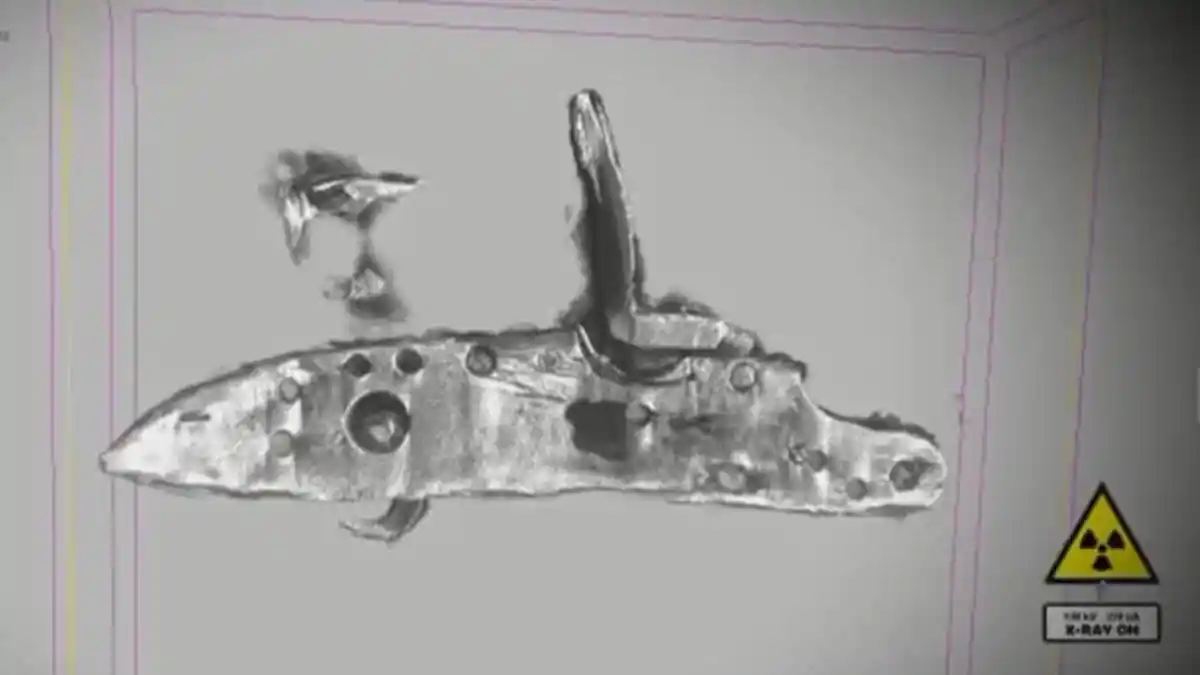 Musket Flintlock Mechanism→
Today the Fort Point Museum stands on the site of Fort Sainte-Marie-de-Grace, commemorating Razilly's landing and the settlement that briefly served as the capital of New France.
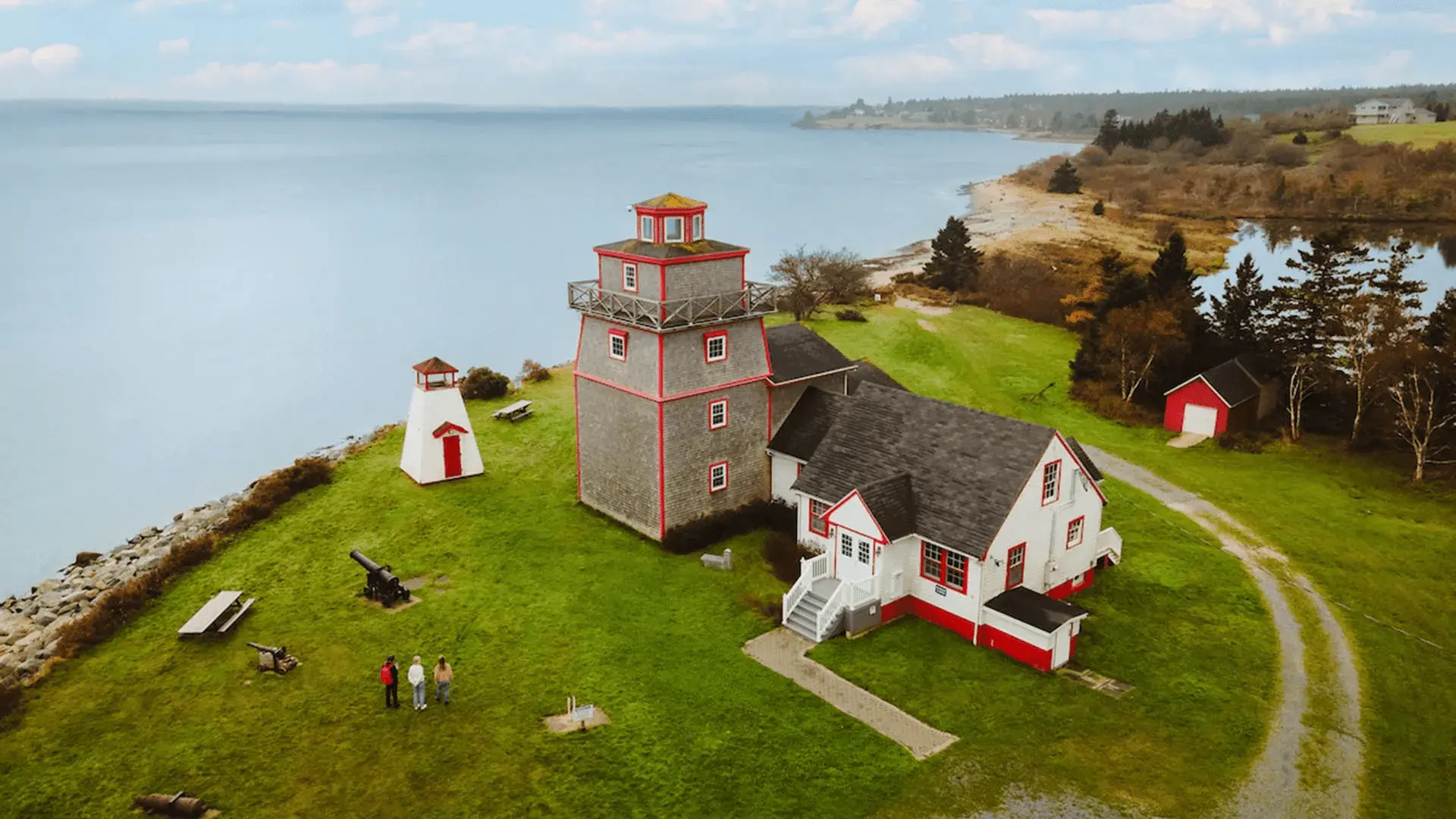 Fort Point Museum→
Three Knights, Three Colonies
1 min
Razilly's governorship of Acadia was not an isolated appointment. By 1636, three Knights of Malta simultaneously governed all of France's territories in the Americas. Isaac de Razilly held Acadia. Philippe de Longvilliers de Poincy, a Grand Cross of the Order, governed the French West Indies from the island of St. Kitts, where he had fortified the island and built several warships with the support of the Grand Master. Charles Huault de Montmagny, Champlain's successor, governed New France from Quebec. His lieutenant, De Lisle, was also a knight. Brasdefer de Chasteaufort, who served as interim governor after Champlain's death in 1635, was of the Order as well. Champlain himself, though not a Knight of Malta, had been selected for his work in Canada by a senior member of the Order: the Commander de Chaste, Governor of Dieppe and one of the original proprietors of the colony.
Major-General Jones, writing in 1933, stated that "one authority believes it was intended to establish the order in Canada as the controlling interest in the Colony, if not its actual proprietor." Quebec under Montmagny became what Jones called "practically a religious community," with the influence of the Order felt at every level of the colonial administration. Montmagny's sudden recall, according to Jones and several earlier historical authorities, came because the French King grew suspicious that his governor was working in the interest of the Order to which he belonged rather than in the interest of the Crown. The King's suspicion was not unfounded. In Acadia, in the Caribbean, and in Quebec, every senior colonial appointment led back to the same fraternity.
The Bureau at Quebec
2 min
Brulart de Sillery, one of the most prominent Knights of the period, founded a chapel, a convent, a hospital, and dwellings for converted Indians near Quebec in 1637, using funds from his commandery at Troyes. The Order's footprint in New France was not symbolic; it was institutional. A stone set in the archway of the Chateau Frontenac bears the cross of Saint John and the date 1647. The Abbe Bois stated that "the Knights of St. John of Jerusalem, Montmagny, Brasdefer, Sillery, and others in Quebec, had erected a Bureau in the courtyard of the Chateau St. Louis; it had cost 40,000 livres." The gable of that building contained a large stone engraved with the arms of the Order. When the building was destroyed by fire during the siege of 1759, the stone fell to the ground, where it lay until rediscovered in 1784. A hill behind what is now the military hospital in Quebec was called Mont Carmel, a name closely associated with the Order.
Two independent English-language sources from the period after the British conquest confirm the existence of a Knights building in Quebec. Captain John Knox, whose journal of the wars in Canada (1759-1760) is considered a reliable eyewitness record, mentions "an imposing house not yet finished for the Knights Hospitallers" in the same passage where he accurately describes the Hotel-Dieu and every other building in the city. He spent eight months in Quebec and was a careful observer. The American Gazetteer of 1763 separately refers to "the priory of the Knights of Jerusalem, a superb building in stone, which had cost, it is said, 40,000 pounds sterling." No record in the Order's archives on Malta confirms an officially established priory or commandery at Quebec. But as Jones concluded, it is reasonable to suppose that a house or bureau for those knights at the head of colonial affairs was constructed, given that "such ardent and pious members of the Order as the Governor and De Sillery" would not have spent years in Quebec without a place dedicated to the fraternity they served.
An Atlantic Ambition
1 min
The Order's interest in the New World did not end with Razilly's death. When de Poincy was recalled by the King of France, he refused to leave St. Kitts. Supported by the Grand Master, and following negotiations with the French Crown, the islands of St. Kitts, St. Croix, and others were purchased outright by the Order in 1653 for five thousand pounds. This appears to be the only time the Sovereign Order of Malta established itself in the western hemisphere through the outright possession of territory. De Poincy, a very old man by then, died shortly after, and the islands were sold to a company of merchants in 1665. The island of St. Croix was later purchased by Denmark and in turn sold to the United States in 1916. As Hume observed, while the Order of Malta never acquired territory from the United States, the United States now possesses territory that once belonged to the Order.
In 1783, during the Treaty of Paris negotiations, Grandmaster Emmanuel de Rohan-Polduc attempted to acquire the islands of St. Pierre and Miquelon, off the southern coast of Newfoundland, within the same Atlantic waters as Nova Scotia. That attempt failed. Then, in 1794, the Maltese Charge d'Affaires in Paris, Commander de Cibon, formally proposed to Colonel James Monroe, the American Minister, that the United States grant land in America to the Order of Malta in exchange for Mediterranean port access and protection against the Barbary pirates of Algiers. Monroe replied on November 22, 1794, stating that the suggestion "merits, in my opinion, the serious consideration of our government, to whom I have already transmitted it." No instructions on the subject were ever sent to Monroe, and there the record ends. Four years later, Napoleon seized Malta itself. The Order lost its island, its fleet, and its sovereignty. The Great Standard of the Order, which according to tradition had never been lowered to an infidel enemy, was captured by a British frigate and can be seen in the Tower of London.
What the Record Establishes
1 min
Razilly died at Fort Sainte-Marie-de-Grace in July 1636. He was buried somewhere on the Nova Scotian coast; the location of his grave has never been found. Charles de Menou d'Aulnay assumed command and moved most of the settlers to Port Royal. The fort was abandoned. In the 1650s it was burned down by Emmanuel Le Borgne, a French merchant and rival of Nicolas Denys. Currents and tides gradually eroded the point of land on which it had stood, and today nothing of the settlement is visible. The remains of the fort were still recorded as late as the early 1900s, but the sea has since claimed them entirely. A stone cairn at Fort Point, designated a National Historic Site of Canada in 1924, marks the approximate location.
What survives is the paper trail. A Knight of Malta wrote the blueprint for French colonial expansion. His uncle, the most powerful man in France, gave him Acadia. He bypassed the established capital and built his fort fifteen miles from Oak Island. His companion sailed into Mahone Bay and recorded an island with big oaks. He petitioned the Grand Master for a Priory on the Nova Scotian coast. After his death, objects disappeared between two inventories of his possessions, including two leather-covered chests whose contents have never been accounted for. Two additional Knights of Malta governed the rest of France's American territories at the same time, and a fourth built a chapel, a hospital, and a bureau bearing the cross of Saint John in the courtyard of the seat of government of New France. The Order continued seeking territory on this side of the Atlantic for another 158 years after Razilly's death. The arc runs from a 74-page memorandum presented to a cardinal in Pontoise in 1626 to a diplomatic letter delivered to a future American president in Paris in 1794. The Knights of Malta did not pass through Nova Scotia. They governed it.
Sources
6 min
The siege of Rhodes and the founding of Malta:
- Eric Brockman, The Two Sieges of Rhodes, 1480-1522 (London: John Murray, 1969). Philippe de Villiers de L'Isle Adam's defence, the honourable withdrawal of January 1, 1523, and the relics evacuated from Rhodes.
- Giacomo Bosio, Dell'Istoria della Sacra Religione et Illustrissima Militia di San Giovanni Gierosolimitano (Rome, 1594-1602), Book XXI. Primary chronicle of the Order's history including the Rhodes siege and Malta settlement.
- Edgar Erskine Hume, "Suggestions Made to James Monroe as American Minister in Paris," published paper. Ottoman losses at Rhodes (90,000 of 200,000), Charles V's grant of Malta 1530, the eight langues, admission requirements (seize quartiers), the 1794 Monroe-Cibon correspondence (full text of Commander de Cibon's letter and Monroe's reply of November 22, 1794), the Caribbean island purchase of 1653, the Order's loss of Malta to Napoleon in 1798, and the Great Standard captured by a British frigate now in the Tower of London. Citation for Monroe's reply: Writings of Monroe, 1899, II, 128.
Isaac de Razilly:
- Leon Deschamps, Un Colonisateur du Temps de Richelieu: Isaac de Razilly, Biographie, Memoire Inedit (Paris: Institut Geographique de Paris, Ch. Delagrave, 1887). Extract from the Revue de Geographie directed by L. Drapeyron. Full biography and first publication of Razilly's 1626 memorandum to Richelieu, held at the Bibliotheque Sainte-Genevieve, manuscrits L f. 36 (74-page manuscript). Documents the Razilly-Du Plessis family connection from 1409, Isaac's birth circa 1580 at the Chateau de Razilly near Chinon, his entry into the navy in 1603, the Brazil expedition of circa 1611, the Brittany squadron command and capture of thirty vessels in 1621, the loss of his eye at La Rochelle in 1627, the Morocco expeditions of 1629-1631 (three campaigns, treaties with Sale and the Emperor, liberation of Christian slaves, establishment of consulates), the royal commission of May 10, 1632, the Compagnie des Cent Associes land concession of May 19, 1632 (river and bay of Sainte-Croix, twelve leagues wide, twenty leagues deep), the letter to Richelieu from Fort Sainte-Marie-de-Grace dated July 25, 1634, and Razilly's death in 1636. Contains the full text of the memorandum including the "flying fish" metaphor for unprotected French merchants and the proposal for thirty warships.
- Archives des affaires etrangeres, Amerique, I, fo 98. Royal commission appointing Razilly lieutenant-general in New France, May 10, 1632.
- Archives des affaires etrangeres, Amerique, I, fo 100. Razilly's letter to Richelieu, July 25, 1634.
- Correspondance de Richelieu, t. II. Letters of December 1 and 10, 1626, from Richelieu to Isaac and Claude de Razilly, including acknowledgement of the memorandum and the instruction to equip twelve ships at Le Havre.
- George MacBeath, "Razilly (Rasilly), Isaac de," Dictionary of Canadian Biography, vol. 1 (University of Toronto/Universite Laval).
- Nicolas Denys, Description geographique et historique des costes de l'Amerique septentrionale (Paris, 1672). Journal of Razilly's companion describing the settlement at La Heve, sailing to the head of Mahone Bay, and finding "some other island with big oaks."
Fort Sainte-Marie-de-Grace:
- Joan Dawson, "LaHave, Capital of New France," Historic Nova Scotia (published November 18, 2019). Description of the fort's construction (bricks, lime, plaster, and planks brought from France), the naming on a feast day of the Virgin Mary, deaths during the first winter, Mi'kmaq assistance with medicinal plants and survival skills, the settlement compound (fort, living quarters, storehouses, mill, chapel with Capuchin monks), gardens (peas, beans, cauliflower, lettuce, melons, cucumbers), apple trees, Mass celebrated with wild grape wine, the fort's abandonment after Razilly's death, its burning by Emmanuel Le Borgne in the 1650s, and the erosion of the point. Also the source for Razilly's arrival with a patch over one eye and approximately 200-300 men.
- Parks Canada, "Fort Sainte Marie de Grace National Historic Site of Canada." Designated 1924. Fort on a point of land where the LaHave River narrows, armed with 25 cannons, farming colony of around 40 permanent residents with a local mill and chapel, fort remains visible until the early 1900s. Strategic setting in an area rich in fishing, trapping, and lumber resources.
The Knights of Malta in Canada:
- Major-General G. Carlton Jones, C.M.G., M.D., "The Knights of the Order of St. John of Jerusalem in Canada Under the French Regime," reprinted from Canadian First Aid, November 1933, p. 11. Also published in The Canadian Medical Association Journal, October 1934, pp. 431-432. Documents Montmagny, Poincy, and Razilly as three Knights simultaneously governing France's American territories; the thesis that it was intended to establish the Order as the controlling interest in the colony; Razilly's Priory proposal of September 8, 1635 (site of Halifax chosen as naval station); the Grand Master's refusal on grounds of Ottoman expenditure; Champlain's selection by Commander de Chaste, Governor of Dieppe; Brasdefer de Chasteaufort and De Lisle as Knights; Brulart de Sillery's chapel, convent, hospital, and dwellings near Quebec (1637, funded from his commandery at Troyes); Montmagny's recall on suspicion of working for the Order rather than the Crown; the 1647 Chateau St. Louis stone with Cross of St. John; the Abbe Bois account of the Bureau (40,000 livres); Mont Carmel; Captain John Knox's journal (1759-60) mentioning "an imposing house not yet finished for the Knights Hospitallers"; the American Gazetteer of 1763 mentioning "the priory of the Knights of Jerusalem, a superb building in stone, which had cost, it is said, 40,000 pounds sterling"; de Poincy's refusal to leave St. Kitts, the purchase of St. Kitts, St. Croix, and other islands by the Order in 1653 for five thousand pounds, and their sale in 1665.
- Jean-Guy Guerin, Knights of Malta from the Crusades to Quebec. Hospitaller presence in New France, Razilly in Acadia, the Jesuit Relations references, and the Chateau St. Louis stone.
The Order's Atlantic ambitions:
- Robert Le Blant, "Le Commerce compliquant de la politique dans la Nouvelle France," Revue d'histoire de l'Amerique francaise, vol. 11 (1957). Isaac de Razilly's 1635 proposal to the Grand Master to purchase lands at La Heve, found a Priory in Acadia, and acquire a naval base at Chibouctou (later Halifax).
- Edouard de Barthelemy, "Les Chevaliers de Malte et la Marine de Philippe d'Orleans," Revue des questions historiques, vol. 15 (1874). The Order's wider Atlantic ambitions including the Caribbean acquisitions and Grandmaster Emmanuel de Rohan-Polduc's attempt to acquire St. Pierre and Miquelon during the Treaty of Paris negotiations in 1783.
Television:
- The Curse of Oak Island, Season 12, Episode 20, "Just Bead It" (History Channel). Judi Rudebusch presents research on Knights of Malta connections to Oak Island. Doug Crowell discusses Isaac de Razilly's settlement at LaHave. Venetian bead connections to Malta.
- The Curse of Oak Island, Season 12, Episode 21, "The Solution Solution" (History Channel). Doug Crowell, Corjan Mol, and Emiliano Cataldi present research on Knights Templar and Knights of Malta. Emiliano describes a 1630 manuscript titled "The Treasure of the Holy Relics Which are in Malta."
- The Curse of Oak Island, Season 12, Episode 23, "Family Ties" (History Channel). Malta expedition. Corjan Mol presents the Villiers bloodline research at the Palazzo Falson in Mdina, tracing the genealogical chain from Gerard de Villiers in 1307 through to Isaac de Razilly in 1632.
- The Curse of Oak Island, Season 13, Episode 3, "Medieval Intentions" (History Channel). Venetian trade beads on Lot 5 connected to Razilly's presence at La Heve, fifteen miles from Oak Island. Razilly established French colony of Acadia in 1632 with headquarters at Fort Point on the LaHave River.
- The Curse of Oak Island, Season 13, Episode 11, "A Knight's Journey" (History Channel). Emiliano Sacchetti presents results of year-long research in Rome, Vatican archives, Ottawa, and Library and Archives Canada. Nicolas Denys journal describes sailing from LaHave to Mahone Bay and finding "some other island with big oaks." Two inventories of Razilly's possessions after his death in July 1636 reveal missing items: copper astrolabe, two flintlock muskets, two leather-covered chests. Connection to the 17th-century French flintlock plate found on Lot 8 in 2021.
- The Curse of Oak Island, Season 13, Episode 12, "A Fort Knight" (History Channel). Alex Lagina, Peter Fornetti, and Emiliano Sacchetti visit Fort Point in LaHave. Local historian Joan Dawson confirms Venetian beads match Razilly's trading goods, confirms Razilly sailed into Mahone Bay with two priests, identifies the flintlock plate as consistent with Razilly's armament, and recognises a Josephus volume as the type of book a Knight of Malta would have kept.
Research:
- Corjan Mol and Christopher Morford, The Jerusalem Files (London: Watkins/Penguin Random House, 2024). The Villiers genealogical chain from Gerard de Villiers (1307) through to Isaac de Razilly (1632) and the broader thesis connecting the Templar escape, the Hospitaller inheritance, and the Nova Scotian connection.